Cover of Where the Tracks End

Where the Tracks End

Science Fiction · 336 pages · Published 2025-10-07 · Avg 3.8★ (6 reviews)

Meet an extraordinary father and daughter in this luminous, aching work of speculative fiction. It is a morning like any other when Kenji Salazar, a Los Angeles Union Station signal technician, steps down to reset a balky relay by Track 12. One moment, the sun is a pale nickel over the clock tower, the smell of brake dust and coffee hanging in the air. The next, he is staggering on a sun-cracked siding outside Barstow, his orange vest dusted white, his toolbox ringing like a bell. Twelve voicemails from his wife and daughter are waiting on his phone.

5:06 a.m. Thursday, August 2.
A blink, a step, a shiver of steel.
5:07 a.m. Saturday, August 4.
Two days, stolen by a line that no longer runs.

From that morning on, at the first terminal chime after dawn wherever he stands, Kenji is shunted onto another dead-end track in an invisible network stitched from the world's abandoned railways. The rule is simple and terrible: each time a day begins, he is switched to the place where the rails stop. Some days he wakes in the grasses behind a shuttered depot at Dos Cabezas, or on the salt-blown platform at Ukiah where the timetables still yellow on the wall. Another sunrise and he is under the glass roof at Hachinohe, chasing the cold neon hum of an arrival board that will never flicker for him. Hours pass for Kenji. Years begin to pass for everyone else.

Meanwhile, Maya Salazar grows up with a father made of echoes. At twelve she rides Metrolink with a notebook and a fistful of rail spikes, sketching distances in graphite. At seventeen she is sneaking into county archives and photographing USGS quads, building an Atlas of Endpoints on her bedroom floor in Highland Park. By twenty-four, after early graduation from Berkeley and a stint in a San Jose signal lab, she has become the West Coast's youngest transit cartographer, studying the mathematics of timetables and bells, decoding the century-old pattern Kenji rides against his will. With a retired dispatcher from Martinez and a historian in Aomori who keeps a drawer full of station stamps, she begins to predict where the next dawn will drop her father.

Word of the man on the phantom lines spreads. Towns paint platforms and sweep leaves from rails that have not seen steel in decades. A developer in the Mojave offers to lay ten miles of shining track if Maya will bring her father there. Someone in Tokyo mails a parcel of wooden geta and a tin whistle from a kiosk in Noheji, certain that sound carries farther than steel.

Where the Tracks End is a love story carried on crossties and ballast, a cartography of grief and stubborn hope. It asks what home means when the ground you stand on turns to air at daybreak, and whether a daughter can draw a line through the vanished map of the world straight to the person she refuses to leave behind.

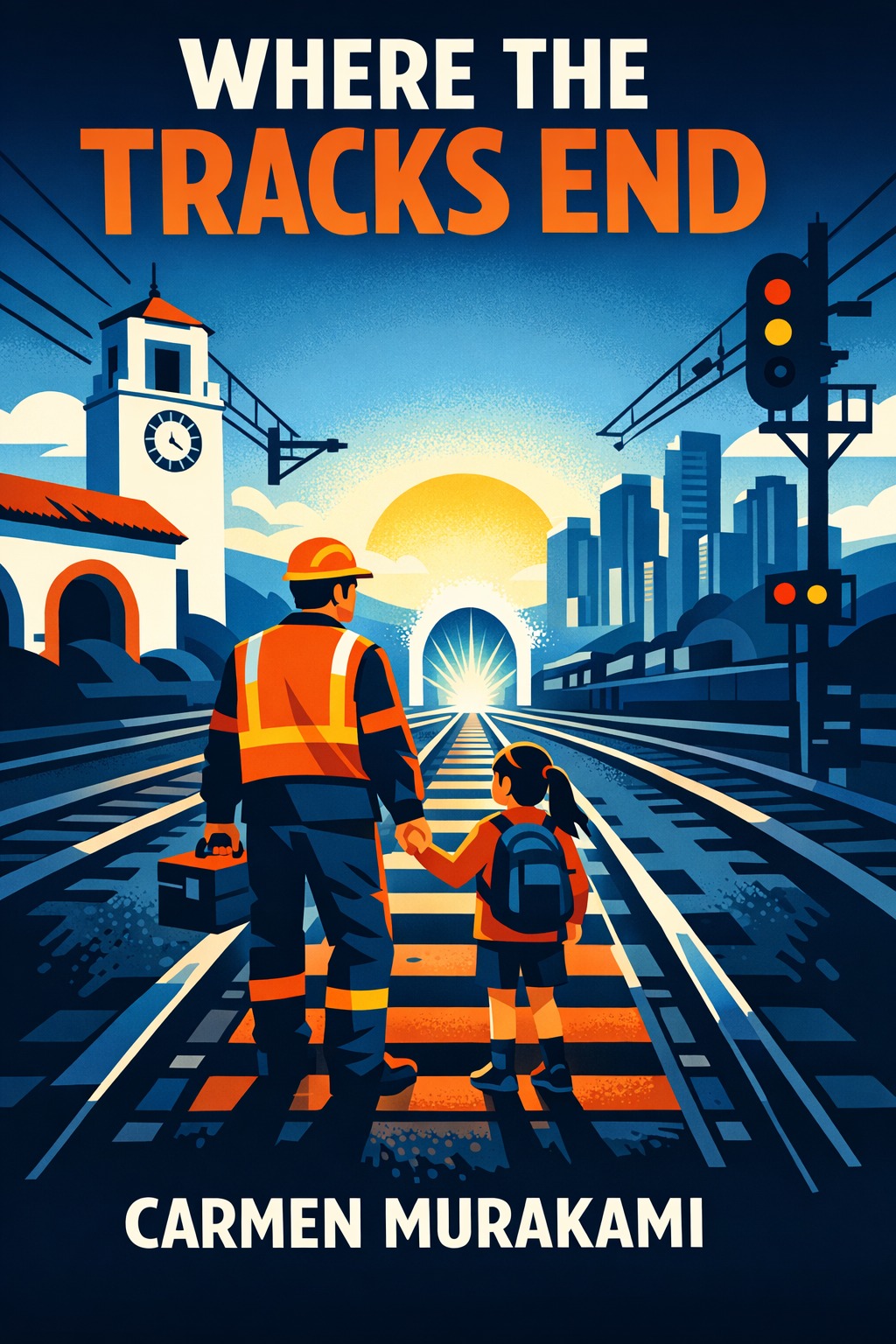
Photo of Carmen Murakami

Carmen Murakami is a Japanese Mexican American writer and former transit data analyst whose work bridges infrastructure, memory, and the uncanny. Raised in Southern California within earshot of the Alameda Corridor, she studied civil engineering and urban design at UC Berkeley before pivoting to fiction that treats maps as instruments and stories as timetables.

Her short fiction and essays have appeared in Strange Horizons, The Magazine of Fantasy and Science Fiction, and Nature Futures, exploring the hidden geometries of cities and the people who carry them. She is the author of the novella Switchyard and the story collection Signal Lost, both of which trace the emotional topography of departure and return. When not writing, she volunteers with rail preservation groups, collects obsolete transit tokens, and hikes decommissioned rights of way across the West.

Carmen Murakami lives in Seattle, where she keeps a map case by the door and an old brass conductor whistle on her desk, a reminder that every journey begins with a sound.

Ratings & Reviews

Marina Valdés
2026-04-10

El mundo de vías fantasmas que propone esta novela es hipnótico: una red invisible que empuja a Kenji, al primer timbre de la mañana, hacia el punto exacto donde las vías terminan. Barstow abrasador, los horarios amarilleando en Ukiah, el techo de vidrio en Hachinohe, la maleza en Dos Cabezas; se siente vivido sin ser turístico.

Me encantó cómo las comunidades responden, pintando andenes y barriendo hojas, y cómo Maya convierte archivos del condado y mapas del USGS en un Atlas de Puntos Finales. La apuesta emocional es clara y sostenida, y aunque alguna escena repite patrón, la atmósfera salina y de café mantiene el latido.

Javier Orozco
2026-03-12

This book wrecked me in the best way. It reaches into the thrum of a station bell and pulls out a human pulse.

The theme is home, but not the tidy kind. Home as a line you redraw every morning, as the rails that used to go somewhere and still remember they did. The moment Kenji steps and loses two days is the thesis in miniature: "a blink, a step, a tremor of steel."

And then Maya answers it with work, with study, with love that looks like cartography. She turns grief into coordinates. She builds a language from spikes and maps and conversations with strangers who sweep leaves from tracks because hope needs somewhere to arrive. I cheered when the world started listening!

There are details I will carry for a long time. The tin whistle from a kiosk in Noheji, the wooden sandals mailed across an ocean, the way a developer dangles fresh rail in the Mojave as if steel could bribe fate. Every object becomes a promise.

I closed the last page feeling like time itself had been retuned. Not louder. Truer. If you have ever stood by a platform at dawn and waited for something you could not name, this novel is the answer ringing back.

Tessa McBride
2026-02-28

By vibe this sits somewhere between Ken Liu's gentler time tales and M. John Harrison's ghosted transit cities, and it mostly works for me. The premise is gorgeous, the map-making sequences with archives and quads are absorbing, yet the middle third drifts as Kenji's stopovers start to echo one another. I liked the ending's hush, but I wished for a touch more propulsion.

Owen Takahashi
2026-01-15

The book's structure toggles between Kenji's day-long jumps and Maya's long years, and the prose keeps a metallic music; at times an info-dump about signaling jargon and timetable math slows the current.

Still, the architecture is elegant, with chapter breaks echoing dawn chimes and a motif of painted platforms accruing meaning. The final stretch lands with quiet precision rather than spectacle, and I found that restraint satisfying.

Priya Nayar
2025-12-05

For my shelves, this lands squarely in adult speculative fiction with a lyrical bent. Readers who prefer puzzles and hard explanations may grow impatient with the metaphysics remaining hazy, and the pace often lingers on mood over motion.

Advisory notes for book clubs and classrooms: separation of family, long-term absence, mild peril around rail yards, and a persistent melancholy. There is much to admire in the craft and the father and daughter bond, but most of my commuters want a faster train than this one provides.

Lena Morrell
2025-11-02

The first dawn that steals Kenji off Track 12 felt like a spark down my spine. One minute Los Angeles air and brake dust, the next Barstow heat and a toolbox ringing.

From there the book keeps resetting him at the end of lines only memory remembers. Salt at Ukiah, glass at Hachinohe, weeds licking Dos Cabezas. The rule is cruel and clean, and the hours he lives against other people's years hurt in a way that made me hold my breath.

Maya is the counterweight. Her Metrolink notebooks, her pocket of rail spikes, her late nights hunched over USGS quads until an Atlas of Endpoints sprawls across a bedroom carpet. Twelve voicemails become ten thousand measurements. She refuses to let the morning steal him.

I loved the way towns wake up to the rumor and sweep their dead platforms, the way a retired dispatcher and a historian trade stamps and signals across oceans. The prose tastes of hot iron and coffee and salt, but it is never fussy. It moves like a bell.

I believed every impossible mile.

Where the Tracks End is a love story built from crossties and stubborn breath, and it left me tuned to daybreak as if a station clock might finally align two lives. I will be thinking of this father and daughter each time I hear a chime!

Generated on 2026-05-04 12:08 UTC