Ledger of impressions:
- Stark architecture as metaphor
- Whitehall offices vividly cold
- Midsection lingers too long on procedure
- Final choice powerful but abrupt
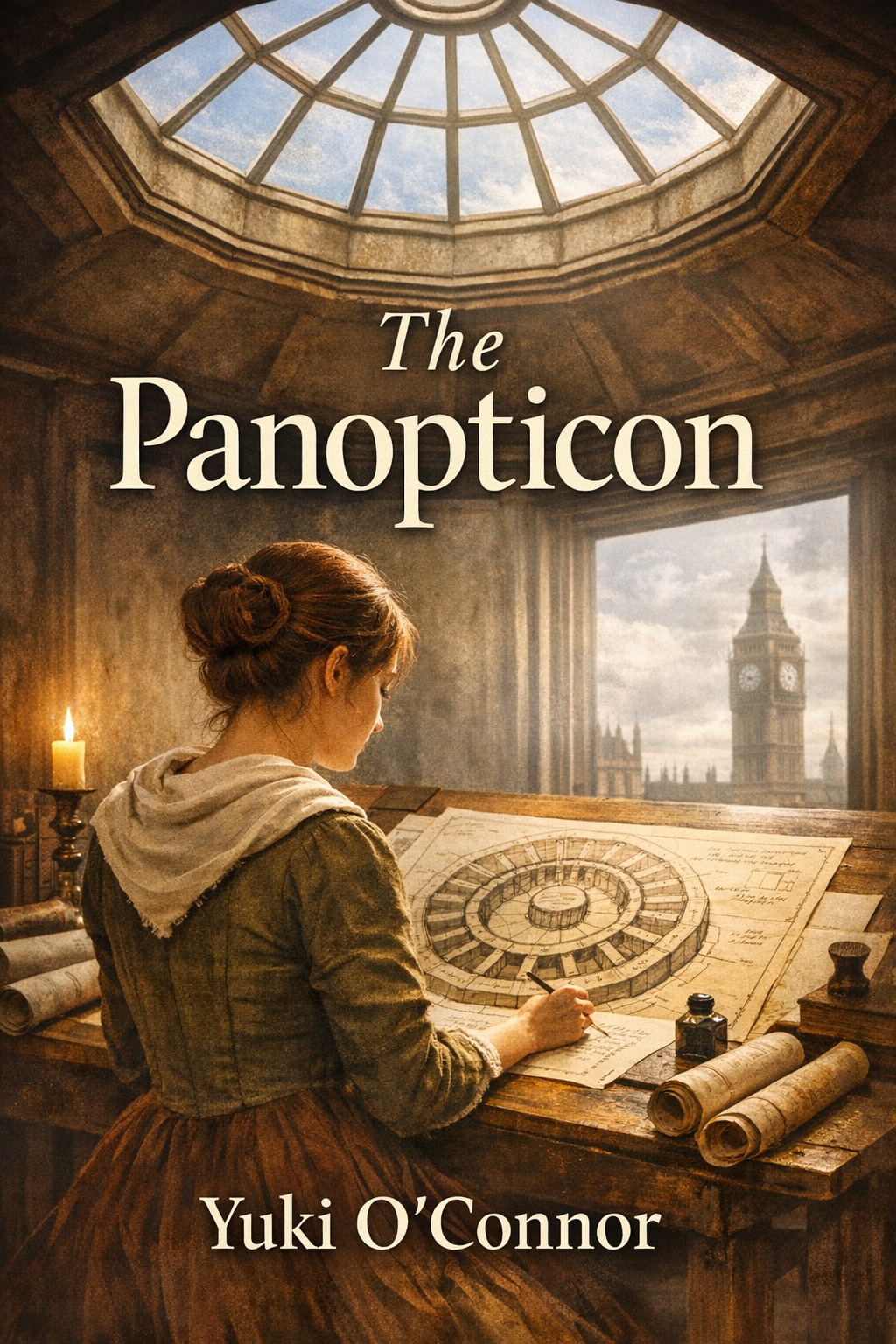
In 1798 Dublin, after the rebellion, scribe Aoife Kinsella is recruited by Dublin Castle to study a radical English design: Jeremy Bentham's "panopticon." Dispatched to the draughty rooms of the Office of Works on Whitehall, she copies vellum plans beneath an octagonal skylight while rumors of French landings crackle through the coffeehouses. Between ledgers and lampblack, she meets Barnaby Harrow, a Bow Street Runner whose case files read like blueprints of fear.
Back in Dublin, Aoife watches Kilmainham Gaol retrofit its wings, and the idea of being watched reshapes streets, taverns, and even church galleries. When a coded note carved into a prison spoon hints that a surviving United Irish commander is held under a false name, she must decide whether to use the new sightlines to free him or entomb him. The city becomes a machine of glass and rumor, gears turning in alleyways from Fishamble Street to the Liffey quays. In the end, the only cell without windows is the one Aoife builds around her own conscience.
Ledger of impressions:
La mezcla de intriga carcelaria y filosofía utilitarista funciona, aunque el ritmo en la mitad se entorpece. Dublin se siente como un organismo vigilante.
Think of it like The Newgate Sketches meets A Geometry of Mercy: courtroom shadows meets philosophical scaffolding. The book balances casework and conscience, with scenes in the Office of Works that hum with quiet peril.
It will particularly satisfy readers who enjoy historical puzzles where architecture is metaphor. The final image of self-built confinement lingers.
Aoife is a revelation: practical, keen, and haunted by the tidy terror of plans. Her exchanges with Barnaby Harrow crackle, not with romance so much as wary respect. His case files, those "blueprints of fear," map neatly onto her draftsman's mind, and their conversations feel like two lanterns testing the same corridor from opposite ends.
One choice near the end reframes every previous glance, and it feels earned.
Viewed through a worldbuilding lens, Dublin and London come across as networks of corridors and listening posts. Kilmainham's refitted wings, the galleries at church, Fishamble Street, the Liffey quays: the city is engineered into an observatory that citizens both fear and maintain.
Sometimes that design-minded clarity shades into schematic coolness, yet the atmosphere remains persuasive. You can almost feel grit on stone and the tilt of light under that skylight.
As a piece of craft, this is deliberate and methodical. The alternating scenes between Whitehall and Dublin echo the panopticon's rings, and the recurring octagonal skylight gives the chapters a unifying visual cue.
That said, the prose sometimes favors meticulous replication over momentum. The copying-room sequences lean heavy on process, and the middle third stiffens. The closing movement gathers itself admirably, but I wanted a few more connective sinews between Aoife's internal calculus and the citywide machinery she helps draw.
I adored how this novel stares straight into the moral geometry of surveillance. The octagonal skylight above the plans is not just a clever image; it becomes a compass that keeps the narrative oriented toward consequence.
Power, here, is a way of seeing and being seen. Coffeehouses buzz like switchboards, prison galleries become stages, and the streets align into "a city made into a machine of glass and rumor." That line of thought thrilled me.
The craft details are luscious without showing off: lampblack under nails, vellum that buckles in damp air, a spoon that smuggles a message. Every prop is an argument in wood and iron.
Aoife's dilemma lands like a struck bell. Free him, entomb him, or acknowledge that the most efficient prison is the one a conscience builds. The book honors the paradox without blinking.
I turned the last page with my heart racing and my head humming. It is rare to find historical fiction that feels both architecturally precise and ethically electric. Brava!