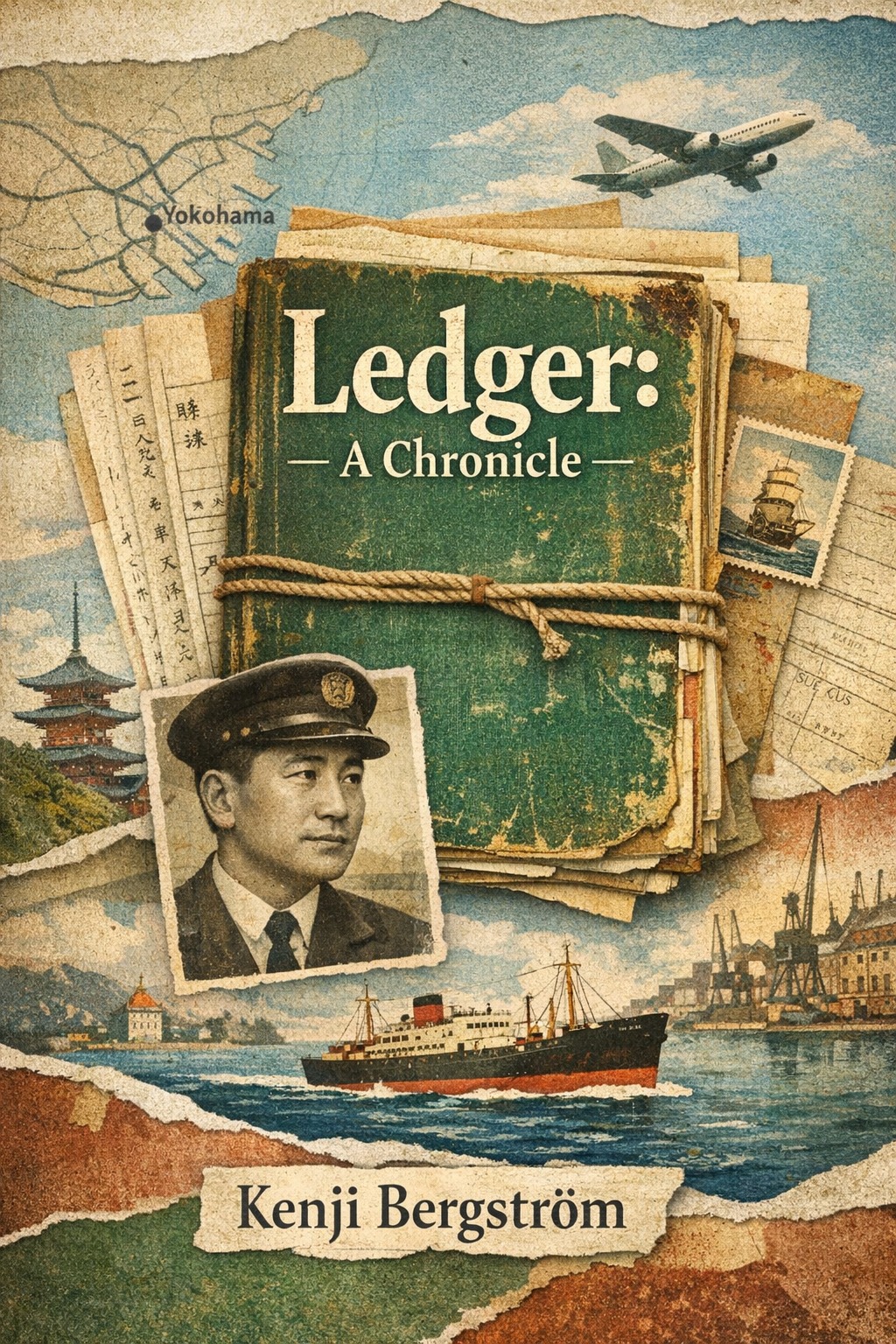

Cover of Ledger: A Chronicle

Ledger: A Chronicle

Biography · 304 pages · Published 2024-11-12 · Avg 4.2★ (6 reviews)

Born in Kobe and apprenticed to the sea, Masao Aikawa (1927–1999) spent half a century as a ship's purser and quay clerk, his battered green ledger traveling from Yokohama to Gothenburg and, finally, Dún Laoghaire. Bergström reconstructs Aikawa's life from salt-stiff notebooks, port manifests, paycheck stubs, and pencil-rubbed tallies found at a Monkstown chandlery sale. Along the way, dates and figures open into tides: the sound of Morse in a fogbound night, a boiler patched with tin, the price of rope entered twice because the first entry washed away.

Photo of Kenji Bergström

Kenji Bergström is a Swedish-Japanese writer and photographer, born in Gothenburg in 1985 and raised between Västra Frölunda and Yokohama. Trained in acoustics at Chalmers University, he worked in documentary subtitling before relocating to Dublin Bay in 2012, where he apprenticed with a Monkstown luthier and volunteered at the National Maritime Museum of Ireland. His practice combines listening and repair, following shoreline geographies and the lives of tools and instruments across essays, memoir, and literary biography.

His essays have appeared in The Stinging Fly, Kyoto Journal, and The Dublin Review, and he has been awarded a DLR Arts Bursary and shortlisted for the Fish Short Memoir Prize. Bergström is the author of the essay collections Harbor Hours (2019) and Small Weather (2021), the memoir Dún Laoghaire (2023), and the biographies Ledger: A Chronicle (2024) and the forthcoming Violin: A Fable (2025), works that treat ledgers, instruments, and harbors as ways of hearing a life. He photographs working ports and restores secondhand cameras; he lives in Dún Laoghaire with a rescued whippet and a cabinet of sea-wet maps.

Ratings & Reviews

Jules Pettersson
★ ★ ★ ☆ ☆
2026-10-05

Useful and thoughtful, though uneven in momentum.

  • Port lore in crisp detail
  • Occasional repetition in cargo terminology
  • Subtle emotional arc
  • Front-loaded notes on Monkstown sale slightly dry
Lucia Menendez
★ ★ ★ ★ ☆
2026-03-22

Como lectura de temas, la obra es una meditación sobre memoria, trabajo y pertenencia. Aquí la contabilidad se vuelve ética y forma de cuidado; los recibos y nóminas son una biografía en cifras. En un momento dado, "fechas y cifras se hinchan en mareas", y esa imagen organiza todo: lo personal y lo histórico suben y bajan juntos.

El libro sugiere que una vida puede medirse sin reducirse, que un ledger verde puede guardar tanto ruido de puerto como compás interior. No hay subrayados moralistas, solo una paciente atención que deja ecos largos.

Colm O'Farrell
★ ★ ★ ★ ★
2025-12-10

As a world of work, the book is astonishing. You can hear Morse in a fogbound night, feel the slap of wet rope on a quay, and see the carbon-smudged corners of port manifests. The Monkstown chandlery sale becomes a doorway into an entire economy of hands and hulls.

Bergström maps Yokohama to Gothenburg to Dún Laoghaire with painstaking tact; the smells are tar and tea, the sounds are winches and pencil on paper. Even the double-entered rope price carries the weight of weather. The maritime lore never overwhelms the life at its center, it makes that life legible.

Rina Bergman
★ ★ ★ ★ ☆
2025-07-30

Masao Aikawa never steps forward to speak, yet he is everywhere in the margins. The tidy sums, the corrections, the note about a boiler patched with tin read like small acts of care. What emerges is a temperament: meticulous, patient, bent toward repair.

There are no theatrical turns, only the slow revelation of a person who kept ships moving and wages fair. By the time the ledger reaches Gothenburg and later Dún Laoghaire, the silence around him feels chosen, a way of making room for work to be done well.

Mateo Ishikawa
★ ★ ★ ★ ★
2025-02-15

The prose is cut to the grain of its materials. Chapters arrive as ports and dates, the lines of text narrow and sure, like columns on a manifest. White space does real work, holding fog, delay, and the ache of waiting for a gangway to drop.

Bergström's structure honors the artifacts he mines: salt-stiff notebooks, pencil-rubbed tallies, and paycheck stubs form a contrapuntal score. Recurring images stitch the book together without strain, especially the repeated price of rope after an entry washed away and the murmur of Morse in fog. The result is exact yet lyrical, a biography paced by stamps, signatures, and the soft thud of ledgers closing.

Keira Donnelly
★ ★ ★ ★ ☆
2024-12-01

Bergström turns cargo tallies into a tide chart of a life, following Aikawa's green ledger from Kobe to Dún Laoghaire with quiet propulsion.

Generated on 2026-11-17 12:02 UTC