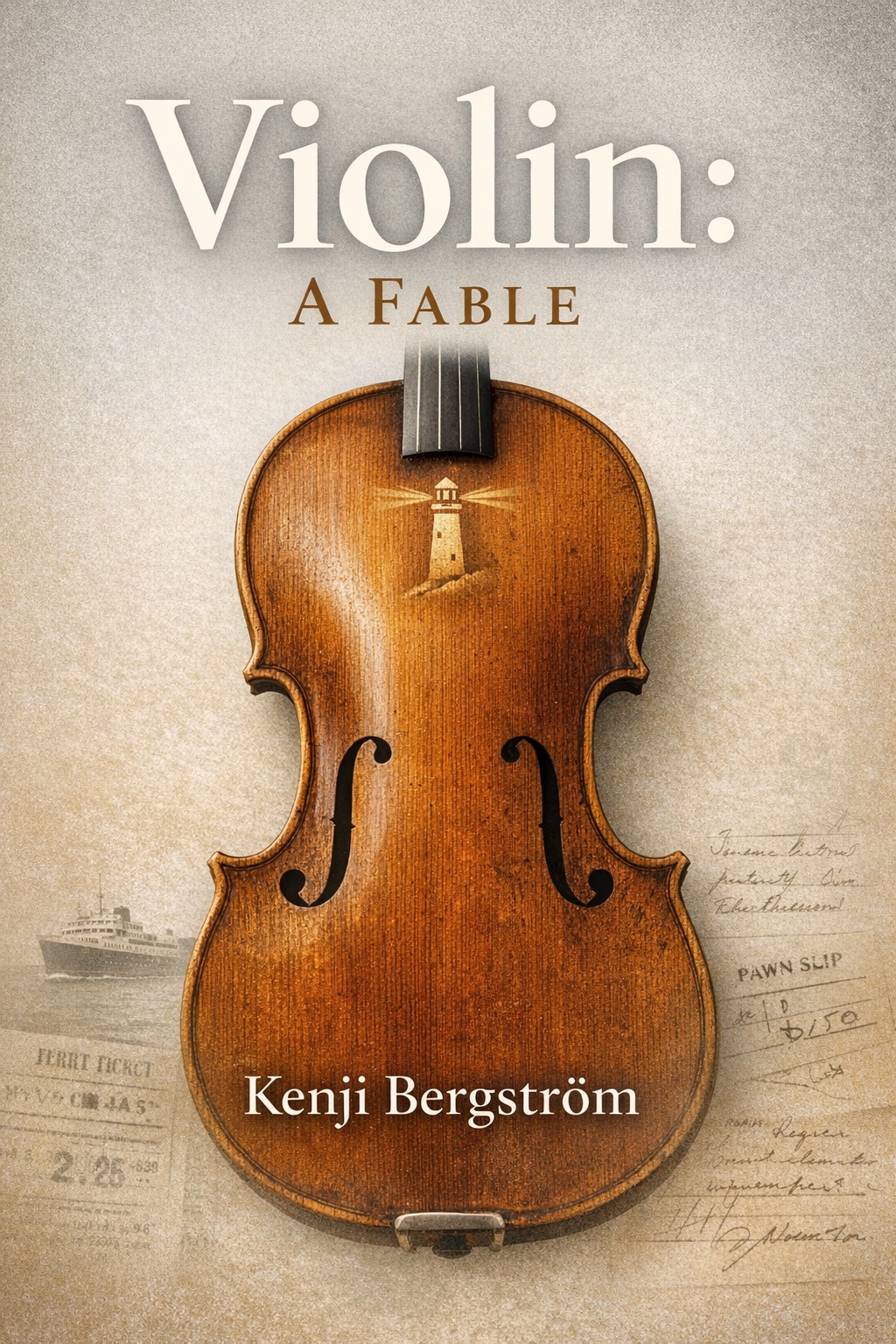

Cover of Violin: A Fable

Violin: A Fable

Biography · 264 pages · Published 2025-05-21 · Avg 3.5★ (6 reviews)

Beginning with a violin built in 1919 in Mittenwald—spruce belly, maple back, and a faint lighthouse glyph burned beneath the button—this biography follows the instrument across a century of crossings. Through pawn tickets from Osaka, ferry timetables to Holyhead, and penciled repair slips stained with hide glue, its owners come into focus: Eivor Lundqvist, a Gothenburg shipyard fiddler; Seiji Katō, a Tokyo conservatory student; and Aoife Ní Bhraonáin, a busker keeping time with the weather on Dún Laoghaire pier. Their stories, like knots in the wood, bind sound to place. Photographs, bench-notes, and 35mm negatives act as a chorus to the instrument's changing voice.

At a luthier's bench in Monkstown, the author listens for the wolf tone, resets a soundpost, and weighs gut against steel. Interviews scatter along the Irish Sea and the Seto Inland Sea, drawing a map of care as the violin survives war, damp, and the rough mercy of repair. The result is a fable-shaped biography—part travelogue, part ledger of hands—in which tone, rosin, and salt remember what people forget.

Photo of Kenji Bergström

Kenji Bergström is a Swedish-Japanese writer and photographer born in Gothenburg in 1985 and raised between Västra Frölunda and Yokohama. He studied acoustics at Chalmers University and worked in documentary subtitling before moving to Dublin Bay in 2012, where he apprenticed with a luthier in Monkstown and volunteered at the National Maritime Museum of Ireland. His essays have appeared in The Stinging Fly, Kyoto Journal, and The Dublin Review, and his work is noted for its quiet attention to shoreline geographies, listening practices, and the craft of repair across memoir, essay, and biography.

Bergström is the recipient of a DLR Arts Bursary and was shortlisted for the Fish Short Memoir Prize. He is the author of the essay collections Harbor Hours (2019) and Small Weather (2021), the memoir Dún Laoghaire (2023), and the biography Violin: A Fable (2025), which extends his fascination with tools, instruments, and the lives objects lead through human hands. When not writing, he photographs working harbors and restores secondhand cameras; he lives in Dún Laoghaire with a rescued whippet and a cabinet of sea-wet maps.

Ratings & Reviews

Lucía Benet
★ ★ ☆ ☆ ☆
2026-10-29

I came hoping for the narrative pull I find in works like The Boatbuilder's Diary by Lina O'Rourke or the quiet rigor of Strings Attached by Kenji Morita, but this book leans too hard on fragments and paperwork. The photographs feel under-captioned, the bench minutiae piles up, and the throughline between owners turns wispy instead of cumulative. If you prize atmosphere over arc, it may sing for you, but I needed more story and less ledger.

Nolan Farouk
★ ★ ★ ☆ ☆
2026-08-03

Through Eivor, Seiji, and Aoife, the violin gains a shy interior life, but the human portraits sometimes feel sketched in pencil rather than ink.

Priya Castell
★ ★ ★ ☆ ☆
2026-05-12

Mixed feelings on structure and momentum, though the craft is undeniable.

  • Evocative bench notes and tactile repair scenes
  • Ferry schedules and ephemera overstay their welcome
  • Wanted a clearer throughline between owners
  • Strong sense of place around the Irish Sea
Sean O Keeffe
★ ★ ★ ★ ☆
2026-01-30

Place is the instrument's other body here, and the book lets it ring. Mittenwald, a Gothenburg yard at shift's end, a Tokyo practice room, the Dún Laoghaire pier counting weather with a busker's bow, and a Monkstown bench where hide glue smells like a memory.

The stakes are practical and patient: keep the violin alive through war, damp, and the rough mercy of repair. The luthier's shop anchors the crossings, and the ferry to Holyhead feels like a recurring motif rather than a postcard stop.

Arun McKay
★ ★ ★ ★ ☆
2025-09-14

This biography moves in lucid, alternating movements between owner, bench, and archive. The prose is precise yet never fussy; sentences carry varnish-sheen clarity. Chapters open with material cues (a glyph, a ticket, a negative) and resolve by returning to sound, which gives the book a cyclical cadence. The only drag appears when documentation stacks too high, but even then the author's ear for texture keeps the line moving.

Tamsin Rowe
★ ★ ★ ★ ★
2025-06-08

An instrument's life told as a fable-biography that listens to wood and weather. From the Mittenwald belly and back to piers and ferries, the book tunes the century to a human pitch.

What moved me is the ethic of repair, the way a soundpost tap becomes a way of reading care. The author names what others overlook, calling the archive a "ledger of hands", and then proves it in scene after scene.

I loved the way interviews drift along the Irish Sea and the Seto Inland Sea, not as travelogue trivia but as attention. When the bench work hunts for a wolf tone, the search feels moral: where is the snag in the story, what resonance have we forced, what must be let go?

The photographs, negatives, and penciled slips are not decoration. They behave like harmonics, faint but binding, and the scuffs of hide glue become small, shining stakes.

By the end I believed that rosin and salt do remember, and that a violin can hold a century without hoarding it. What a generous, ringing book!

Generated on 2026-11-10 12:01 UTC