Cover of Jellyfish Tuesdays

Jellyfish Tuesdays

Horror · 352 pages · Published 2026-06-04 · Avg 2.6★ (5 reviews)

Every Tuesday when the afternoon ferry groans past Wickham's Quay, a lace of moon jellies washes into the harbor and the town holds its breath. Clara Nwamba, a forensic photographer turned field tech for the University of Rhode Island's marine lab, returns to Wickham to clear out her aunt Ebele's cottage after Ebele's drowning, ruled 'accidental' despite the neat, unreadable welt-lines coiled around her wrists like writing. The locals mark Tuesdays with salt-bowls on stoops and copper hooks hung over doorways, a superstition dismissed by the selectboard but kept faithfully by those who remember the 1938 storm. Clara teams with lighthouse keeper Hannah Fisk, whose midnight logs detail blooms that arrive as if summoned. Dr. Lian Nwosu, a lab biologist, shows her polyp strings clinging to pilings in tidy rosaries; a ragpicker named Milo Cranch boils jellies into enamel pots for 'collagen' and swears the water hums like a wire. In the historical society's attic, Clara unboxes a ledger's worth of ferry stubs flecked with dried brine and a hand-carved stamp of a saint with a tentacled halo—Our Lady of Stings.

As Tuesdays sharpen and stings creep farther inland, the town's bargains begin to surface. Wickham's prosperity was founded on a pier-side covenant called the Tuesday Truce, a post-hurricane promise that each week the water would be 'fed' what the community would not name. The offerings—jars of squid ink, a coin sealed in salt, a strip of oilskin—once kept the bay gentle; now they only seem to buy time. The mayor, Deke Sarno, threatens Clara when she connects the truce to a decades-old skimming scheme and a line of vanished women, among them Ebele. With Hannah and a GPS drifter buoy, Clara traces the jellyfish corridor to a derelict cannery called Hallow & Pike, where vats of oily brine preserve not fish but evidence: court files, bone buttons, a brass wedding ring. Something below has learned the town's ritual clock, and it keeps immaculate Tuesdays. On a king tide, amid a green-lit swarming that climbs the church steps of Our Lady of Good Voyage, Clara must choose between letting the old bargain consume another life or cutting the line that binds Wickham to its quiet drownings—knowing that once unmoored, the sea does not forgive or forget.

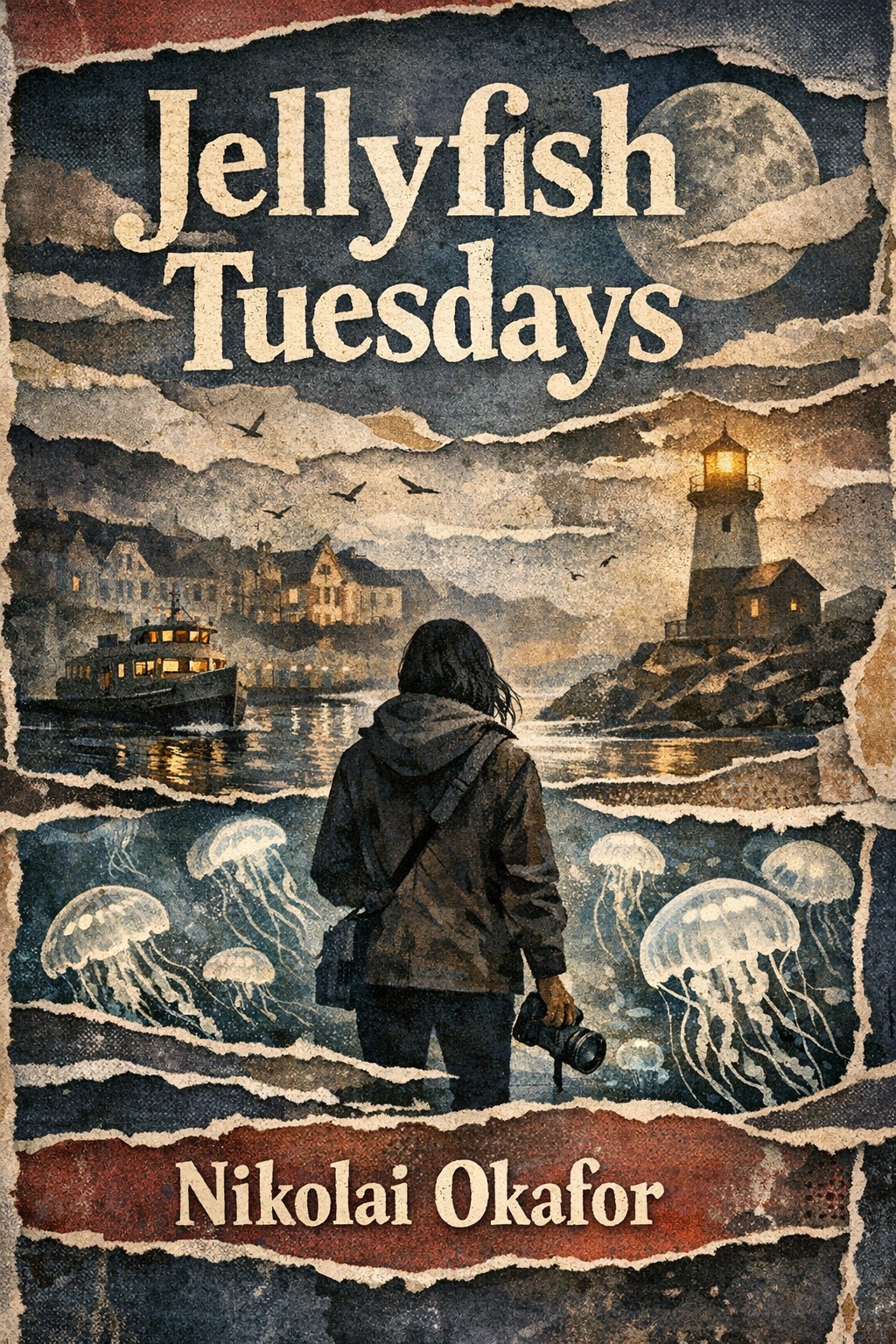
Photo of Nikolai Okafor

Nikolai Okafor is a Nigerian–Russian American novelist and former investigative journalist. Born in Port Harcourt and raised between St. Petersburg and New Bedford, Massachusetts, he studied journalism at Northeastern University and spent a decade covering courts, boats, and corruption along the New England coast. His reporting on maritime fraud, missing persons, and cold cases anchors the briny atmospherics and razor-edged suspense that run through his thrillers and the strand of folk and maritime horror he now explores.

Okafor is the author of the thrillers Salt Workshop (2021), Drowned Orchard (2023), and Pewter (2025), as well as the coastal horror novel Jellyfish Tuesdays (2026). His short fiction has appeared in regional journals and anthologies. He has been honored with the North Atlantic Noir Prize and was a finalist for the Harbor Lights Thriller Award. When not writing, Nikolai volunteers with a search-and-rescue unit, tends a small garden of hardy herbs, and co-hosts the folklore podcast Grey Water. He lives in Providence, Rhode Island.

Ratings & Reviews

Trudy McKeen
★ ★ ☆ ☆ ☆
2026-09-25

For readers who like maritime folklore, small-town secrets, and a slow, briny creep rather than big shocks. The pace is patient and sometimes circular, so casual horror readers may lose interest.

Content notes:
- Drowning and near-drowning
- Stings and mild body-horror sensations
- Implied ritual sacrifice
- Corruption and threats
- Animal harm to jellyfish

Selena Roche
★ ★ ★ ☆ ☆
2026-09-01

Wickham's folk mechanics are the star: salt-bowls on stoops, copper hooks above doors, the carved saint with a tentacled halo, and the reviled Tuesday Truce that feeds the water. The jelly blooms mapped by a drifter buoy, the humming harbor, and those tidy rosaries of polyp on pilings make a system that feels half-ritual, half-ecology, but the rules blur just when the stakes crest, leaving awe laced with a bit of shrug.

Jonah Petrov
★ ★ ★ ☆ ☆
2026-08-09

Clara's technical gaze and private grief run in parallel, and when she handles the salt-bowls, ferry stubs, and those welt-lines that read like script, you sense a mind filing evidence even as the tide works on her resolve.

Her orbit with Hannah clicks in small, unshowy ways, while Dr. Lian's dry precision and Milo's off-kilter mutterings add texture, and the mayor's pressure is brute and believable. Dialogue skims the surface more than it dives, so the people sometimes feel pulled by the current of the plot rather than kicking against it.

Shanice Morrow
★ ★ ☆ ☆ ☆
2026-07-02

The Tuesday-to-Tuesday structure promises a metronome of dread; instead it settles into repetition, with set pieces landing on cue and bleeding urgency. The prose often over-salts its metaphors, leaning on camera terms and marine jargon until scenes feel lacquered rather than alive, and the inserted lighthouse logs, while evocative, sit like splinters instead of joining the main grain.

Parker Lin
★ ★ ★ ☆ ☆
2026-06-18

A maritime horror that balances patient investigation with tidal menace, Tuesdays knot the dread even as the middle drifts in circles before the cannery thread pulls it taut again.

Generated on 2026-09-29 12:03 UTC