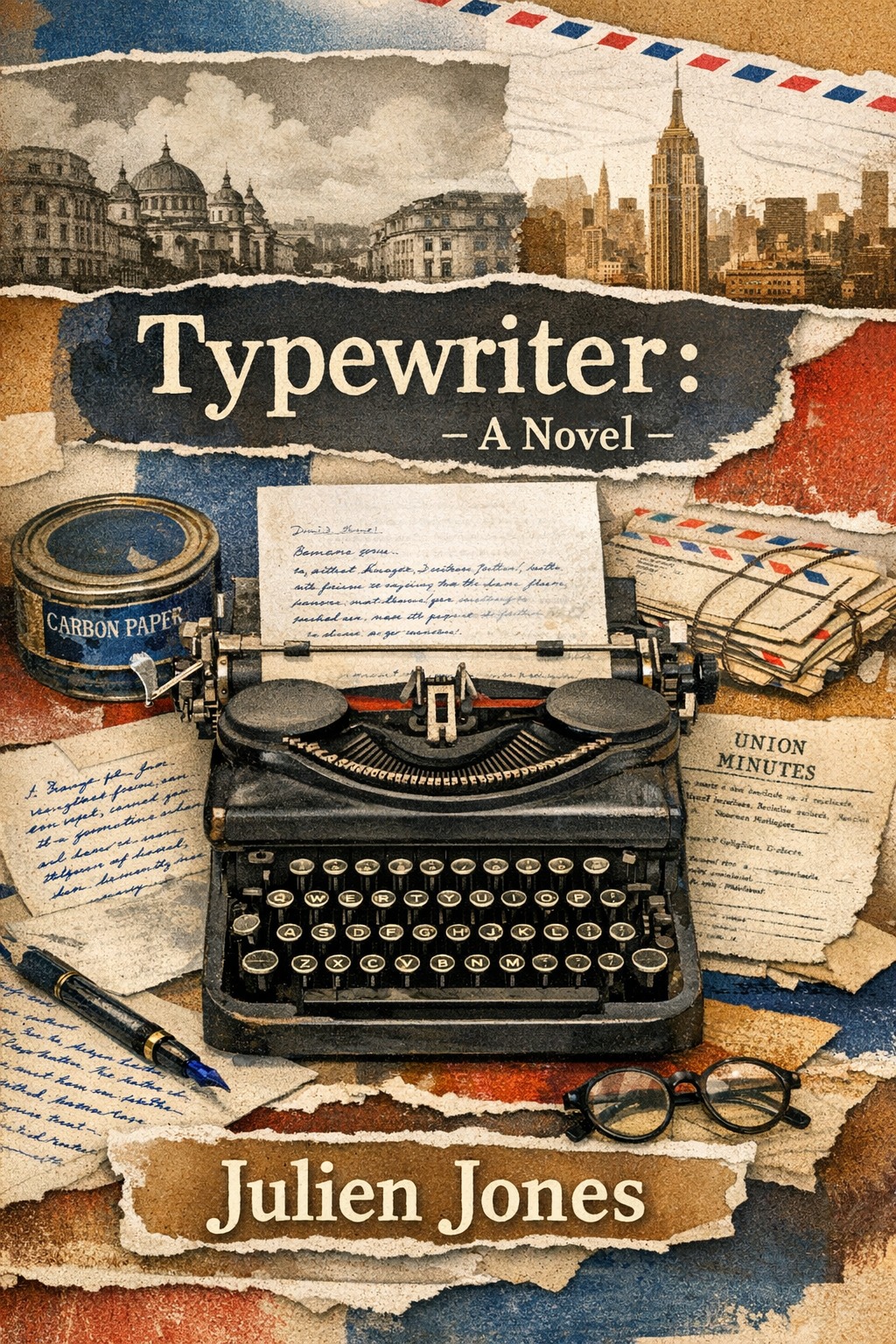
Cover of Typewriter: A Novel

Typewriter: A Novel

Biography · 368 pages · Published 2024-04-30 · Avg 2.2★ (6 reviews)

Julien Jones reconstructs the hidden life of Lyle Petrescu, a Romanian émigré whose Remington Noiseless followed him from Bucharest's gray boulevards to New York's East Village. Through letters ribboned in cobalt ink, union minutes, and a tin of carbon paper found in a Ludlow Street walk-up, Jones charts Petrescu's ascent from hotel porter to ghostwriter for backroom politicians. Alongside the man moves the machine, its worn keys mapping a secret cartography of cities, debts, and loves.

Following leads through the Municipal Archives on Chambers Street to a shuttered newsroom in Cluj-Napoca, the biography doubles as a detective story about authorship itself. Interviews with a Harlem church choir director, a former speechwriter in Albany, and an aging mechanic in Tangier illuminate the cost of a life built behind other people's signatures. When a final roll of onion-skin drafts surfaces at a flea market on Coney Island, Jones confronts the line between witness and ventriloquist.

Photo of Julien Jones

Julien Jones is a biographer and essayist from Halifax, Nova Scotia, now based in Brooklyn. A graduate of McGill University and the University of Iowa's Nonfiction Writing Program, Jones has worked as an oral historian, union archivist, and research librarian. Their work often braids personal reportage with meticulous document-hunting, bringing overlooked lives into sharp relief.

Jones is the author of Letters to a City and Fugitive Margins, and their essays have appeared in Harbor Quarterly, Peregrine Review, and New Atlas. They have received a Mid-Atlantic Arts Fellowship and were shortlisted for the Northstar Nonfiction Prize. When not writing, Jones teaches archival methods at a community college and volunteers repairing Olivetti and Royal machines at a neighborhood fix-it clinic.

Ratings & Reviews

Jamal Noor
2026-07-14

Notes from a frustrated reader.

  • Long archival detours
  • Thin narrative drive
  • Occasional gem interview, buried
  • Overexplained thesis on authorship
Rhea McAdams
2026-03-22

This is meant to be a study of authorship's price, but the argument blares. Every chapter insists that the ghost's labor erases the self, then repeats the point with a new file folder.

The recurring fetish object, those "letters banded in blue ink", is treated like a revelation each time it appears. I needed the silence between artifacts, the negative space where meaning might accumulate, not another nudge telling me what to think.

When the onion-skin drafts surface in Coney Island, Jones stages a crisis of witness versus ventriloquist. Instead of tension, I felt a lecture, complete with self-justifications that flatten the very paradox he wants to illuminate.

There is a poignant idea here about the cost of writing behind other people's names, about debts and loves cartographed by a machine, but the theme is hammered until it warps. Two stars because the questions matter, even if the treatment exhausted me.

Bogdan Keller
2025-09-30

The book breathes in its places. Jones is best when mapping transit: gray Bucharest boulevards, a narrow East Village walk-up, the echoing stacks on Chambers Street, a salt-streaked flea market at Coney Island, even a shuttered newsroom in Cluj where dust has its own politics. Atmosphere carries what the plot does not.

Livia Desai
2025-02-11

Jones gets closest to Lyle in the margins of other people's recollections: a quiet porter who learned to disappear, then a ghost who learned to speak for the living. The interviews let him flicker into view, pragmatic and slightly mournful, a man who understood signatures as currency. He is patient; he is lonely. The portrait is affecting, even if the biographer keeps stepping in front of the camera.

Owen Hatch
2024-08-19

This collage of sources promised tensile elegance; instead I felt stranded almost every chapter.

The letters in cobalt ink, the union minutes, the tin of carbon paper are intriguing artifacts, but the prose leans on them like crutches. Scenes begin, stop, and swerve, and the turn from Bucharest to the East Village lands with a thud. I kept waiting for a throughline to hold, and my patience thinned.

Jones often steps in to explain what the material "means" before the material has a chance to breathe. When he edges toward ventriloquism, the mimicry feels like performance rather than insight, a cleverness that cancels the intimacy the book seeks.

There are bright spots: the choir director's memory has warmth, the Albany aide sketches real compromise, the Tangier mechanic hears time in the Remington. But the montage is diffuse, the detective engine idles, and clues drift past without pressure.

I love archival narratives, but this one clacks when it should hum. For a biography about a Noiseless machine, the sentences are noisy in all the wrong ways.

Marina Cordero
2024-05-07

Promete una pesquisa por archivos de Chambers Street a una redacción cerrada en Cluj, pero el ritmo se arrastra y los hallazgos llegan tarde, con la Remington más evocadora que la historia del propio Petrescu.

Generated on 2026-09-15 12:02 UTC