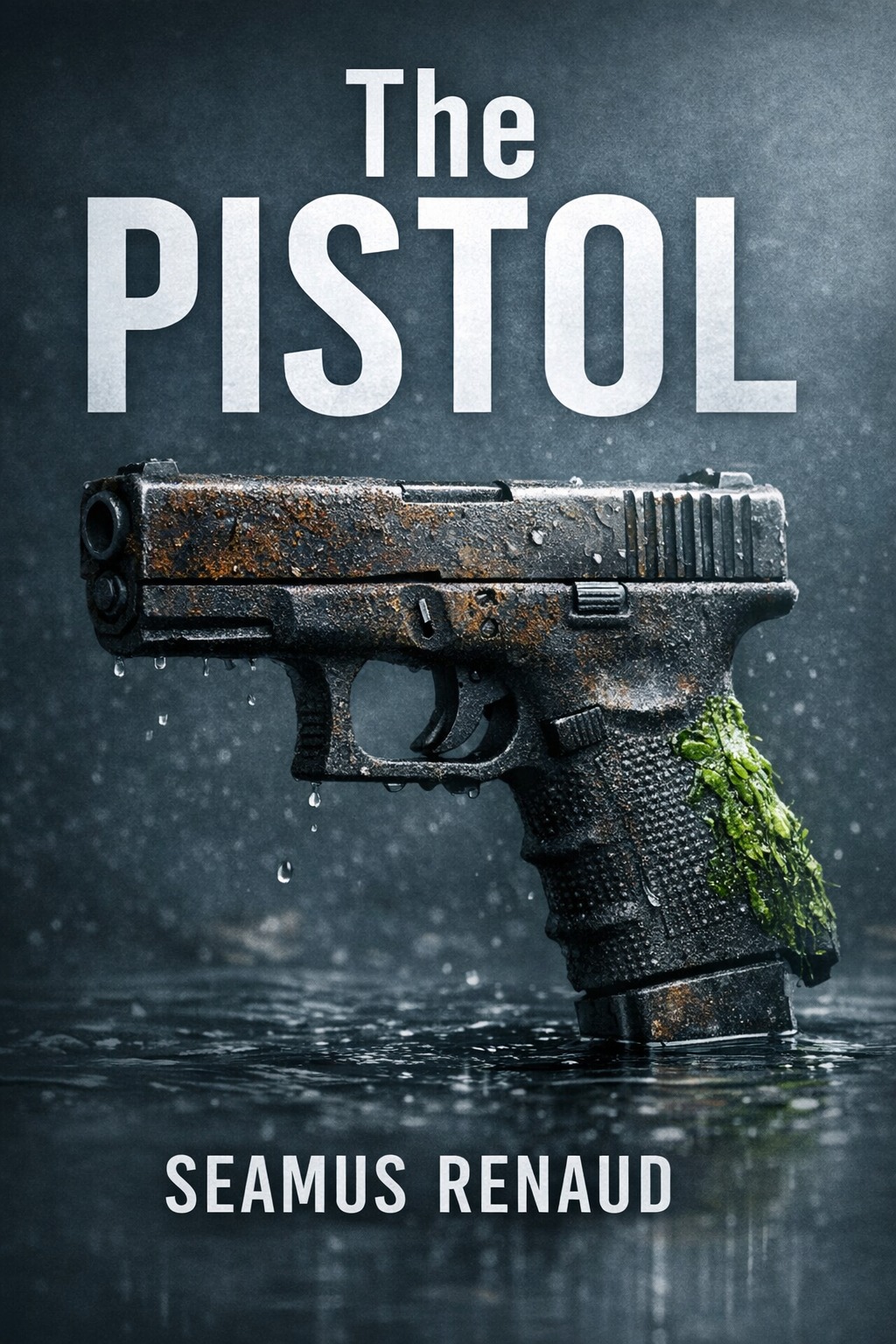
On a wet Tuesday in February, a Garda diver surfaces from the Royal Canal at Binns Bridge with a supermarket bag sealed around a dull weight. Inside is a compact 9mm pistol, pitted with rust, its polymer grips filmed in algae. The serial has been planed down, the slide is scored, and the magazine is still half full. Evidence tag 331487 is stapled to a manila envelope and the weapon disappears into the gray drawers of the ballistics lab at Garda Headquarters in Phoenix Park. That should be the end of a gun. But it is where Seamus Renaud begins.
The Pistol is a work of documentary nonfiction that follows one handgun from a factory floor in Central Europe to a Dublin canal, and through the invisible bureaucracies that let it move, vanish, and reappear. Renaud does not write about murder as spectacle; he writes about ledgers, stamps, servers, and the small choices of ordinary people who say "just let it through" because they are tired, under-resourced, outmaneuvered, or simply told to move the queue along. He shows how a single object acquires a passport of numbers, how it sheds that passport, and how, even when pulled from the water, it remains a question that refuses to resolve.
The trail begins in Uherský Brod, Czech Republic, where a retired machinist named Pavel remembers the day in 1992 when his lathe whined the wrong note and a supervisor tapped his shoulder before the lunch bell. Across the street, the canteen still serves potato pancakes and beer to men who made receivers and slides for state buyers they never met. A ledger entry shows a batch of sidearms shipped to a Slovak distributor; a decade later, a deactivation certificate is stamped in Bratislava under a standard later tightened after the Paris attacks. The certificate says "rendered permanently inoperable". Renaud sits in a fluorescent-lit ministry corridor, listening to a clerk explain how permanence can be a moving target.
From there the pistol drops into a marketplace that is both tactile and digital. In Rotterdam's Waalhaven, a shipboard inspection logs a pallet of "tools and parts" bound for Antwerp; the paperwork is perfect. A man in a blue Hi-Vis vest named Samir says you can only check so much when there are six thousand boxes an afternoon and your terminal is short three men. In Tallinn, Renaud meets an Estonian corporate registrar who drinks strong coffee and shrugs when asked why a shell company owned by another shelf company in Valletta can hold an import license. "The directive is clear," she says, "and so are the loopholes."
Back in Dublin, a steel shutter rattles up in a lock-up off the Naas Road. In the oil-slick light, a benchtop vise, a battered hairdryer, and a box of tiny springs are arranged with the care of a watchmaker. Renaud does not publish diagrams. He watches, listens, and refuses to turn a criminal method into an instruction manual. Instead he asks what permits were granted, what pallets cleared, what signatures were haste-scribbled on a Friday afternoon. The answers have names: terminals, customs codes, a directive drafted in Brussels, a pilot program evaluated by McKinsey, a dashboard flashing green.
The book steps into a Friday night at the Mater Misericordiae University Hospital, where an emergency consultant named Aoife Larkin talks about minutes: the minute a call comes, the minute a tourniquet changes the odds, the minute a young man named Martin – not his real name – looks at the ceiling tiles and asks if he will walk again. Renaud's reporting pulls on a different thread here: hospital procurement, the national trauma plan, a charity-funded "violence interruption" project in Ballymun that must show impact to a foundation in London by Q4. The language of wounds and the language of targets overlap uncomfortably. A volunteer named Darren says, "We keep telling them: you can't KPI grief."
In The Hague, at Europol's glassy HQ, a woman from the Analysis Project for Firearms shows Renaud a heat-map of seizures and a wall of confiscated slides engraved with lions, eagles, and stars. She speaks about data that never arrives because it sits on a paper form in a county office in Ireland or a police station in Košice, because the field labeled "optional" is always the first to be left blank. "We can model a continent," she says, "but not the choice of a single customs officer at dawn."
The Pistol is also a book about the bargains we make with control. We outsource vigilance to software, authority to stamps, conscience to flowcharts. We convince ourselves there is a center that can hold if we can index everything. Renaud, who has reported on procurement in Irish hospitals and data governance in Estonia and Brazil, finds in a gun's itinerary the same half-believed promise: if we label it properly, it will behave. He meets a Garda sergeant in ballistics named Clodagh Murphy who keeps a retired barrel on her desk like a paperweight. "Metal remembers," she says, and shows how a toolmark whispers a story of force and friction that no policy can write over.
In Belgium, Renaud spends a morning with a probation officer who lights cigarettes one from the other and keeps a stamped card of a football team taped to his monitor. He supervises a man we will call K., once a forklift driver in Charleroi, who moved boxes for extra cash. The boxes contained what he was told were "party guns" – the euphemism used for gas pistols and blank-firers sold as novelty. K. shrugs. "I never opened them," he says. "You don't open what you don't need to see." In Dublin, a mother named Teresa puts on a kettle in a kitchen in Finglas and lays out biscuits for a reporter she doesn't particularly want to talk to. She says her son is not a headline and not a statistic and not a lesson. The kettle ticks as it cools; the street outside is quiet.
Renaud follows the pistol into forensics and out into budgets, into courtrooms and out into housing estates, into ports and ministries and charity offices, until the object becomes less important than the web it proves exists. Along the way he challenges the instinct to tighten our grip on the wrong things – to pour energy into PR statements, target dashboards, and spectacular raids – and instead asks what it would mean to notice the switch that didn't flip, the sanction that didn't bite, the form that everyone agrees is nobody's job. He is not sentimental, but he is precise: names, dates, the color of the chairs in a corridor, the code of a customs regime.
Structurally, The Pistol moves in eight sequences – Factory, Certificate, Port, Locker, Ward, Spreadsheet, Alley, Drawer – braiding scenes with reporting and interviews. Each sequence returns us to a question that is less about villains than about systems that allow well-meaning people to abdicate tiny duties that aggregate into harm. The book does not promise redemption. It offers, instead, a hard clarity: that agency is most real at the scale where a person with a stamp or a wrench or a browser tab decides to do the boring right thing. Renaud's cool, restrained prose and refusal to glamorize violence make this an unsettling, necessary account of a continent that believes in its paperwork and a city that keeps pulling weapons out of its canals.
By its end, the gun rests again in a drawer under case number 331487, the canal water dried from its slide. The reader is left with a catalog of points where the world might bend – not in speeches or hashtags, but at desks, counters, and thresholds. It is a book about a pistol, but more truthfully it is a book about us: what we choose to see, what we sign, and what we let pass.