Cover of Last Rites for Amersfoort

Last Rites for Amersfoort

Memoir · 288 pages · Published 2023-09-12 · Avg 4.2★ (6 reviews)

A tender, unsparing memoir of a life braided between three languages and one stubborn city, Last Rites for Amersfoort traces Carmen Larsson's attempt to bless what can't be saved: a mother's failing body, a father's ferrying silences, and the medieval streets that held her first names. Born to a Swedish mechanic who loved long northern twilights and a Spanish nurse who kept a rosary tucked inside a tin of violet pastilles, Carmen grew up off the Eem near the Koppelpoort, where bike bells were liturgy and the bells of the Onze Lieve Vrouwetoren punctuated dinner. In classrooms in Amersfoort-Noord, she learned to conjugate verbs she spoke at home to different gods—Du, tú, jij—while nuns at Sint Franciscus Xaveriuskerk pressed a thumb to her brow on the Feast of Saint Lucy. Her mother, Marisol, demanded crisp hems and perfect Dutch; her father, Anders, calibrated the world with grease on his hands and ABBA on the radio. There were winters of erwtensoep and rookworst, Midsommar saffron buns mailed from an aunt in Uppsala, and summer months in Jerez de la Frontera with a grandmother who swore by garlic soup and flamenco whispered after midnight.

As Carmen aged out of the old city and into an art program in Rotterdam, painting sets at the Schouwburg and falling for a sound engineer named Bas, her Dutchness hardened and the other cords slackened. She chased studio deadlines, weekend gigs, and the relief of being known by only one name. When Marisol's hands began to tremble and her speech thinned into air—early-onset Parkinson's with dementia—Carmen came home, learning pill schedules and night care, learning again how to pray. Between bus 3 to Vathorst and the hospice near the Eemhaven, she stitched a new liturgy from ordinary things: a chipped Delft plate, a cassette of Camarón de la Isla, a Lutheran hymn hummed into a Spanish lullaby. In pages steeped in incense and canal light, salt herring and tortilla española, she writes with humour and bite about paperwork and pilgrims, stubbornness and surrender, and how a city can be both cradle and witness. Last Rites for Amersfoort becomes a procession through memory—past the perfume counter at the V&D-that-was, past Bas's empty flat, into a sacristy where a priest named Pieter whispers the final blessing in Dutch and Spanish—until Carmen understands that departure is its own rite, and that to love a parent, a place, and a self divided by borders is to keep walking after the bells go quiet.

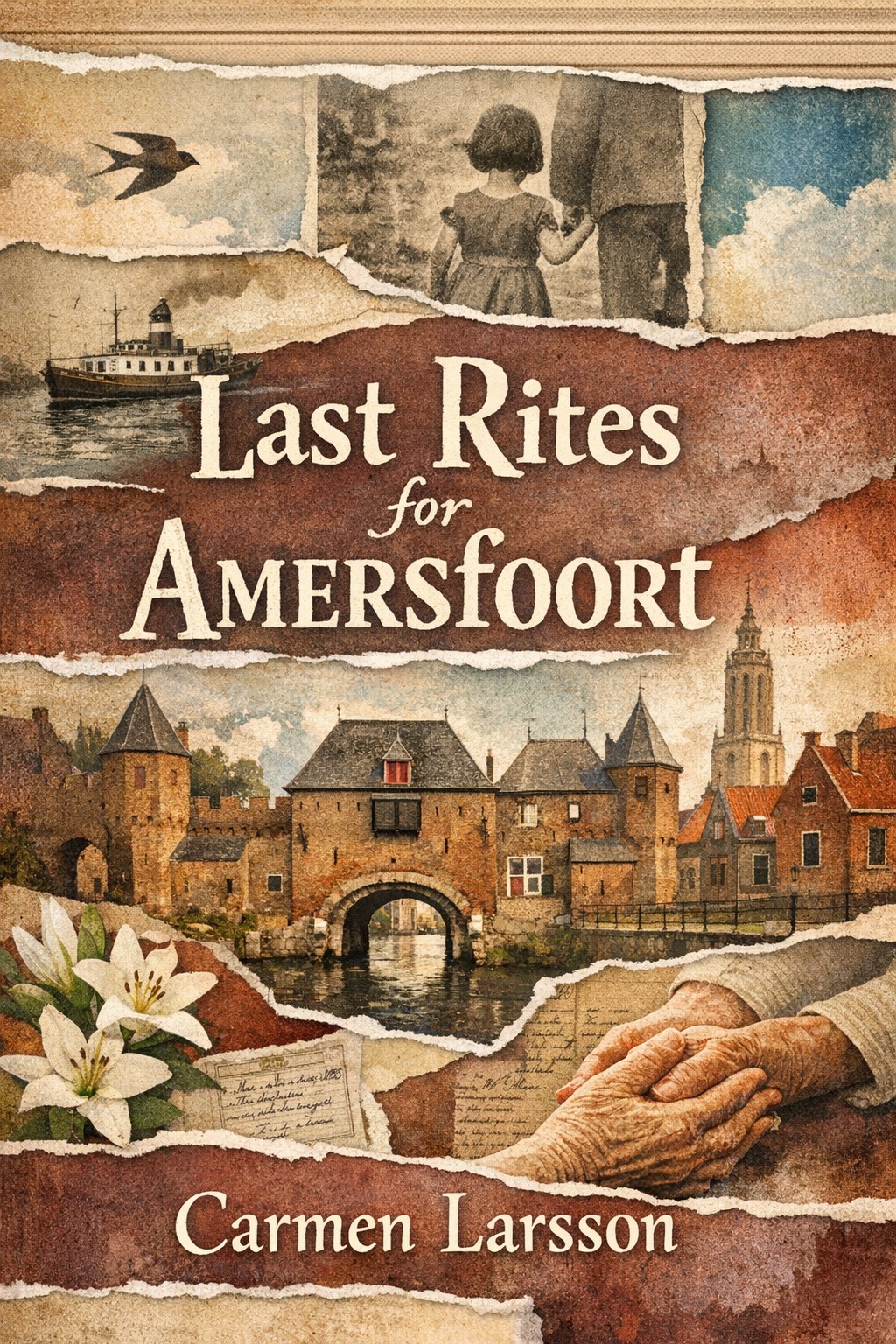
Photo of Carmen Larsson

Carmen Larsson is a Dutch-Swedish-Spanish writer and visual artist raised in Amersfoort and based in Rotterdam. She studied scenography at HKU University of the Arts Utrecht and later completed an MA in Cultural Analysis at the University of Amsterdam, where she researched ritual, migration, and the architectures of memory.

Her essays and criticism have appeared in De Groene Amsterdammer, The Stinging Fly, and Brick, and her chapbook of lyric essays, Guide to Bicycles and Saints, was shortlisted for the Nieuwe Non-Fictie Prijs in 2020. Carmen Larsson has worked as a museum educator at Kunsthal Rotterdam and as a caregiver in palliative wards, experiences that inform her intimate attention to bodies, rooms, and the quiet theatre of daily life.

She lives near the Maas with a secondhand drafting table, too many cassette tapes, and a sourdough starter named Marisol.

Ratings & Reviews

Nina Perera
2026-07-02

File this next to Durga Chew-Bose and Nell Stevens: place-attentive, sonically precise, and quietly bold about care work. Readers drawn to multilingual lives, interfaith texture, and the craft of scene-making over plot fireworks will find a thoughtful companion here. Some administrative stretches run long, but the canal-lit atmosphere and lucid ethics of tending a parent make this a keeper for reflective memoir shelves.

Thijs Noorlander
2025-12-14

Place as ritual, ritual as survival. I could smell erwtensoep, hear bike bells crossing the Koppelpoort, feel the weight of that tin of violet pastilles in a pocket that also holds a rosary.

The devotion to Amersfoort is fierce and tender, not nostalgic fog but canal light over hard cobbles. Yes, yes, yes: to a city that keeps watch without promising rescue, to a daughter who learns to make liturgy out of pill boxes and hymn fragments.

When bus 3 rolls to Vathorst and she clocks the hospice routines by the Eemhaven, the writing refuses easy sanctity and becomes more holy for it. I choked up at the crossed languages, not because they were exotic, but because they were ordinary and exact.

By the time Father Pieter whispers blessings in two tongues, the book has taught you how to listen. I closed it with gratitude and the strange courage to keep walking after the bells go quiet.

Alba Jiménez
2025-03-21

Lo que más me impresionó fue la manera en que Carmen escucha los silencios. Marisol no es solo una paciente; es madre exigente, enfermera orgullosa, mujer que se va quedando sin palabras, y Larsson la mira con ternura y filo a la vez.

También Anders y Bas aparecen con matices, nunca como funciones del dolor de ella. Hay pasajes algo largos sobre trámites, sí, pero la música de las campanas y de las cintas viejas sostiene la historia con un pulso íntimo.

Keisha Lum
2024-11-09

Moved by the subject, mixed on execution.

  • City writing that glows
  • Caregiving detail clear, unsentimental
  • Middle stretch drifts between Bas and forms
  • Timeline jumps blur urgency

Still, the closing movement resonates, and the place-love lingers.

Bram de Wilde
2024-02-17

Larsson orchestrates memory with painterly control; chapters loop from Amersfoort to Rotterdam and back, each return sharpening the motif of care without losing the thread. The code-switching reads as necessary rather than ornamental, and the sensory detail is meticulous. A few scenes linger in the tedium of forms and visits, yet the sentences stay clean, the perspective humane, and the structure ultimately cohesive.

Ingrid Solares
2023-10-05

This memoir rang like the Onze Lieve Vrouwetoren at dusk over the Eem. Larsson braids languages with a caretaker's steadiness and a daughter's fire, and I felt every splice between duty and defiance.

When she names her journey "a procession through memory," something opened for me. The scenes of soup steam, incense, and clinic fluorescents feel consecrated without ever turning pious, and the city becomes an unruly witness you come to love.

I set the book down to breathe.

The chipped Delft plate, the cassette of Camarón de la Isla, the Lutheran hymn easing into a Spanish lullaby are her sacraments, and the ordinary turns incandescent. Paperwork becomes a language lesson; grief becomes logistics; love keeps time with bike bells.

By the final blessing in Dutch and Spanish, I was spent and grateful, and yes, somehow steadier. This is an elegy with grease on its hands and saffron under its nails, and it blessed what I thought couldn't be blessed.

Generated on 2026-08-25 12:03 UTC