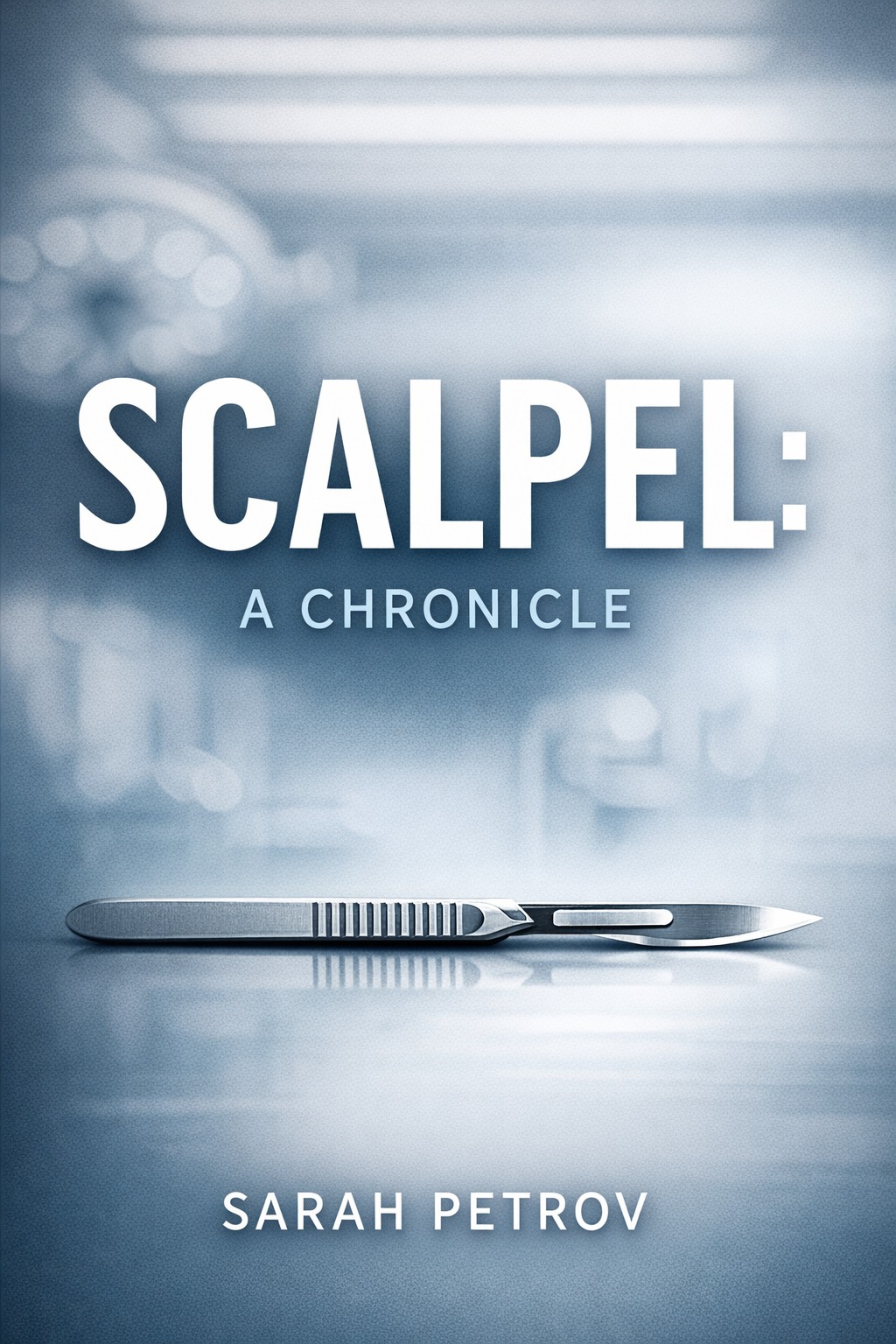
Be honest: how much of your operating day do you actually choose, and how much simply rides the conveyor of routine? Scalpel: A Chronicle is a precise, countercultural account of clinical agency from a trauma surgeon who learned to cut through more than tissue. Not another pep talk. Not twenty habits to hack. Not a mindfulness echo chamber. This is craft-determination — the uncommon life of the everyday operator who must master uncertainty at 2:17 a.m. in OR 6.
Here is the truth no one says out loud on morning rounds: you are not careless; you are bleeding attention. Like a patient with a slow venous ooze, your best focus seeps away through automatic, protocol-bound reflexes and the invisible drag of hierarchy. The pager's Pavlovian buzz, the EMR's templated clicks, the checklist treated as talisman — together they assemble the gloved robot. You never fully chose this programming; you inherited it from rooms you walked into: Kings County Hospital's scrub sink at dawn, a windowless call room, the flicker of the old anesthesia monitor in Savannah General. The first move in this chronicle is surgical and surprising: identify the leaks and suture them closed.
As a clinician, you can:
• Write your own practice charter, from consent to closure, and build a conservation mindset for time, motion, and attention.
• Transmute adrenaline into steadiness without hardening your heart — firmness through gentle hands, never through attack.
• Stop wasting motion — in how you pre-load a needle driver, lay out drapes, and route decisions — and start saving lives, minutes, and your back.
• Override pager-driven reflexes and the rigid theater of deference, so your judgment is no longer a stereotype of training but the living sum of your craft.
• Do the cold, careful thing when spectacle tempts you, because real power accrues in consistency, discipline, and clean margins.
Forget the long problem list. This path narrows the work to three consequential skills: stopping, harmlessness, and extreme self-care. Stopping is the micro-pause above the skin, the breath before a cut, the willingness to not cut at all. Harmlessness is the quiet nerve to de-escalate, to speak to families without leaving scars, to repair team dynamics while you repair fascia. Extreme self-care is the unglamorous architecture of rest, hydration, mobility, and honest boundaries that let you hold a retractor and a life without shaking. These three skills return a rare trifecta: self-regard, self-mastery, and durable clinical power — and, yes, a more deliberate experience at the table and away from it.
Across night shifts in Brooklyn and daybreak clinics in Kisumu, the pages track vivid, granular work: a blue-handled No. 15 blade clicking into a Bard-Parker, chlorhexidine tracing a cold square on an abdomen, a Mayo stand arranged like a small city with loupes, Adsons, Metzenbaums, and a silent headlamp in reserve. There is a near-miss with a hidden splenic tear in Fargo during a snowed-in call, a bone saw's whine in Managua that forces a rethinking of speed, a misplaced suture that taught more than grand rounds, and a patient named Mirela who rewired consent itself. Names and places root the ideas: Dr. Lila Santos in OR 2, charge nurse Frankie Molina who saved a line and a life with a sentence, Abasi Otieno in supplies who taught what scarcity requires, and pathologist Henrik Dahl who found what hustle would have missed.
This is not a rebellion against checklists. It is a reclamation of authorship within them. It is not war against collegiality. It is a refusal to let your judgment be reduced to noise by culture, fatigue, or bravado. It is about doing the hard, quiet thing — tightening a single instrument habit, refusing one corrosive joke in the locker room, rewriting the consent conversation so it is clean, honest, and kind — and discovering that, over months, your hands, your charts, and your nights change.
Scalpel: A Chronicle does not ask you to believe; it asks you to notice. To trace where your energy goes between sign-out and skin closure. To test the three skills against a living list: ruptured ectopic in Bed 12, angry cousin in the waiting room, an intern who will remember how you spoke more than what you did. It offers field notes, not commandments; cases, not slogans; tools you can fold into a pocket beside your penlight.
Power in medicine is not granted by title; it is earned in the dark when no one is watching. Fair warning: once you sharpen your senses for the leaks, you will not unsee them. Do you hear the call room pager? Do you feel the weight of the handle in your palm? The room is ready. The field is prepped. Pick up the scalpel.