
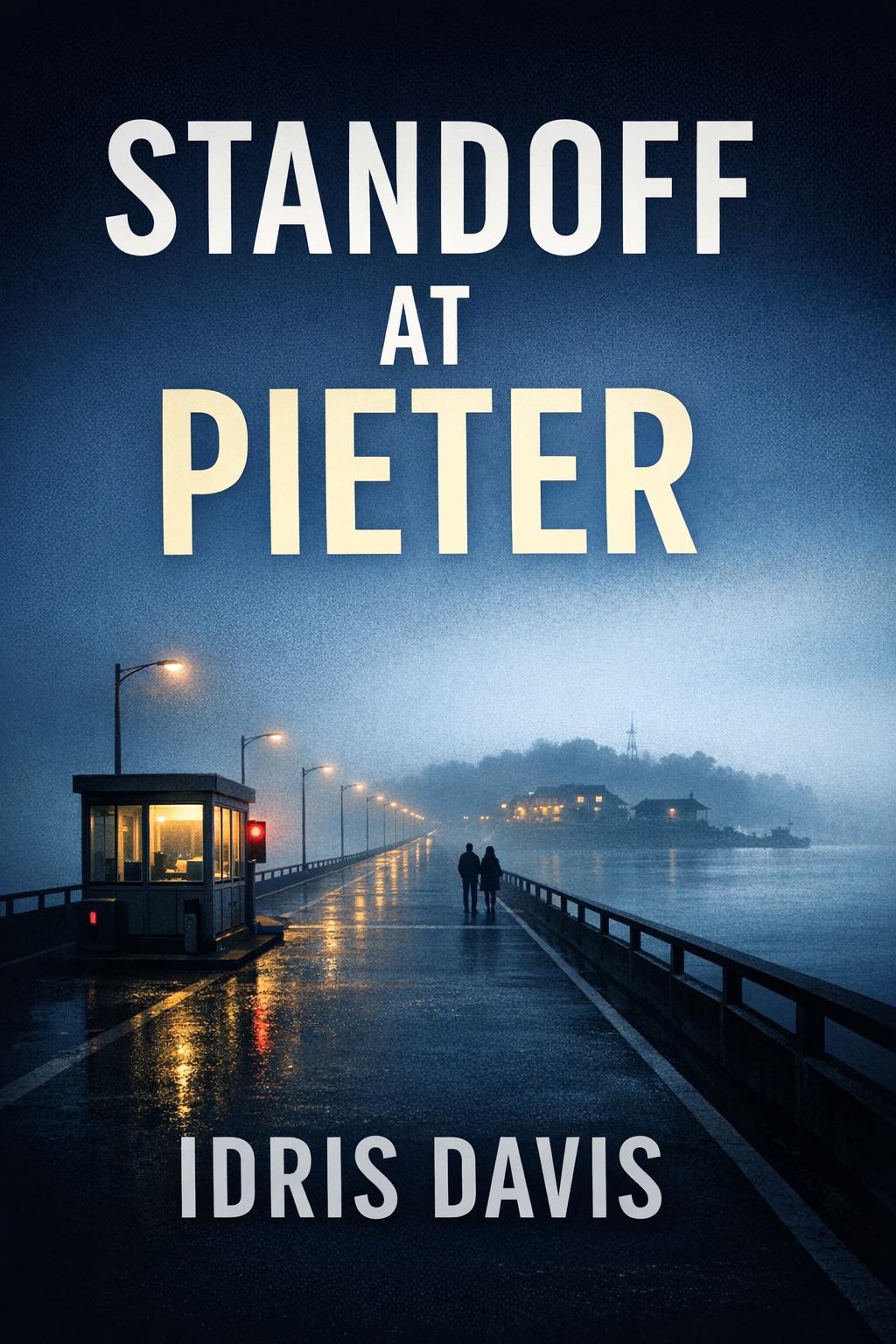

Cover of Standoff at Pieter

Standoff at Pieter

Suspense · 344 pages · Published 2025-10-14 · Avg 3.3★ (6 reviews)

Every dawn, Nora Vance unlocks the glass booth at Pieter Causeway, the only road onto the island, and counts the same cars across the salt-slick span. The Blue Wharf Diner opens on cue, Harbormaster O'Connell lumbers past with his stubby radio, and a couple she has named Eva and Bram pause beneath the chipped blue bench to split a paper bag from Kilner's Bakery. Routine is the one thing Nora can still control. Then, through her brass telescope, she notices something that does not belong: a red oilskin parcel pressed into Eva's palm by a stranger on a silver Vespa, a glance over the shoulder, a flinch. Fog slides in. Sirens jump. The bridge locks down and the whole town is funneled to a stop at Pieter as officers set up barricades and rumors fly about a missing girl from St. Martin School. Nora has sixty seconds of recorded feed before the cameras loop to storage, and in that minute she sees the detail everyone else misses. Now she is no longer just the quiet woman in the booth; she is the only witness who can thread together the diner receipts, the ferry schedules, the man with sea-glass eyes. But getting heard means stepping out from behind glass, past the horn-honking line, into the hands of people who have a stake in keeping Pieter sealed. The standoff is not only at the barricades. It is in every choice Nora makes as the tide turns, the fog lifts, and the past she fled finally recognizes her face.

Photo of Idris Davis

Idris Davis is a Welsh-born journalist and novelist whose work explores the tension between coastline communities and the secrets they keep. Raised in Swansea and educated at Cardiff University, he spent a decade covering shipping incidents and port corruption for regional papers and maritime trade journals, reporting from Milford Haven, Rotterdam, and Reykjavík. His long-form features earned him the Wales Media Award and a British Journalism Award (shortlist) for investigative reporting.

Davis turned to fiction after relocating to Bristol in 2018, publishing the story collection Breakwater Nights and the novella Salt Line, both noted for atmospheric detail and taut, propulsive pacing. He lectures part-time on narrative nonfiction at the University of the West of England and volunteers with a coastal rescue charity. When not writing, Idris Davis can be found walking the Gower cliffs with a battered field notebook and a stubborn lurcher named Finn.

Ratings & Reviews

Renata Morel
2026-07-28

Librarian take: recommend to readers who enjoy small-town lock-ins, meticulous observation, and a single, persistent witness holding the thread. Strong content flags for sensitive patrons include a missing teen rumor, claustrophobic crowds at a barricade, surveillance footage tension, and implied stalking.

For me, the narrow scope felt stifling rather than suspenseful, with long stretches of queue-bound procedure and recycled fog-scene beats. That said, I will still hand this to patrons who ask for coastal mysteries where a causeway traps secrets and one watchful person refuses to look away.

Caleb Norwood
2026-06-15

Themes ring through like buoy bells: visibility, consent, and the cost of attention. Nora protects herself with ritual until the island needs her to be seen, and that tug-of-war gives the story its moral weather. The way she patterns diner receipts against ferry crossings is less about clue-mongering and more about ethics—who is noticed, who is overlooked, and why. The novel keeps reminding us that the standoff is "not only at the barricades"; it is inside any community that confuses silence with safety. I admired the argument even when the narrative momentum pulsed unevenly.

Mara Kline
2026-03-02

Nora Vance gripped me from the first page of dawn to the last surge of tide, and I loved her for her ferocious quiet! The ritual of unlocking the glass booth, tracking the Blue Wharf Diner, watching Harbormaster O'Connell shuffle by with that stubby radio—every detail made her world precise, and then the silver Vespa flashes past, a red oilskin parcel trades hands, and suddenly precision becomes peril. I cheered as Nora notices what others blur, as she sifts the horn-honking chaos with that brass telescope and an unshakable mind.

What thrills me most is the way Nora chooses courage in small increments. Sixty seconds of recorded feed is all she has, but she uses it like a scalpel. She recognizes patterns in diner receipts and ferry schedules, and she understands how rumor can seal a town tighter than any barricade. The way she steps from glass to asphalt, from witness to actor—I felt it in my chest.

I believed every flinch, every held breath.

The people around her crackle with life: O'Connell's weary decency, the couple she calls Eva and Bram under that chipped blue bench, even the man with sea-glass eyes who seems to bend the fog around him. Dialogue is clipped, true, and edged with the kind of courtesy that hides secrets. When the causeway locks down and the line snarls, Nora listens; she hears the town's heartbeat.

This is suspense built on empathy and nerve. The island's weather closes in, the past tilts into view, and Nora refuses to vanish again. What a stunning, generous story of seeing and being seen—and standing up when it costs everything!

Priya Laghari
2026-02-18

Craft-wise, this hums. Vance's routine feels like a metronome: click, click, click. The prose is salt-clean, favoring angular verbs over ornament, and the nautical touches never tip into jargon. I liked the tactile choices—the oilskin parcel, the chipped blue bench—because they anchor the abstractions of fear and rumor.

Structurally, the book lives inside limited windows, from that sixty-second loop to the queue at the barricades, and the design is admirable even when the timing logistics start to show. A few beats recycle (fog, siren, stall), yet the close, steady point of view keeps the frame disciplined. It reads like a well-edited feed that occasionally buffers.

Hector Juarez
2026-01-11

The premise is terrific, but the execution bogs down once the bridge is sealed.

  • Sharp opening in the glass booth with the brass telescope
  • Clever sixty-second camera loop setup
  • Repetitive fog-and-siren beats
  • Coincidence stacking in the clue chain
  • Late-stage tension feels muted compared to the start
Siobhan Leary
2025-11-05

I am in love with this island and its nerve-wracking artery! Pieter Causeway is not just a setting; it is a throttle on breath, a narrow promise between tide and town. When the sirens jump and the bridge locks, the geography itself becomes a pressure cooker, and you feel how a single booth can decide who gets in, who waits, who turns back.

The booth is a control room that only looks small. Nora's brass telescope, the looping cameras, the clack of receipts from the Blue Wharf Diner, the ferry timetables—these are circuitry, and she is the one who keeps the board from shorting out. The red oilskin parcel is a bright, pulsing diode in the fog, and the stranger on the silver Vespa is a flicker at the edge of the screen you cannot dismiss.

What dazzles is how the macro and micro lock together. The rumor of a missing St. Martin student swells like weather, yet the stakes remain intimate: a glance over a shoulder, a hand that won't stop shaking, a town that pretends routine is safety until routine turns traitor.

Atmosphere this taut, this saline and specific, is rare—and it sings! Five stars for a world built with restraint and nerve, where every gull call and grille of headlights matters.

Generated on 2026-08-04 12:01 UTC