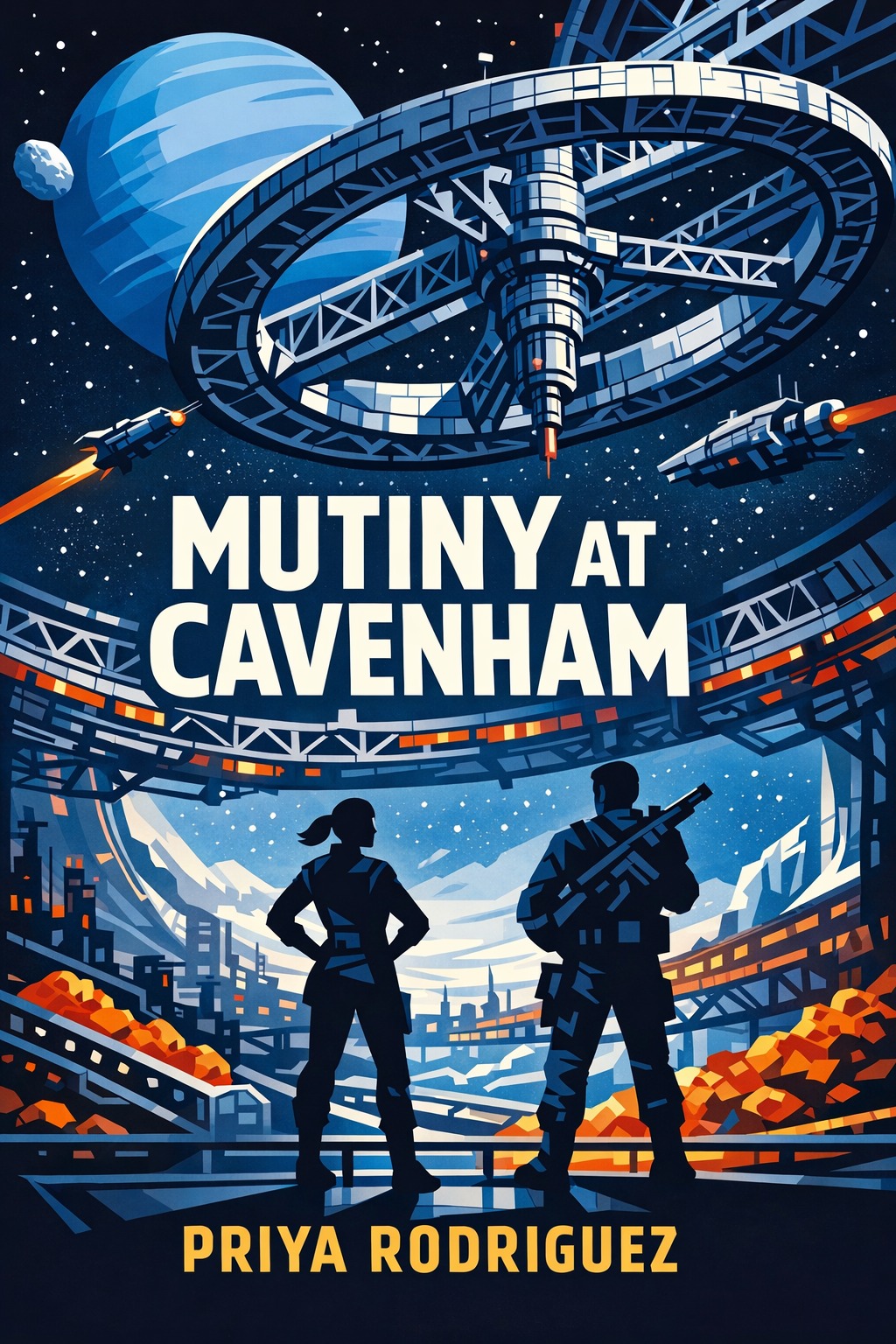
Cover of Mutiny at Cavenham

Mutiny at Cavenham

Science Fiction · 320 pages · Published 2025-03-11 · Avg 4.3★ (6 reviews)

Le Guin meets The Expanse in a tensile, relay-race thriller through a knife-edge orbital city where rumor weighs as much as cargo. Cavenham Spindle is built from truss and testimony, a ringed quarter-mile worldlet swinging at Neptune's L5, where ore from the Kuiper bleeds into the last weather of Earth and every contract is a kind of gravity.

When a sleepless welder named Kaito Chu catches a backchannel ping that the Spindle will choose its own Warden—and that they will sign the vacuum—he tells it to Mx. Parnassus, a cards-dealing sysop at Molybdenum's Rest. Parnassus tells Zoya Kincaid, a gondola driver on Tramline G, who tells Constable Osei, who's already fielded five panicked calls before shift change. By the time it reaches Leda Vass on Dock 14 with a coilgun and a conscience, it's settled into the guts of Cavenham—half-decided, more law than rumor.

Mutiny blooms without banners: a contract dispute becomes a climate hack, an airlock wedding becomes a blockade, an AI called HECATE learns to refuse orders. Told as a shifting chorus of shiplogs, receipts, and breath-held corridor whispers, this is low-grav, razor-edged science fiction that will make you rethink what rebellion sounds like in vacuum.

At the publisher's request, this ebook is released DRM-free.

Photo of Priya Rodriguez

Priya Rodriguez is a science fiction author and aerospace engineer whose work explores labor, language, and life support on the fringes of human space. Raised in New Mexico and educated at the University of Colorado Boulder, she spent a decade designing telemetry systems for microgravity habitats before turning full-time to fiction. She lives in Halifax, Nova Scotia, where the fog reminds her of coolant leaks in a kind way.

Rodriguez's short fiction has appeared in venues such as Uncanny, Escape Pod, and Shoreline of Infinity, and her novella Aphelion for Beginners was a finalist for the Orbital Debut Prize. Her collection The Maintenance Gospel won the Kite Award for innovative speculative fiction in 2023. When she isn't writing, Priya mentors underrepresented engineers, restores retro ham radios, and keeps an herb garden under grow lights that she swears are not repurposed from a cubesat project.

Ratings & Reviews

Priya Deshmukh
2026-07-12

If you vibe with Malka Older's governance puzzles and Linda Nagata's hardware-smart tension, this will fit your shelf. It's procedural without being cold, full of labor math and moral grit, and the DRM-free release feels like a wink toward its own politics.

Laurel McKendry
2026-02-14

I am buzzing after this book; it sings about how communities choose their own orbits!

The chorus structure shouldn't work this well, yet it does because every register—shiplog timestamp, receipt stub, hallway breath—argues about power without preaching. I kept pausing to reread lines where labor and law braid together.

And then HECATE says no.

Contracts here aren't paperwork but physics, and rumor is treated like mass. One character repeats that "rumor carries the weight of cargo," and the plot proves it with the speed of a ping turning into policy.

I finished breathless, not from explosions, but from the precision of care—airlock vows, splice burns, a constable listening harder than they are paid to. This is humane, defiant, and gorgeous science fiction, and I'm in love with it.

Mateo R. Hinojosa
2025-11-02

Neptune's L5 feels lived in, with truss grit under gloves, contracts acting like artificial gravity, and ore trains meeting weather data from a fading Earth. The city's economy of rumor is a believable physics, and the airlock wedding-turned-blockade reads like social engineering rather than spectacle.

Sienna Okafor
2025-06-18

Kaito's insomnia feels like a burn along the hull; Parnassus shuffles kindness under the cards; Zoya hums through the tram fog; Osei counts calls instead of hours; and Leda arrives with a coilgun and a conscience. In a few pages each, they reveal stubborn cores and small mercies.

HECATE's arc surprised me not with fireworks but with a simple, bracing "no," and that refusal echoes through the crew's choices. The dialogue is clipped, local, and warm in vacuum.

Omar J. Laghari
2025-04-05

It splices shiplogs, receipts, and whispers into a polyphonic ledger: tight, elliptical, and rarely indulgent. Occasional jump-cuts left me reorienting, but the cadence of work orders and corridor gossip becomes its own propulsion.

Renee Halvorsen
2025-03-22

Cavenham Spindle thrums as a rumor outruns gravity and jobs turn into junctions. The relay-style chapters keep tension high without wasting air.

Generated on 2026-07-30 12:02 UTC