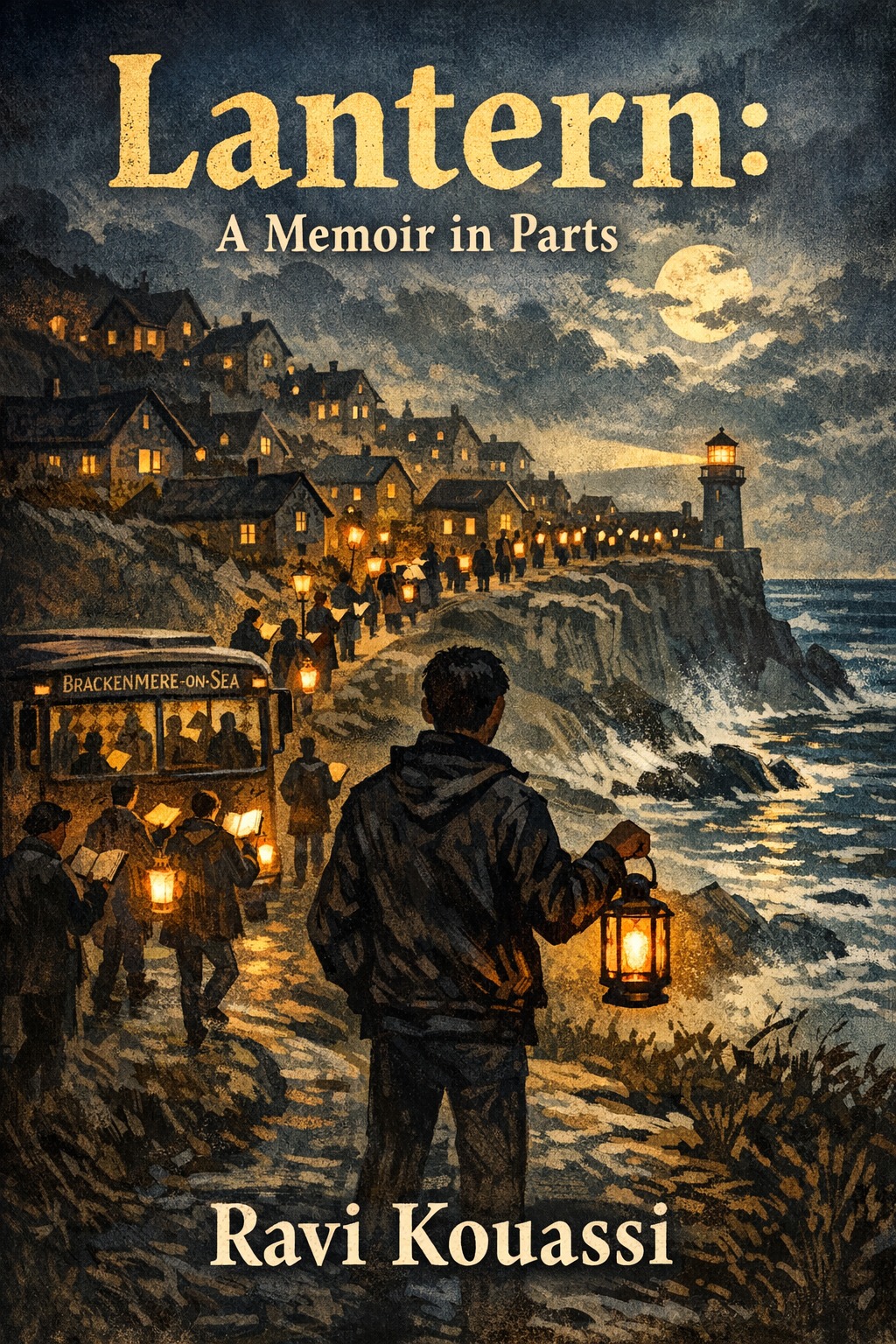
My nephew Ade is in serious trouble. I send him to the cliff village of Brackenmere-on-Sea, which looks like the perfect place to ride out a storm. The town is hosting its annual Lantern Walk in honor of local essayist Elinor Marsh; coaches of readers arrive with thermoses and dog-eared paperbacks. On the first night, something unsettling happens. On the fog road above Gull Teeth Cove, a pale hitchhiker stands in the same lay-by after dusk and halts each slow-moving car. He leaves behind a scorched shard of lantern glass in the cup holders, each piece marked with a single name.
By morning, the guests take part in the Margins Hunt, a sprawling orienteering game based on marginalia and false trails. The make-believe crime collapses when a real one surfaces. Jonas Pike, a volunteer, is found dead in the reed beds with a tin lighthouse badge pinned backward through his coat. I begin a private inquiry, part confession and part ledger of what I failed to stop. I am joined, warily, by prosecutor Mateo Arfe and Sergeant Freya Dalrymple of the Brackenmere constabulary. Dalrymple grew up here, and more than one door in this town seems to know her name.
In Calder Gate, far inland, Inspector Ivo Stanic hunts for a kidnapped boy last seen at a bus shelter lit by a failing streetlamp. Investigative journalist Ola Bacewicz answers the message of a novice vlogger, Rhea Bell, who has unsealed a bricked-off room in a Victorian terrace on Silvertree Row. Inside they find a chair, a thermos still warm, and a portable lantern that will not go out. They are not alone on that floor.
How do the hitchhiker, the reed-bed badge, and the impossible light bind Brackenmere to Calder Gate? Who is next when the Walk reaches the cliff path? Told in fragments of case notes, taped interviews, and memories that warp like heat over a flame, Lantern: A Memoir in Parts threads coastal noir, classic detection, and psychological fracture. In these pages, the past bargains, the present misleads, and every lantern shows only what it wants you to see.