
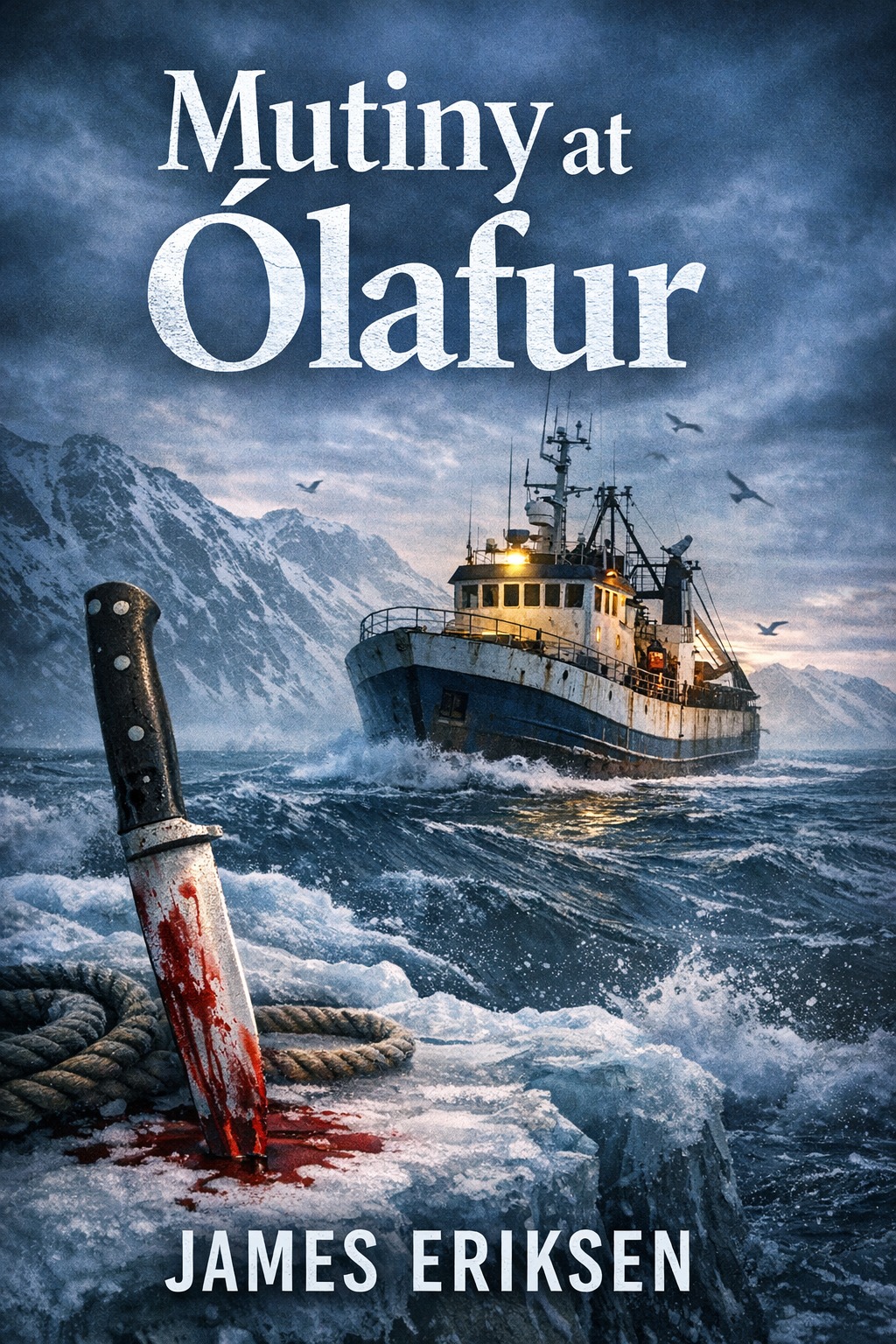

Cover of Mutiny at Ólafur

Mutiny at Ólafur

Suspense · 352 pages · Published 2025-03-14 · Avg 3.6★ (5 reviews)

On the knife-edge of the Denmark Strait, the longliner Ólafur takes on a final winter charter crewed by old classmates from Reykjavík Nautical College—Saga Jónsdóttir, Ari Magnússon, Disa Halldórsdóttir, Petur Kade, and Theo Brink—who've promised each other a clean slate after the training-boat disaster off Akranes that nearly sank them for good. The man who made it all possible is Anton Brookes, a charming London-born fixer with a spotless smile and a quiet in with NordÞing Fisheries. He swears it's simple: a week of line setting, fast quotas, fat envelopes, then shore leave at the decommissioned whaling station on Hesteyri, which his company has refit into a private retreat. But when a polar low muscles in from the Greenland ice and crushes their weather window, the Ólafur loses AIS, the satphone coughs out half-finished distress calls, and the captain is found crumpled in the blast freezer with a winch cable cinched through his coat.

As the vessel skews off course and knives of black water slam her decks, the charter turns on itself. Someone has smashed the EPIRB, someone else has moved the bearings on the old brass compass they swore they'd never use again, and Anton's name begins showing up on emails cached in the dead server room. A harpoon rigged as a tripwire goes off in the gutting bay; a body disappears into the fish hold; another resurfaces with a lifeline cleanly cut. Every lie from the Akranes inquiry, every betrayal they sealed with salt and silence, floods back in the dark. The only land in reach is a black tooth of rock and a shuttered lighthouse at Hornbjarg—if they can survive the mutiny that may not be of the crew, but of the ship itself. When the storm breaks, will any of them make landfall alive?

Photo of James Eriksen

James Eriksen is an Icelandic-British suspense writer raised between Keflavík and Aberdeen, where winter seas and foghorns seeped into his storytelling. After working as a deckhand and later a radio technician on North Atlantic trawlers, he studied maritime law at the University of Iceland and began publishing sea-bound thrillers noted for their technical accuracy and icy atmosphere.

Eriksen's debut, Black Fish, White Wake (2021), introduced readers to his blend of procedural detail and emotional suspense and was awarded Icelandic Crime Fiction Debut of the Year. He followed with Dead Reckoning at Krossnes (2023), a bestseller in Iceland and Scandinavia, praised for its portrayal of remote fjord communities under pressure. His essays on working-waterfront culture have appeared in The Reykjavík Grapevine and coastal journals in the UK and Norway.

James Eriksen lives in Akureyri, where he splits his time between writing, volunteering with a local search-and-rescue unit, and sailing a 28-foot cutter when the weather allows.

Ratings & Reviews

Helen McCrae
2026-07-10

I wanted a cold, taut survival thriller, but I kept slipping on exposition patches and vague sabotage mechanics.

The storm scenes shout and shout, yet clarity blurs whenever the plot needs a hard choice. AIS down, EPIRB smashed, fine, but the harpoon tripwire sequence reads like stage directions tossed in a blender.

Characters sink under the weight of secrecy. I never got a clean sense of why this exact group signed on again beyond "fat envelopes," and when motive finally flickers it feels thin for the body count implied.

Pacing is choppy. Chapters snap short, then linger on technical detail that muddies tension, and the cuts back to cached emails stall momentum at critical beats.

There is atmosphere for miles and a killer premise, but I left the Ólafur frustrated, not breathless. Two stars for the ice and the idea, none for the fog.

Lucas Pettersson
2026-02-14

The novel keeps pressing on what a mutiny really is, worrying at complicity until systems feel as treacherous as people, and those "knives of black water" are only the most honest part of the night. Guilt sours into mistrust; technology fails, and the old brass compass becomes a referendum on memory versus math. By the time Hornbjarg looms, the question isn't who cut the line so much as who taught them to believe a clean slate was possible.

Priya Kale
2025-12-01

Salt-burned steel and lurching decks turn the Denmark Strait into a living antagonist, with Hornbjarg's dark light watching like an eye.

Edda Gunnars
2025-06-05

These classmates carry decades of salt and silence, and the book makes their histories crease every line of dialogue. Saga and Ari keep circling shared guilt without naming it, while Disa and Petur default to competence as a shield. Theo's jokes go brittle fast. Anton smiles like a solution, then speaks just enough to sound plausible. When the storm eats the noise, their choices read like arguments with themselves.

Noah Lindstrom
2025-03-20

Tight, salt-bitten prose keeps the lines taut while the narrative cross-cuts between storm-thrashed decks and the dead server room. Brookes threads in through cached emails: clean, unnerving timestamps that drip motive without stopping the ship.

The structure leans into repetition of failed signals and broken gear to build dread, and most chapters end on a hard turn rather than a cheap sting. A couple of transitions blur orientation, but the cadence overall hums like a well-tuned winch.

Generated on 2026-07-27 12:07 UTC