Cover of Taxidermy Afternoons

Taxidermy Afternoons

History · 384 pages · Published 2025-11-04 · Avg 4.2★ (6 reviews)

Across the treaty ports of Amoy, Foochow, Hong Kong, and Singapore, the back rooms smelled of camphor, arsenical soap, and damp rope. In these quiet, meticulous spaces—after the foghorns stilled and the customs flags came down—clerks, lighthouse keepers, missionaries, and fishermen stitched seabirds, pinned dragonflies, and labeled coils of fish gut. Drawing on lighthouse logs, hydrographic surveys, cargo manifests, and the ledgers of the Imperial Maritime Customs Service, Li, Zheng reconstructs the 'taxidermy afternoons' that knit together a maritime world. Here, the consular naturalist Robert Swinhoe corresponded from Pagoda Anchorage, J. D. D. La Touche sorted waders beside the Min River, and a Cantonese preparator named Chen A-Kui balanced a needle between his teeth while translating Hokkien place names into Latin. Glass eyes, brass calipers, cotton batting, bell jars—the objects of this craft became instruments of rule and memory.

From the Ninepin Group to Waglan, Dongquan to Pratas, island stations doubled as observatories and collecting posts. Keepers' families trapped terns and shearwaters under moonlit nets; a Hokkien widow on Gulangyu mounted flying fish to pay for schoolbooks; Malay fishermen near St John's Island traded jars of pipefish for quinine. Parcels marked with red-waxed seals sailed with lighthouse oil and signal rockets to the Raffles Museum in Singapore, the British Museum (Natural History) at South Kensington and Tring, and missionary cabinets in Macau and Xiamen. Along these littorals, classification blurred with surveillance: quarantine lazarettos measured cholera in eels and rats, pilots tallied seabirds as proxies for storms, and coral cores sank into boundary arguments with rival colonial offices in French Indochina and the Dutch East Indies.

A history of technique as much as empire, Taxidermy Afternoons shows how specimen work naturalized sovereignty at sea. The same hands that stitched skins also charted reefs, placed iron-bell buoys, and translated reefs and shoals into navigational data. Li, Zheng follows disputes over guano islands and light dues through correspondence between Sir Robert Hart's customs headquarters in Beijing and magistrates in Zhangzhou and Haicheng, where standardized labels and printed blanks lent bureaucratic force to beachcombing. The living world entered files; pelagics became paper; and the everyday craft of preservation underwrote legal fictions that fixed moving waters into maps.

War and revolution scattered the cabinets. Influenza swept through Quarantine Island in Hong Kong in 1918; the 1937 bombings of Xiamen shattered glass domes on university shelves; Japanese occupation repurposed lighthouse dwellings into listening posts. Yet, fragments endured. Li, Zheng traces a spoon-billed sandpiper skin from the Min estuary to Tring and, a century later, to a primary school in Fujian; he listens to pilots on Dongyin recall night-signals and to shipwrights in Kinmen explain the best wood for a specimen drawer. Closing in the present, he follows community museums and citizen scientists along ferry piers in Shekou and Penghu, where binoculars, phone cameras, and eBird lists echo earlier ledgers. Taxidermy Afternoons is a sweeping, intimate history of how coastal people, cabinets, and states met—one stitched wing at a time—and why their entanglements still shape conservation, provenance debates, and maritime belonging today.

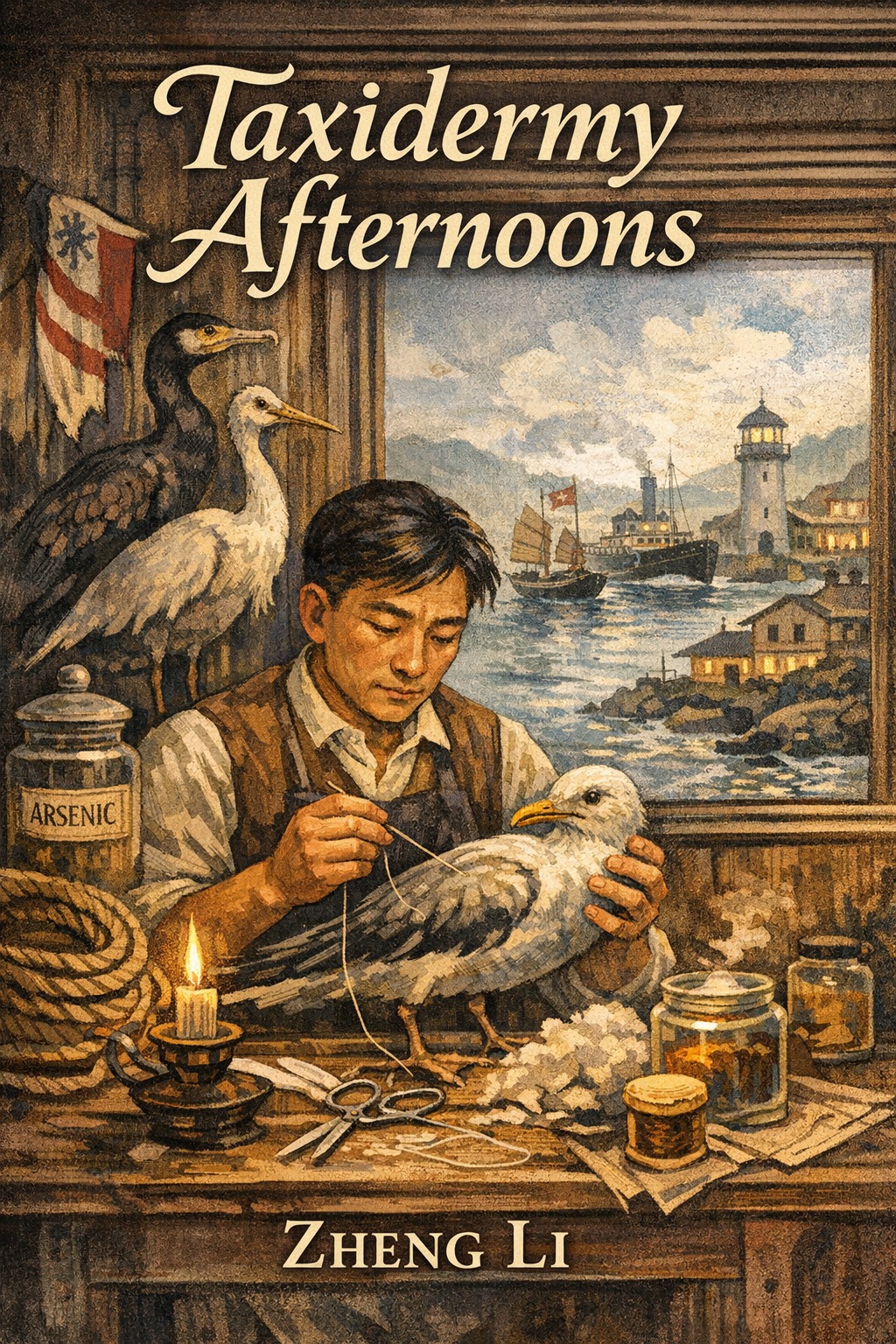
Photo of Zheng Li

Li Zheng (b. 1969, Quanzhou) is a historian of maritime Asia whose work explores port cities, cartography, and everyday life along coastal frontiers. He earned a B.A. in history from Peking University and a Ph.D. in Asian history with a focus on seaborne networks, and has held teaching and research posts in Hong Kong and Singapore. He mines lighthouse logs, hydrographic surveys, ship registers, and customs archives across East Asia and Europe, and frequently partners with local museums to record oral histories from shipwrights, pilots, and preparators. His writing ranges from peer‑reviewed studies to narrative histories for general readers, including Fading Horizons, which examined coastal governance and informal trade across Qing and colonial boundaries.

Li Zheng lives between Xiamen and Hong Kong, balancing months in archives with fieldwork on smaller islands. He travels by local ferries to lighthouse islets to interview keepers' families, photograph weathered specimen labels, and survey derelict quarantine stations. He collaborates with institutions in Quanzhou, Hong Kong, and Singapore on cataloging projects and community exhibitions, and mentors students working with Chinese Maritime Customs records alongside Portuguese, Malay, and Hokkien sources.

Ratings & Reviews

Hernan Valdez
2026-06-10

Para estudiantes y docentes de historia marítima, museología y estudios coloniales, este libro es una apuesta segura. Útil en cursos sobre Asia marítima, archivos y ciencia imperial, con mapas y notas que orientan y un glosario de topónimos que evita pérdidas. Advertencias de contenido: enfermedad y cuarentena, bombardeos en 1937, ocupación japonesa, descripciones de taxidermia. Recomendado para clubes de lectura en museos locales y para bibliotecas públicas que atienden a comunidades costeras.

Rina Matsuo
2026-04-07

The figures who pass through these rooms are not grand protagonists, and that is the point. Chen A-Kui's translations, keepers' families hauling nets, and a Hokkien widow mounting flying fish are presented through scraps of log entries and receipts, which Li patiently stitches into glimpses of motive, pride, and fatigue.

Rather than force voices, he lets the texture of lighthouse reports and missionary cabinets do the speaking. When pilots on Dongyin recall night signals or shipwrights explain the right wood for a drawer, the book honors craft without turning people into props.

Gareth O Shea
2026-02-28
  • Luminous sense of place along Min and Pearl coasts
  • Archival reach feels authoritative
  • Pacing bogs down in administrative exchanges
  • Taxonomy detours crowd out human voices

Worth reading, but I wanted tighter navigation between scenes and files.

Anita Koh
2026-01-15

The littoral is the protagonist here.

From the Ninepin Group to Pratas, the island stations come alive as observatories, homes, and collecting posts. Moonlit nets, red-waxed seals, and lighthouse oil share space with dragonflies and terns, and the quarantine lazaretto quietly counts rats and eels while flags sink into arguments about borders. By the time parcels travel from Pagoda Anchorage to Singapore and South Kensington, you feel how classification bleeds into surveillance and how that history shapes today's conservation debates.

Thomas Wain
2025-12-03

Li arranges his chapters like specimen drawers: labeled, compressed, and unexpectedly airy.

The prose toggles between scene and citation with a curator's eye, and even when a paragraph leans on acronyms and light dues arithmetic, the narrative soon returns to people at work with cotton, brass, and paper. A few transitions feel abrupt, but the cumulative structure is assured and the closing chapters land with calm authority.

Mei Lin
2025-11-12

What an astonishing history. I could almost smell camphor, arsenical soap, and damp rope rising from benches as Li, Zheng threads lighthouse logs and cargo lists into a living archive.

This is a book about technique turning into power, the moment "the living world slipped into files" and stayed there. I felt the tug of labels, the quiet pressure of calipers, and the tenderness of stitching that is never free of intent.

Swinhoe writing from Pagoda Anchorage, La Touche sorting waders by the Min River, and Chen A-Kui with a needle balanced between his teeth are rendered with electric clarity. The objects matter, glass eyes and bell jars and printed blanks that make sovereignty seem self-evident.

When the cabinets shatter in war and influenza empties a quarantine island, Li refuses simple elegy. He follows threads onto ferries and into community museums where phone cameras and eBird lists echo the old ledgers.

I finished and looked at my city's shoreline differently. Meticulous, humane, and quietly fierce, this book belongs on every shelf touched by salt.

Generated on 2026-07-25 12:02 UTC