Cover of Ravi Anand

Ravi Anand

Fiction · 312 pages · Published 2026-02-04 · Avg 3.7★ (6 reviews)

Ravi Anand never planned to be seen. For years he made his living at a Melbourne start-up that promised to tidy the internet: drafting apology templates, nudging search results, filing takedown notices between the Docklands light rail and a perpetually humming server room. Then a stray internal memo he wrote about "compassion thresholds" leaks, and Ravi, at fifty-eight, becomes a reluctant folk hero and villain at once. He is invited on ABC Radio Drive to explain decency. A current affairs show wants his thoughts on shame. An ex posts a photo of him in a shiny Brunswick cricket uniform and the comments melt into accusation and praise.

Ravi has survived a thousand tiny humiliations: a marriage dissolved at the Dandenong Registry Office, a father's corner shop sold under duress in suburban Perth, an inglorious sacking from a bank after a printer jam exposed everyone's KPIs, a karaoke incident in Fitzroy that became a meme. He has navigated WhatsApp family wars about biryani, an adult son who won't return texts, a rented terrace in West Footscray with a roof that weeps, and a pandemic that made the city sound like an empty tram looping Swanston Street at midnight.

Just as the spotlight hardens, an archivist from a community radio station in Fremantle calls with the question Ravi has been dodging since 1989. Back when he was a student volunteer with a tape recorder the size of a lunchbox, he captured a protest and promised to donate the audio to their collection. "Do you still have that tape?" she asks. He does. Somewhere between an old Myki card and a stack of Officeworks receipts.

Told in brisk vignettes—Slack pings, ethics committee forms, recipe cards rescued from a shoebox, CCTV screenshots, cricket email threads—Ravi attempts to assemble a ledger of what he owes and what is owed to him: favors, silences, edits, apologies. In a voice at once sardonic and tender, the novel roams from Perth cul-de-sacs to Melbourne sharehouses and back again, asking what we surrender to belong, and what it costs to be seen at last. Ravi hasn't been able to submit a clean record of himself—he's been too busy maintaining everyone else's.

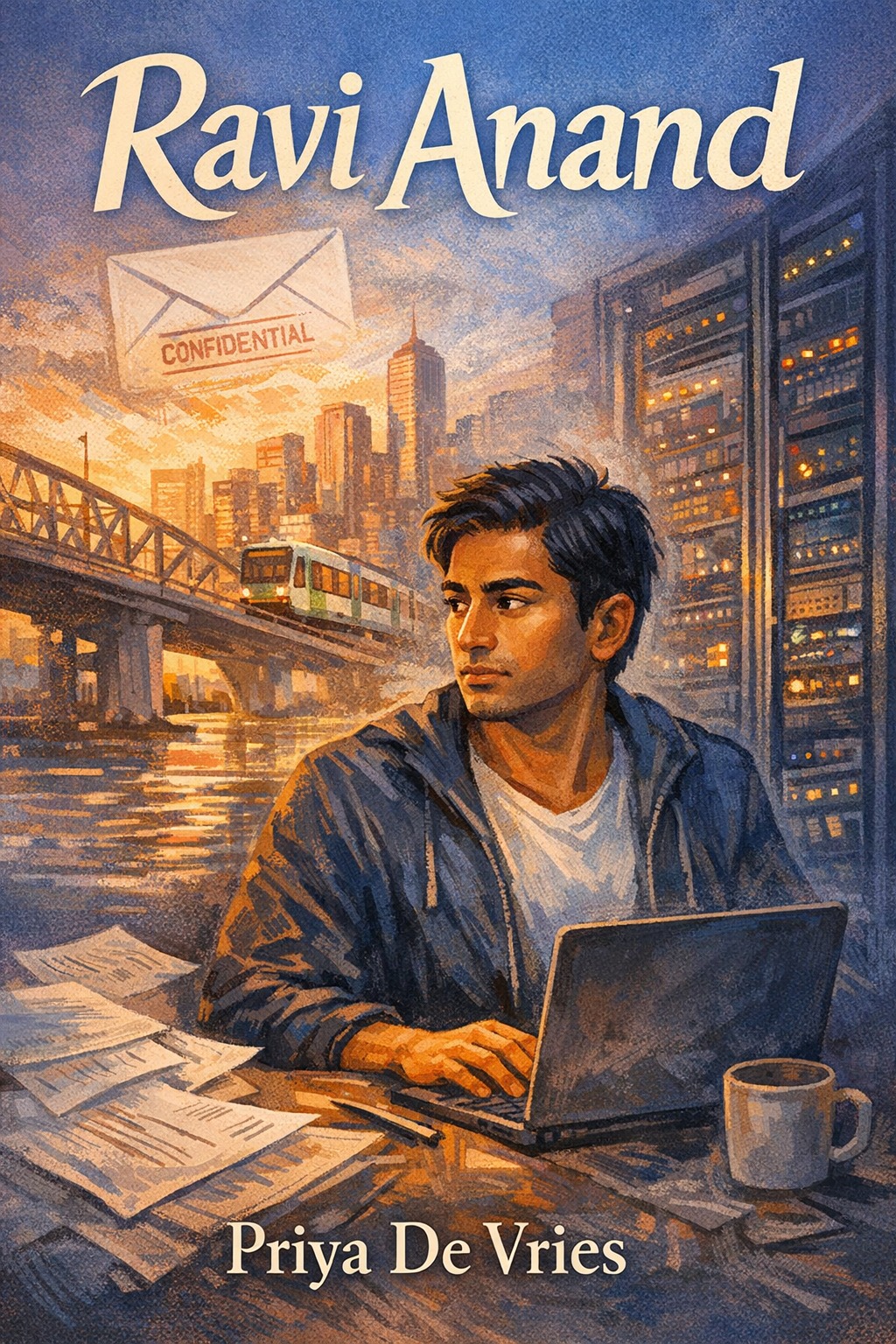
Photo of Priya De Vries

Priya De Vries is an Australian novelist and essayist whose work maps ambition, surveillance, performance, and the quiet bargains people make to belong. Born in Pietermaritzburg to a Dutch–South African father and an Indian mother, she migrated to Perth as a teenager and later studied sociology and creative writing at the University of Western Australia. She completed an MFA at Victoria University of Wellington. Her essays and short fiction have appeared in Meanjin, Overland, Griffith Review, and The Saturday Paper, and her stories have been shortlisted for the Peter Carey Short Story Award and longlisted for the Stella Prize.

Priya De Vries is the author of the novels The Algorithm of Forgetting, Glass Lantern Country, and Tall Poppies, works of fiction that blend keen social observation with an eye for the systems—digital and human—that govern intimacy and power. Alongside her novels, she writes criticism and teaches narrative design at RMIT, where she mentors writers interested in hybrid forms and contemporary life online. She volunteers with PEN Melbourne and lives in Brunswick with her partner and an elderly whippet. She is at work on a collection about work and desire, continuing her interest in how ordinary people negotiate visibility, privacy, and care.

Ratings & Reviews

Asha McKinnon
2026-07-18

For readers who like humane tech-adjacent fiction that thinks about decency without sermonizing.

  • Melbourne specificity, from Docklands light rail to West Footscray rain
  • Nonlinear vignettes that reward attention
  • Occasional admin-jargon drag in the middle
  • Gentle wit over spectacle, steady afterglow
Gareth Noon
2026-06-12

A wry, tender collage of Melbourne life in which a leaked memo and a long-buried protest tape force a fixer to audit himself, humming with the same quiet electricity as that server room.

Eleanor Chiu
2026-05-05

I wanted a novel about accountability; instead I got a scrapbook that keeps winking and wagging its finger at the same time. The radio invites, the current affairs segments, the internet-cleanup gig — all ripe material, yet the book treats outrage like background Muzak.

When Ravi's memo leaks, we're told this is a cultural flashpoint, but the pages retreat into clever fragments. I kept waiting for the promised "thresholds of compassion" to become more than a slogan about etiquette and optics.

The collage can be lively, sure, but here it often feels like camouflage. Slack pings and forms pile up until the people flatten, and the supposed "ledger of debts and surrenders" reads like a spreadsheet annotated with sighs.

The family threads — WhatsApp fights about biryani, a son who won't text back — arrive as gestures rather than wounds. If shame is the currency, I needed to feel its cost, not just its receipt numbers.

I'm frustrated because the novel keeps insisting it's asking hard questions while standing politely at the doorway. No, just no.

Lucía Ortega
2026-04-10

La ciudad es protagonista: Docklands con su sala de servidores, West Footscray con un techo que llora, el tranvía nocturno como un latido; y luego Fremantle, la cinta prometida que vuelve como pregunta. La atmósfera está muy lograda y el tono irónico-tierno funciona, pero a ratos las viñetas se sienten dispersas y la inercia del collage tapa las apuestas emocionales. Aun así, la geografía moral y urbana de Ravi deja un eco interesante.

Sanjay Pillai
2026-03-02

What kept me rapt was Ravi himself, fifty-eight and allergic to attention, trying to make a moral ledger while the world turns him into mascot or villain. The small humiliations pile up — the Brunswick cricket photo, the karaoke clip that became a meme, the son who ghosts his texts — but he narrates them with an unsentimental wit that never hides the bruise. Even the phone calls and email threads feel like conversations with a man who has trained himself to apologize before anyone asks.

I believed him, even when he didn't believe himself.

Maya Corcoran
2026-02-15

The collage form suits Ravi's almost-invisible career: apology templates, Slack pings, ethics forms, recipe cards from a shoebox, CCTV stills, and cricket email threads accrete into a sly, kinetic rhythm. The leak and the long-lost tape keep the book pulsing while the chapters hop from Perth cul-de-sacs to Docklands server hum with assurance. Occasionally the administrative texture crowds the page and a scene feels like a case file, but the voice stays dry and humane. The structure trusts us to connect the edits and omissions, and that trust pays off in sharp, quiet turns rather than fireworks.

Generated on 2026-07-22 12:02 UTC