
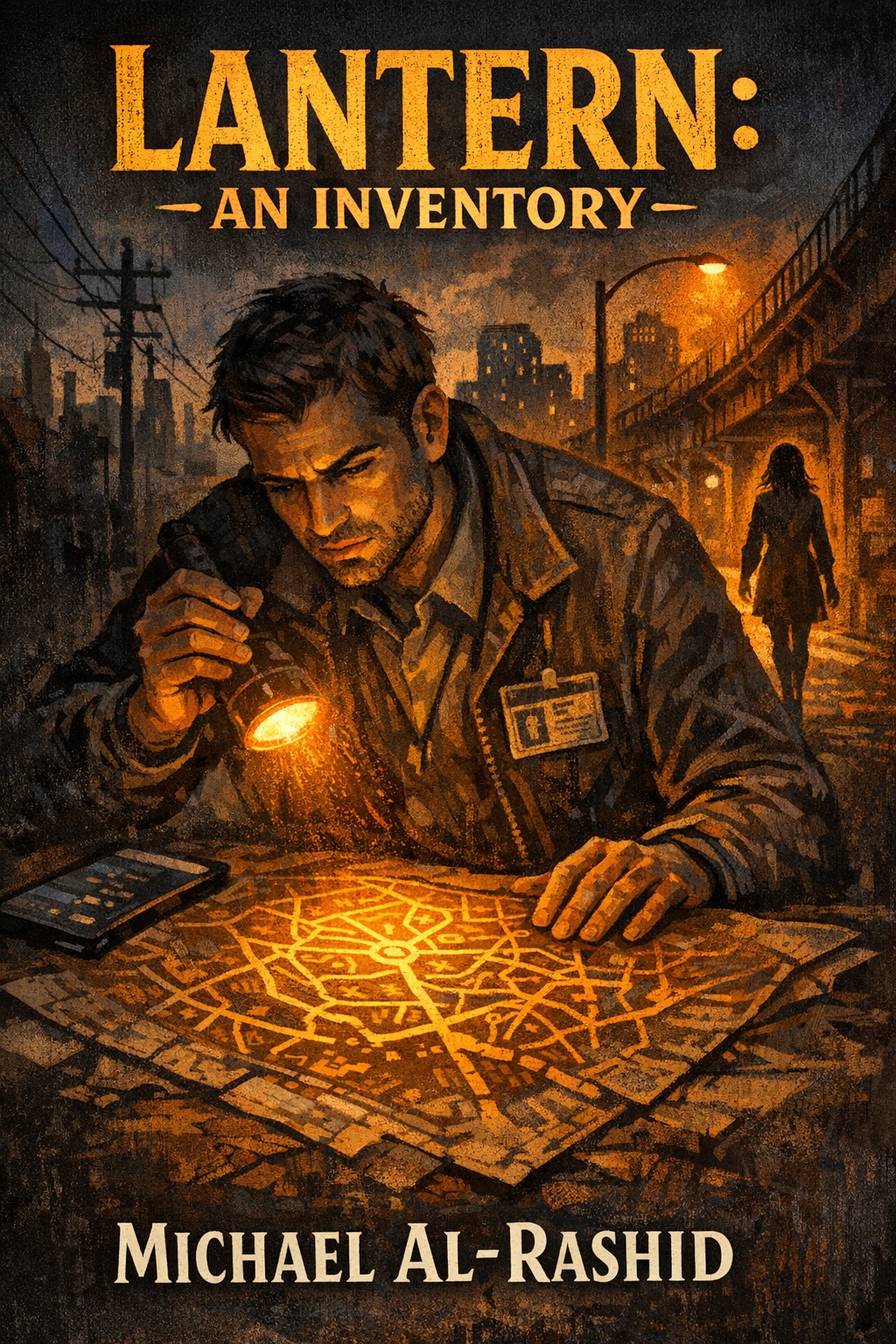

Cover of Lantern: An Inventory

Lantern: An Inventory

Thriller · 352 pages · Published 2025-04-22 · Avg 3.7★ (6 reviews)

An alternate map of the city can be read only under a sodium lamp. Who are you? What have we built around each other? These are the questions Elias Kazmi faces on the morning after a blackout drill when his co-worker, Mara Vega, vanishes from a Queens Boulevard field audit and the inventory tablet she carried turns up wiped. The NYPD suspects Elias. Mara's friends at the Department of Transportation say she was afraid of him, that she said he was following her on G train platforms and down Rivington Street. He swears it isn't true. A forensic scrape of his work laptop shows strange downloads—substation schematics, ferry timetables, a folder labeled "lanterns". He says the files aren't his. And then there are the insistent calls to his prepaid phone, the ones that light up 917 numbers and die before he can answer. So what did happen to Mara Vega, and why do the barcodes in the city's streetlights not match the night?

Photo of Michael Al-Rashid

Michael Al-Rashid is a journalist and urban planner whose work explores how cities reveal our private lives in public. Born in Dearborn, Michigan, he studied engineering at Wayne State University before earning a master's in urban planning from Columbia and a journalism degree from NYU. He reports on housing, public space, and civic conflict, and also writes fiction that turns the mechanics of urban systems into intimate, high-pressure stories.

His reporting has appeared in City Limits, The Atlantic, and The Guardian, and he has consulted on community engagement for small cities across the Northeast. A recipient of the Urban Reporting Fellowship from the Metro Policy Lab and a Front Page Award for feature writing, he is the author of the nonfiction works Sidewalk Atlas, Metered, and Last Rites for Bleecker. His fiction, including the thriller Lantern: An Inventory, extends his preoccupations with infrastructure, surveillance, and neighborhood memory into narrative form.

Michael Al-Rashid teaches adjunct courses in participatory planning at Pratt Institute and lives in Brooklyn with his partner and an elderly rescue mutt that insists on walking the long way home.

Ratings & Reviews

Patrice Monroe
2026-06-28

For readers who enjoy infrastructure-forward thrillers — think policy memos, site audits, and the way a streetlight can be a clue — this will scratch the itch. For my general-fiction crowd, the cool tone and dense procedural detail may feel remote, and the persistent ambiguity around the allegations and the wiped tablet offers theme over catharsis. Content notes for stalking claims, police interviews, blackout-drill anxiety, and sustained surveillance stress.

Lucía Cabrera
2026-03-03

Intriga urbana que convierte lámparas de sodio, códigos de barras y andenes del G en pistas, mientras Elias duda de sí mismo y de una ciudad que se pliega en mapas secretos.

Arturo Blaine
2026-01-15
  • Strong, eerie atmosphere from Queens sidewalks to ferry slips
  • Compelling uncertainty around Elias, the downloads, and the 917 calls
  • Middle third lingers on audit minutiae and slows momentum
  • Ambiguous resolutions fit the theme but left me more admiring than moved
Mei Lin Chau
2025-11-07

Craft-wise, this is sharp. The author leans into procedural texture — inspections, wiped devices, careful timestamps — and cuts between Elias's tight interiority and cool documentary surfaces; that friction keeps the heat on. A few transitions land with a thud, but the prose has a taut, metallic clarity that suits a story about light sources and the lies they expose.

Darius Kovacs
2025-08-19

The worldbuilding is electric: a New York that only reveals its true routes under sodium lamps, where streetlight barcodes and ferry clocks whisper a second grid beneath the visible one. Queens Boulevard audits, G train platforms, and those aborted 917 calls knit into a shadow-cartography that feels both plausible and uncanny, and the stakes stay personal without losing the city‑scale shiver.

Shyla Menon
2025-05-02

I finished Lantern: An Inventory at 2 a.m., lights off, feeling like the city outside my window had rearranged itself. The book keeps returning to that aching refrain, "Who are you?", and somehow it makes the question feel municipal as much as personal.

This is a thriller about the infrastructure of trust. The sodium lamp trick, the barcodes that don't match the night, the way an inventory tablet can become a confession — it all hums with menace and wonder.

Elias insists on his innocence while the evidence behaves like a bad mirror. The forensic scrape, the ferry timetables, the folder named "lanterns" — every detail clicks into the story's deeper argument about systems that define us whether or not we notice.

And the streets feel haunted in the best way: Queens Boulevard, the G platforms, Rivington, all of it filmed in amber light where maps and selves refuse to align. The unanswered 917 calls kept my nerves skittering.

I'm thrilled by how precise and humane this is. It's rare to find a book that interrogates identity, surveillance, and care with such voltage — I was buzzing long after the last page.

Generated on 2026-07-21 12:04 UTC