Cover of Hourglass: A Fable

Hourglass: A Fable

Nonfiction · 304 pages · Published 2024-11-05 · Avg 4.2★ (6 reviews)

A meditation on time, trust, and the tensile thread between care and release, Hourglass: A Fable follows essayist and amateur horologist Nikolai Larsson through a single year on Sweden's southeast coast, where a handmade sandglass and a wayward raven teach him how to measure days by more than clocks. When a spring gale tears through Österlen in April 2021, Larsson brakes hard outside Brantevik to avoid a black knot in the road—a fledgling raven, damp and stunned, blinking as though the world had shown up too quickly. He carries it home in his wool cap, lines a crate with an old flannel shirt, and begins to learn, by trial and error, the rituals of keeping a wild creature alive without unmanning it: soaked grains and minced herring delivered by syringe, quiet minutes in the dim pantry to slow the bird's thudding heart, and walks at dusk along the lichen-bright walls near Stenshuvud while the fledgling clambers from his shoulder to his head, testing height with every hop.

He names the raven Sot for its soot-black gloss and its habit of stealing the warmest thing in the room. Sot raids the windowsill for bottle caps, dismantles a wristwatch on the kitchen table, and trains Larsson to hear the difference between a warning croak and the soft conversational clicks meant only for a chosen companion. Determined that the bird remain free, he keeps the doors unlatched. Sot lifts to the ash tree, then the power line, then—one mid-June noon—to the thermals over Hammar's low cliffs, leaving behind a scatter of feathers and a spoon dragged beneath the stove. Some evenings, uncalled, the raven returns to tap the pane with a coin or a gull-bright shard; more often he does not. Larsson learns to hold both possibilities at once: the joy of a shadow spilling down from cloud, and the ache of an empty sill. To tether the bird would be its own diminishment; to love it requires an attention that refuses ownership.

Threaded through this account are forays into the textures and histories of corvids and timekeeping: Norse tales of Huginn and Muninn, Sámi drums where birds mark passage and omen, fieldwork with Dr. Elin Sjöström of Lund University banding jays in oak woods near Dalby, and the obstinate craft of blowing glass in Ystad to shape an hourglass whose sand is taken—grain by amber grain—from the wind-loud dunes at Sandhammaren. Larsson turns to poets and physicists, to farm ledgers and migration maps, asking what our instruments can and cannot hold. In the end, it is the raven's rasp, not the sand's fall, that becomes the truest metronome: a sound that arrives when it will, an hour that keeps its own counsel, a lesson in how to count by letting go.

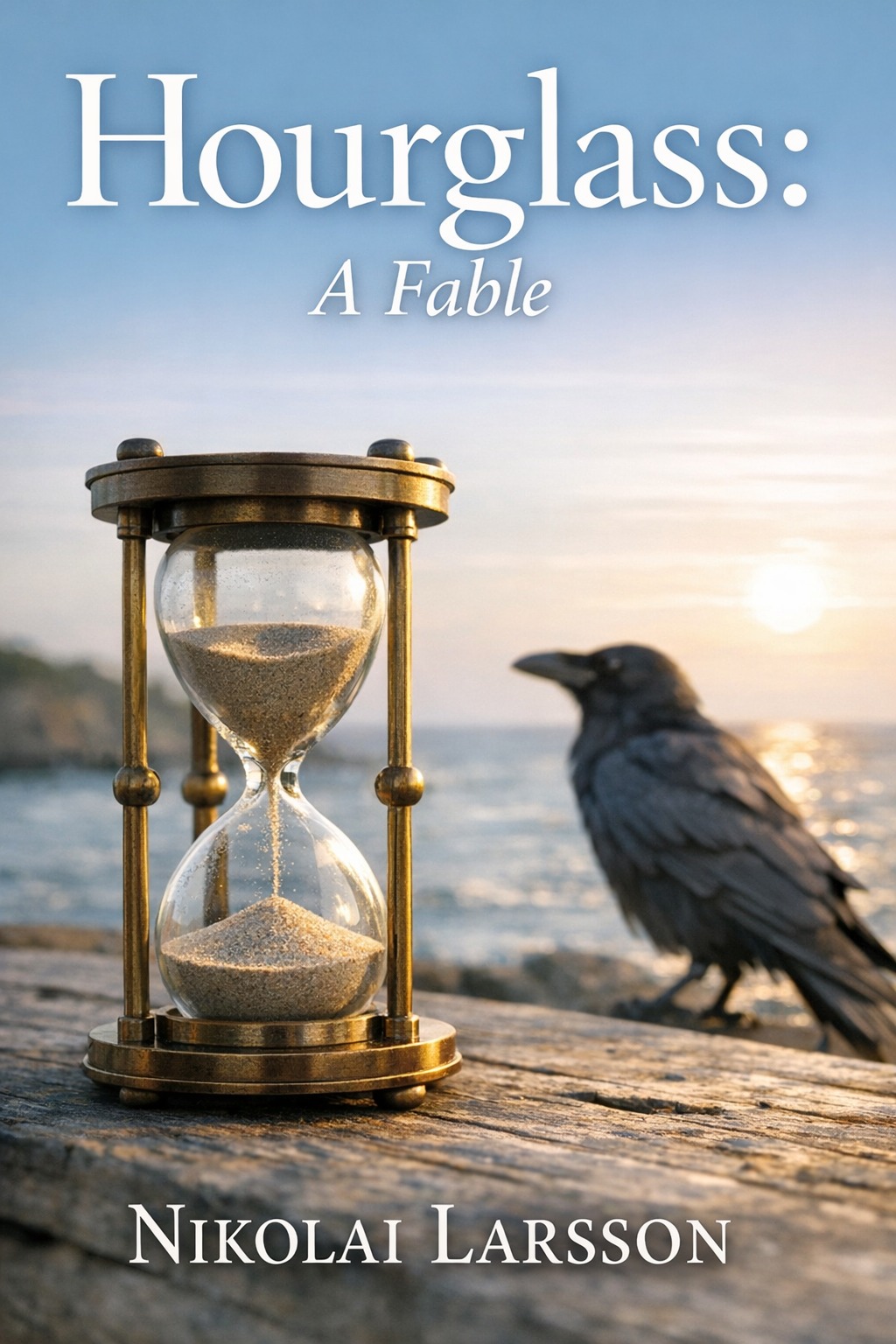
Photo of Nikolai Larsson

Nikolai Larsson is a Swedish essayist and translator whose work explores the edges where craft, ecology, and memory meet. Raised in Västerbotten and trained in literature at Lund University, he later apprenticed with a clockmaker in Ystad, a detour that shaped his enduring fascination with the human urge to domesticate time. His essays have appeared in Dagens Nyheter, Granta Scandinavia, and Ord & Bild, and his reporting on coastal erosion in Skåne earned him the Publicistklubben's Culture Prize in 2019.

Larsson is the author of Sea of Bearings (2017), a collection of coastal vignettes, and The Silence of Pendulums (2020), a short treatise on timekeeping and attention. In 2022 he received a residency at Baltic Art Center on Gotland to study historical glass and shoreline geomorphology. He lives in Malmö with his partner and an elderly rescue spaniel, volunteers with wildlife rehabilitators in Skåne, and divides his days between a desk, a workbench strewn with brass filings, and long walks along the dunes at Sandhammaren.

Ratings & Reviews

Sofia Lindholm
2026-07-10

Stillsam, saltmättad och exakt, denna bok låter en korp och ett timglas visa hur omsorg kräver öppna dörrar och hur dagar kan mätas bortom klockor.

Anika Persson
2026-05-02

As a portrait of relationship, this is astonishingly careful. Larsson's interiority is honest but never showy, tuned to the fine-grained work of noticing without claiming, and Sot is rendered not as a pet but as a presence whose agency keeps recalibrating the space between them.

The small signals carry the weight: the conversational clicks, the coin at the pane, the decision to keep doors unlatched even when it hurts. That ethic of attention becomes character in itself, and by the end I trusted it as much as any plot.

Omar Haddad
2026-01-15

Think Lyanda Lynn Haupt meets Kathleen Jamie: a quiet, observant year where attention itself becomes the event. The corvid anecdotes, the Ystad glass shop, and the side trips to migration maps and farm ledgers make a textured companion for readers of reflective natural history, and while a couple of scholarly asides linger a beat too long, the final resonance is tender and precise.

Jiang Wenlu
2025-08-20
  • Lyrical field notes and sharp raven facts
  • Lush coast atmosphere around Österlen
  • Repetitive sand metaphors across chapters
  • Meandering middle that blurs urgency
Clare Donnelly
2025-03-08

This book cracked open my sense of time in the gentlest possible way and then filled it with wing-noise and salt air. I kept stopping to breathe, because the sentences ask you to be as deliberate as a hand tipping an hourglass.

The scenes are so intimate without ever feeling invasive: a damp fledgling blinking in a wool cap, syringe feedings in a pantry made into a dim sanctuary, those dusk walks along lichen-bright walls while a young raven tests height by hopping from shoulder to head. I could hear the clicks, the soft private speech of trust.

And then the craft of the hourglass itself, sand carried from Sandhammaren and lungs learning how to shape heat into glass. The history is not padding here; it's a counterweight. Norse stories, a Sámi drum face, a morning banding jays near Dalby with cold fingers and bright tags. Every strand feels earned.

What moved me most was Larsson's practice of care without possession, a discipline of leaving the door unlatched and learning to live with the ache of an empty sill. He names what so many of us fumble toward as caregivers and friends: "counting by letting go."

I finished in a hush and wanted to step outside immediately, to listen for a croak, to notice the small coin-tap of the world asking to be seen. Five stars, and if I could tilt the glass again for another hour with it, I would.

Malcolm Rivera
2024-11-12

Larsson's year-by-the-sea is arranged as a braided essay, toggling between close observation of Sot and lucid excursions into corvid lore, timekeeping, and glasswork; the structure gives the book a tidal pulse that suits its subject. The prose is spare and tactile, with images of grain, wing, and light returning like motifs, though a few physics digressions and the finer points of glass-blowing occasionally slow the current before the narrative lifts again whenever the raven interrupts the clock.

Generated on 2026-07-17 12:02 UTC