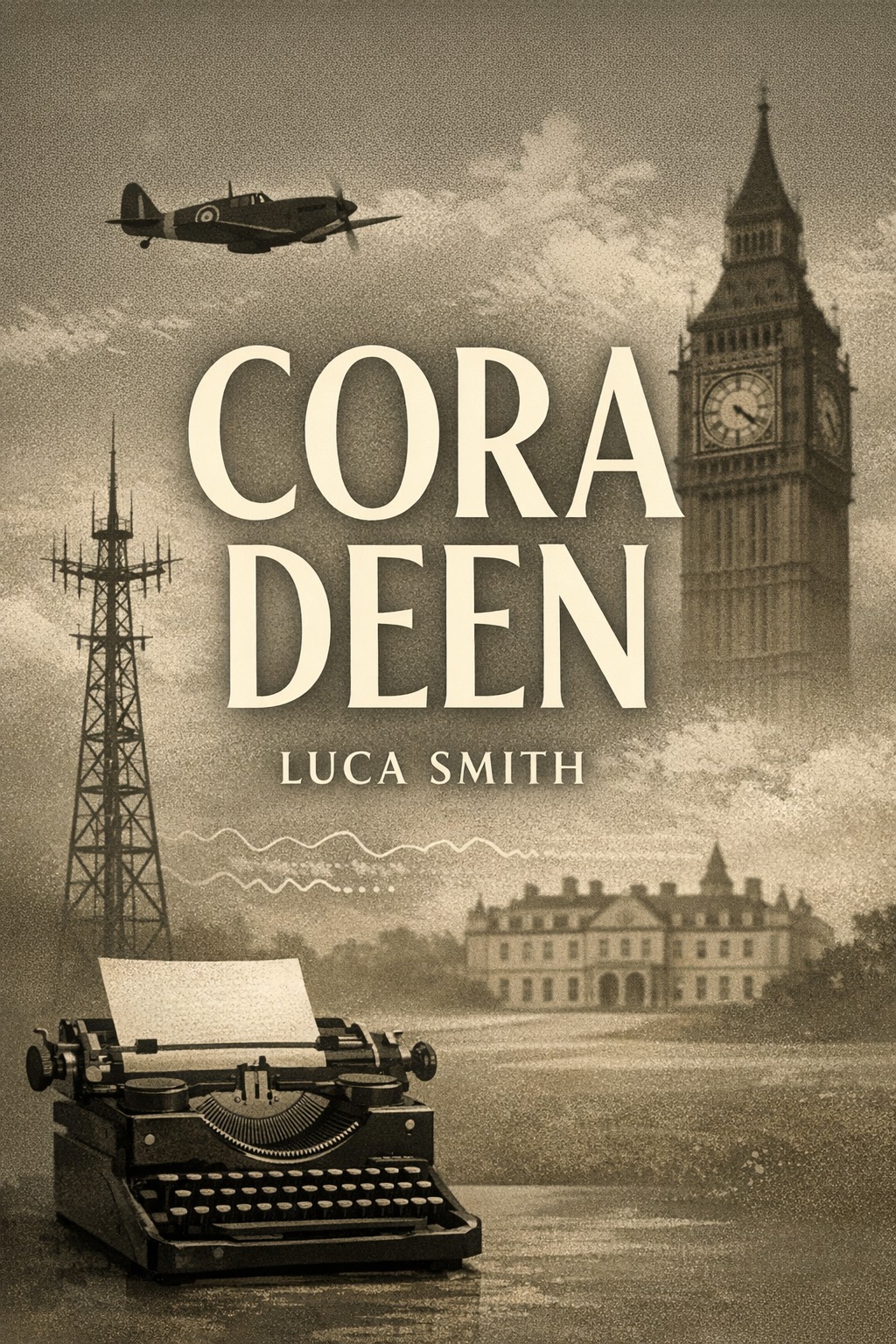
Cover of Cora Deen

Cora Deen

Historical Fiction · 448 pages · Published 2024-11-12 · Avg 3.8★ (6 reviews)
  1. As masts rise like black needles over Britain and the BBC seizes Caversham Park for its Monitoring Service, three women step into a world of voices and vanishing ink. Cora Deen, a quiet court stenographer from Margate with perfect pitch and the patience to hear a lie in a breath, is recruited to copy hostile radio traffic on a Remington Noiseless while her fingers dance over GPO teleprinters. Leena Vaher, an Estonian refugee with fluent German and a suitcase of banned poems, translates propaganda from Berlin and Rome, clipping it to blue foolscap with rusted paperclips. Moira Kellett, a steel-nerved draughtswoman from Sheffield who can repair a Marconi CR100 with a hairpin, rebuilds blacked-out receivers and keeps a ledger of call signs in a grease-smudged notebook. In a windowless room beneath the ballroom—where an Eddystone receiver hums and a Hallicrafters SX-28 spits static—they begin to notice a nursery rhyme cadence threaded through innocuous weather bulletins from Norddeich Radio and Belgrade, a numbers-poem that seems to steer U-boats like wolves along the Channel. Cora is drawn into the orbit of Julian Ware, a smiling Admiralty liaison with a handcuffed briefcase and a fondness for Lyons Corner House cakes, who promises her that their work will save lives. But a botched midnight intercept—part tip, part trap—diverts a convoy into a killing ground off Hartland Point, and the silence that follows bites as deep as winter. Suspicions bloom; a sealed deposition disappears from a safe, Leena vanishes after an air raid on Reading, and Moira buries her rage under the Official Secrets Act and a stack of bridge blueprints. The trio shatters, and the echo of their betrayal thrums in the cables they once trusted.

  2. With coronation bunting fluttering on every lamppost from Blackfriars Bridge to Berwick Street, Cora teaches shorthand to girls who have never heard the word blackout. Then a biscuit tin tied with baker's twine appears on her doorstep, holding a spool of wire recording and a torn page from Moira's old ledger: a string of coordinates, a doodled crown, and a single penciled word—Hexham. The wire, when threaded onto a borrowed Webster-Chicago machine, crackles with a waltz from Radio Belgrade that dissolves into a child's counting rhyme, the exact cadence that haunted Caversham's nights. Another scrap, postmarked from a nurses' registry near Warley, hints that Leena lives—misnamed, sedated, and jailed by diagnosis. Cora rides the milk train to London, slipping through fog and into a private ward where a kind-eyed switchboard operator, Ada Sykes, helps her pry Leena from a door labeled Moral Management. They find Moira on the Tyne, sleeves rolled, drawing turbine halls by lamplight; she admits she too has received envelopes stamped with an unfamiliar crest and a list of Admiralty call signs that should have died with the war. The traitor their ears once grazed has resurfaced beneath a company called Kingsmere Export, buying surplus wireless sets to smuggle blueprints and names via coded shipping forecasts on the Light Programme. To unmask him, Cora, Leena, and Moira resurrect old arts: voiceprints traced from wire loops with wax pencils, grease-pencil rings on acetate discs, postcard books of the coronation route used as one-time pads. Bowler-hatted men trail them along the Embankment; a polished shoe waits beneath a public telephone in Soho; and the name that rises from the static is not only Julian's, but a knighted superior whose signature they once copied without question. Each step pulls them back to the Map Room under Caversham's ballroom, where a temperamental machine they christened the "Echo" still ticks, spooling secrets no one recalled to burn. In a city crowned and rain-washed, the last broadcast they stage is both trap and testimony—and Cora Deen must choose between the safety of silence and the dangerous clarity of being heard at last.

Photo of Luca Smith

Luca Smith is a British-Italian novelist and former radio producer. Raised in Leeds and Rome, Smith studied history at the University of St Andrews before working with archival audio at a community station in North Yorkshire. The obsession with forgotten frequencies and everyday courage informs Smith's historical fiction, including the acclaimed debut The Salt Drawers and the follow-up Ash & Aerials.

Smith's essays have appeared in small magazines and on BBC Radio 4 documentaries, and short fiction has been shortlisted for the Costa Short Story Award and the Bridport Prize. When not writing, Luca Smith volunteers digitizing oral histories and teaches evening classes on narrative craft. Smith lives in Brighton with a partner, an elderly cat named Barclay, and shelves of valve radios rescued from car boot sales.

Ratings & Reviews

Elspeth Moore
2026-03-30
  • Gorgeous radio lore and tactile detail
  • Pacing sags after the Hartland Point sequence
  • Antagonist's reappearance feels telegraphed
  • Emotional payoff muted until the staged broadcast
R. K. Mahoney
2026-02-17

The book's world hums like a tuned set. From Caversham's commandeered rooms to the faint hiss of a Hallicrafters SX-28, the technical atmosphere is immersive without fetish. I could smell hot dust on valves and see the pencil rings tightening around call signs.

That same density sometimes crowds out momentum. The Light Programme gambits and the Kingsmere Export scaffolding are convincing, yet a handful of scenes pause to admire their own kit. When the story moves, it moves with authority, particularly in the Map Room and in the ward where a single locked door says everything about the era's cruelties.

Owen Pettifer
2025-11-03

As craft, this is admirable historical fiction that understands circuitry and sentence both. The split timeline is handled with restraint; the 1953 sections counterbalance the early war fever. Chapters are cut to the beat of intercepts and handoffs, with tidy scene exits that feel like clipped teleprinter tape. A few expository passages over-annotate equipment already made clear by context, and the closing orchestration tidies one thread too swiftly, but the line-by-line control and acoustic imagery are consistently sharp.

Saira Dutt
2025-06-28

Cora's ear for breath and lie, Leena's fierce poise wrapped around a suitcase of poems, and Moira's stubborn grace with wire and grease fuse into a friendship that splinters, aches, and rethreads itself until the final signal demands they choose the person they will be.

Lucia Benítez
2025-04-10

Historia de espías íntima que recuerda a "The Secrets We Kept" de Lara Prescott y, por su melancolía sobria, a Charlotte Philby. La combinación de Caversham, los receptores rebeldes y la resurrección de viejos oficios crea una atmósfera singular, y la transición a 1953 aporta un contrapunto humano. Si buscas intriga con oído fino y mujeres que leen el mundo a través de cables, aquí hay recompensa.

Nadia Green
2025-01-15

Cora Deen tunes its heart to the frequency of witness, and it thrums. The book hears what others miss, catching the hush between syllables, the paper-squeak of a ribbon at the edge of ink, the terrible music of coded weather.

I was lit up by the way the author insists on the dignity of painstaking work: transcription, translation, soldering, splicing. That commitment turns into moral pressure, so when the old cadence returns, it is not a puzzle-box gimmick but a reckoning. The quoted phrase "voices and vanishing ink" could have been a flourish; here, it is a promise the story keeps.

The years pivot cleanly from blackout to bunting. The Coronation streets gleam, yet the Map Room's stale air still clings to Cora's clothes, and the wire reel in the biscuit tin crackles like a revenant. Julian's public charm set against private signals made my stomach drop in exactly the way wartime euphemism is meant to.

Every texture feels earned: Remington keys like rain on slate, a hairpin bite in a stubborn chassis, grease pencil circles tightening around a voice. The Echo machine is the novel's metronome, ticking until the truth finds breath.

By the final broadcast, I had that rare jolt of recognition and courage. This story sings about work, friendship, and the cost of audibility, and I wanted to stand up and cheer.

Generated on 2026-07-12 12:02 UTC