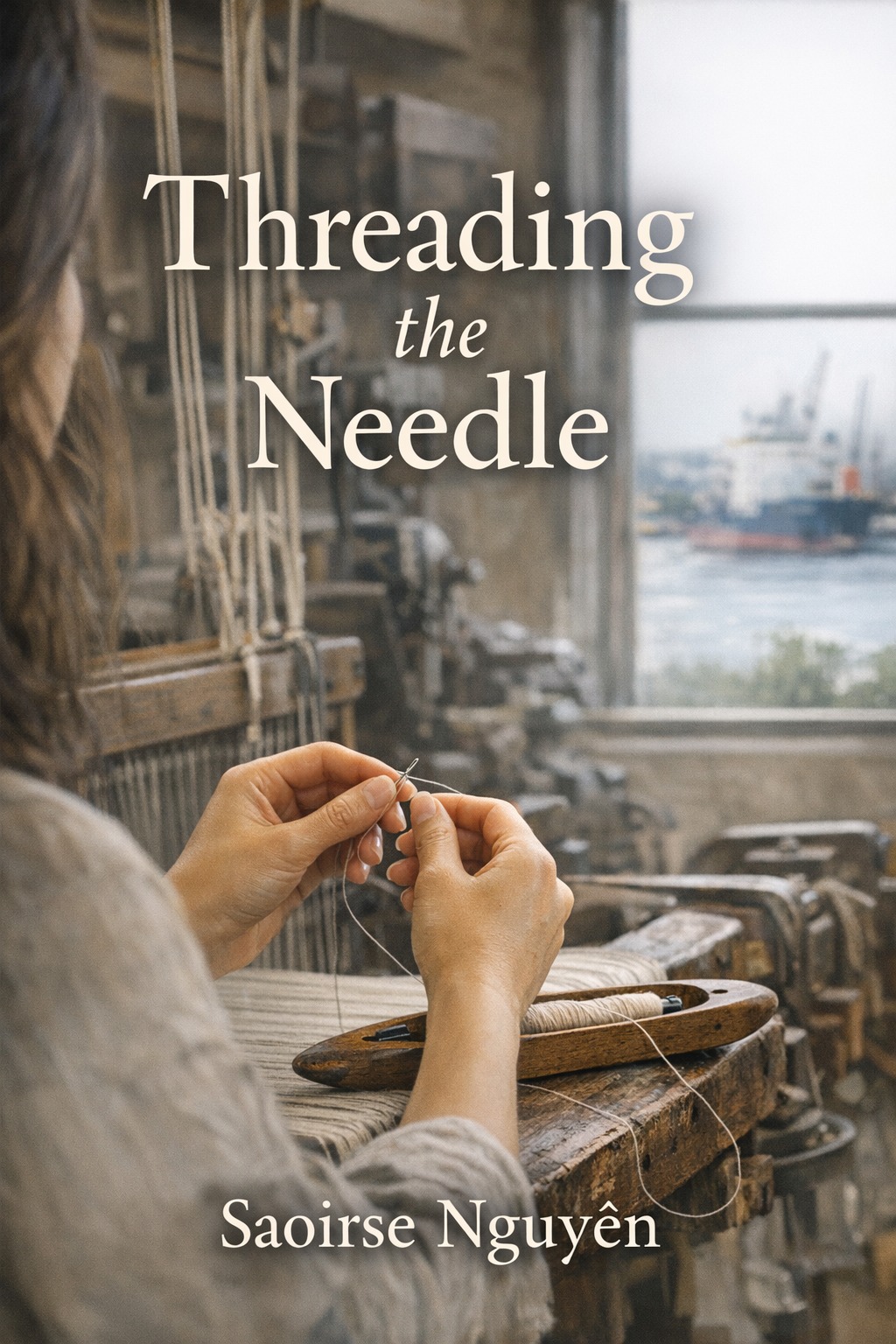
A meticulous novel with a few snags.
- luminous textural detail
- occasional chill in the voice
- middle-section repetition in archive scenes
- politics skews didactic in two spots
Still, the closing quiet reframes the stakes with grace.
Threading the Needle threads together the hush of a workshop and the noise of a changing world, following Mai Anh Phan, a restorer of antique looms at the Shandon Linen Museum in Cork, as a new trade regime ripples across two coastlines and closes old doors. When the Pacific Thread Accord standardizes stitches and stories alike, it values impeccable seams and punishes improvisation; motifs are cataloged, errant flourishes fined. Across the water in Hải Phòng, her aunt Hạnh, a revered seamstress in the Thanh Xuân Cooperative near Lạch Tray Stadium, begins tucking tiny histories into hem allowances: three knots for a disappeared neighbor, a running stitch that maps the Bến Nghé Canal, a border of rice grains for the lost harvest. The messages arrive with bolts of moss-green cotton at a warehouse off Penrose Quay, addressed to nobody and everyone. Mai finds them as she inspects a shipment by the light of a buzzing bulb, her fingers catching on a burr of thread.
From District 4 alleys scented with star anise to rain-streaked Eyre Square, Mai catalogs what she is meant to erase, smuggling errata into the museum's vitrines and into her own house on Barrack Street, where a Singer 99k hums beside a chipped blue thimble and a ledger with red margins. Her lover Siobhán works at Keane Textile Trust and believes in tidy archives; her cousin Bảo believes in untidy uprisings. Between them, Mai must decide whether to mend the fabric she has been given or unpick it altogether. In compressed, lucid scenes that can be cool-eyed, tender, despairing, passionate, and wry, the novel reveals the hard edges behind soft textures, as present-day tendencies are pulled taut to their logical ends. By turns sly, startling, and devastating, this is a satire with a heartbeat and a warning stitched in the selvedge.

A meticulous novel with a few snags.
Still, the closing quiet reframes the stakes with grace.
If you liked Sara Baume's A Line Made by Walking for its tactile attention to the ordinary, and Anakana Schofield's Martin John for its sly comedy edged with unease, this will sing to you. Mai's ledger and the museum vitrines scratch that itch for process and mind-at-work while the satire bites just enough to leave marks.
Perfect for readers who enjoy art-world ethics, small acts of defiance, and cities that feel lived-in rather than photographed.
Mai is a marvel of quiet resistance. You can hear her thinking in the way she touches cloth, tallying rules while her body remembers older rhythms. Siobhán is not a villain, just someone who cannot bear the mess of history on her neat desk, which makes their love scenes ache with tact rather than speech. Bảo is the spark that keeps the book from becoming purely curatorial, and Hạnh's presence arrives like scent before sight. Together they feel like a family arguing over the same bolt for different futures.
As craft, this is disciplined and sly. The chapters are short, lucid vignettes that swing from Barrack Street to District 4 without fanfare; the restraint is surgical. Dialogue lands with soft taps, like chalk on muslin, and the narrator's cool eye lets satire bloom in the margins. There are a few transitions that feel clipped, especially around the museum's policy shifts, but the accumulation is powerful. The final arrangement of motifs and scenes leaves a tensile afterimage.
Threading the Needle excels at place-making through touch and sound. Cork's rain, the buzz of a workroom bulb, the grain of moss-green cotton, and the shuffle at a warehouse off Penrose Quay meet Hải Phòng's cooperative floors, drumrolls from Lạch Tray Stadium, and alleys scented with star anise. The Accord's cold bureaucracy is never abstract; it is present in fines, in templates, in the small pause before a daring flourish.
The world feels stitched, not painted.
What a fierce, tender novel, humming like a Singer 99k and pricking like a pin! I started it for the museum lore and stayed for the ache of craft under pressure. Every page feels basted to the next with a care that refuses silence.
Mai learns to listen to fabric the way some people listen to weather. The Pacific Thread Accord tries to flatten story into standard, but the book keeps opening a seam for air and memory. I kept catching my breath when a burr of thread snagged her finger or a ledger line turned into a river.
The secret messages from Hải Phòng glow. Three knots for a neighbor, a running stitch that maps a canal, a tiny harvest along the border. They are both contraband and prayer, and they make the museum glass look suddenly thin.
The love and the arguments at home feel as charged as the shipments off Penrose Quay. Siobhán's faith in tidy archives and Bảo's faith in messy change collide in a chorus that sounds like cities at night.
By the end I felt steadied and alarmed at once, the way a sharp needle steadies cloth while it pierces it. This book is "a warning stitched into the selvedge", and it beats like a heart.