Cover of Pewter

Pewter

Thriller · 352 pages · Published 2025-10-21 · Avg 3.8★ (6 reviews)

Some metals don't rust—they remember. After a humiliating whistleblower case costs Orla Denning her job and her fiancé, she retreats to Pewter Key, a wind-scoured island off the coast of Maine, to empty her late father's lighthouse cottage. Officially, she's there to list the property. Unofficially, Pewter is where she plans to disappear.

But the island refuses to be quiet. At 4:07 a.m. each night, the weather radio crackles to life with coordinates that pinpoint the shoals east of the point. The brass barometer needle slams to storm and snaps back again. A dented pewter tankard keeps appearing on Orla's nightstand, beaded with seawater. And from the fog outside her door comes a voice—hoarse, urgent—calling her father's old nickname for her.

Delving into a box of Coast Guard logs and a salt-stiff ledger hidden beneath the hearthstone, Orla unearths the century-old wreck of the Hester Gray, a trawler that went down in 1899 with a cargo no one would admit existed. Names recur: Oona Bligh, a lighthouse keeper dismissed in disgrace; Clive March, a developer whose company, Marcliffe Energy, is quietly buying every deed on Pewter; and the Pewter Syndicate, a clandestine network that turned storms into smokescreens.

As Orla follows the trail—from the Rockland archives to a shuttered dive bar called the Tern & Tiller—she realizes the coordinates are not random. They draw a shape, point by point, a message traced on the water by women erased from the island's records. With a nor'easter bearing down and Marcliffe's private security closing in, Orla must choose between exposing a conspiracy her father helped bury and surviving the night. Pewter keeps its shine by tarnishing what holds it—metal, memory, and the living who dare touch it.

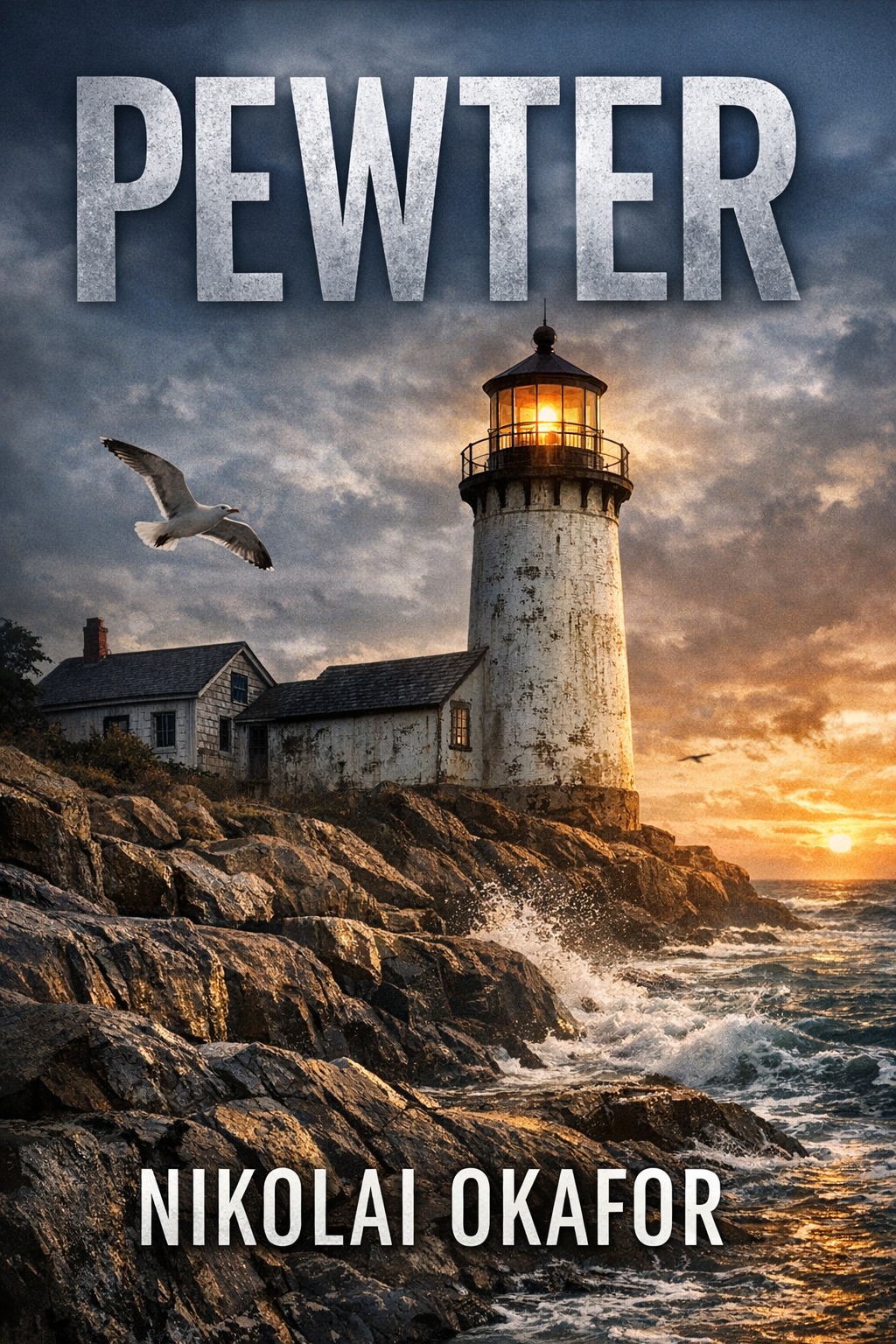
Photo of Nikolai Okafor

Nikolai Okafor is a Nigerian–Russian American novelist and former investigative journalist. Born in Port Harcourt and raised between St. Petersburg and New Bedford, Massachusetts, he studied journalism at Northeastern University and spent a decade covering courts and corruption along the New England coast. His reporting on maritime fraud and cold cases informs his fiction's briny atmospherics and razor-edged suspense.

He is the author of the thrillers Salt Workshop (2021) and Drowned Orchard (2023), and his short fiction has appeared in regional journals and anthologies. He has been honored with the North Atlantic Noir Prize and was a finalist for the Harbor Lights Thriller Award. When not writing, Nikolai Okafor volunteers with a search-and-rescue unit, tends a small garden of hardy herbs, and co-hosts the folklore podcast Grey Water. He lives in Providence, Rhode Island.

Ratings & Reviews

Grace Yamada
2026-06-17

For readers of coastal noir and conspiracy thrillers who like their chills grounded in weather, hardware, and archives, this hits the mark. I would suggest it to adults and mature teens who can handle storm peril, stalking, brief violence, grief, and corporate intimidation. Strong book club potential around whistleblowing ethics and how communities decide what to remember.

Marta Escudero
2026-04-28

I wanted a stormy thriller with bite, and the premise had me pacing. Whistleblower exiled to a Maine rock, a lighthouse inheritance, a radio that talks in the dead hours. Yes, please. But chapter after chapter, the novel swaps tension for symbolism that clangs.

The idea that metal holds memory is intriguing, yet it is underlined so hard that it left dents. The pewter cup shows up, again and again, like a stage cue. The needle leaps then resets on command. The weather feels less like threat and more like a lectern.

Themes of erasure and conspiracy matter, especially the pattern traced by women who were pushed off the ledger. Still, the coordinates drawing a picture on the water plays as schematic rather than uncanny. I needed mess, not connect-the-dots neatness.

Even the book's own promise gets overquoted. "Some metals do not rust, they remember" is a fine thought the first time, but by the fifth it is a slogan. I get it. Memory corrodes. People polish the past. Trust the reader.

There are sharp sentences and a few scenes that finally crack with danger, so I am not writing this in pure despair. I am just frustrated that the story keeps telling me what to see instead of letting the fog hide a little longer.

Colin Breslin
2026-03-05

Pewter Key feels cold, hard, and weirdly alive. Barometers twitch, the tankard beads with brine, and the radio spits out numbers that sketch the sea like a primitive plotter. The developer's quiet land buys rub against lobster traps and rusting rigs, giving the island an economy and a grudge. Every gust curls around the lighthouse glass so convincingly that you can smell the kelp.

The place becomes a character without tipping into fantasy.

Adriana Vo
2026-01-20

Orla is compelling because she is contradictory, a principled whistleblower who also wants to vanish. Her prickly talk with clerks in Rockland and the wary back-and-forth at the Tern & Tiller sketch a woman who trusts evidence more than people, even as the voice outside tempts her grief. The father-daughter undertow is strong without sentimentality, and when the island starts pushing back, her calculations feel human rather than heroic.

Jerome Patel
2025-12-14

Structure braids Coast Guard logs, ledger fragments, and present-tense stakeouts; the cutaways are disciplined and the reveals arrive with clean timing. A few mid-island scenes recycle the same dread, yet the line-by-line choices shine, with tactile verbs and crisp maritime detail. Orla's limited third person holds steady and the chapter breaks land like buoys that keep you oriented even as the fog thickens.

Nina Carmody
2025-11-02

A storm-haunted island, a whistleblower in exile, and a weather radio that speaks just past four each night make for a taut chase with salt in the wires. The final stretch turns the coordinates into a dare and I stayed tense until the last squall.

Generated on 2026-07-08 12:01 UTC