Cover of Tall Poppies

Tall Poppies

Fiction · 342 pages · Published 2025-03-04 · Avg 2.7★ (6 reviews)

Mara Iyer has made caution a habit. Risk officer at Halcyon Mutual, she rides the 7:13 a.m. Route 11, eats the same honeyed oats from the canteen, files reports that turn potential disasters into tidy bullet points. Beige cardigan, beige lunch, beige outlook. Melbourne glitters past the Docklands glass, but she does not look up. She does not notice how small she has made herself. Someone else does.

The first thing left for her is a plain envelope tucked beneath her chipped turquoise mug in the Level 17 kitchenette, sealed with a pressed red petal. Inside: a Polaroid of a lane behind Flinders Lane, an address scrawled in fountain-pen ink, and a single word: Bloom. Then the messages begin from a number saved on her phone by its sender as TALL. They know the brass shoehorn in her hallway, the dead spider plant on her balcony she keeps watering out of habit, the lullaby her mother hummed on the Western Express from Dadar to Churchgate. It feels impossible and intimate all at once. He starts asking for more.

One instruction. One step further. One line crossed after another. Skip the board meeting to stand under the stained-glass ceiling of the Nicholas Building at noon. Switch two nameplates at a gallery opening on Gertrude Street so the critic from The Age will rave for the wrong artist. Take the 11:21 p.m. Frankston line and leave a note taped under the third slatted bench at Platform 2. Drive out before dawn to a flower farm near Monbulk where poppies burn in frost-whitened rows, and wait among the stems as a drone hums overhead. With every act, the sender is there—gardener and blade—training her reach, testing the height of what she might dare.

Who is he? The councilman with the perfect tie knot at the ethics hearing, the registrar at Sable & Co. Gallery, the neighbor in the yellow raincoat who never meets her eyes? And more urgently: how far will Mara let the cutting go before the shears turn back on her? As a city of lanes and lightwells becomes a board of moves, Mara learns that standing tall invites not only awe, but aim. Note to reader: a small surprise waits between the chapters, pressed flat like a secret petal. Keep it safe.

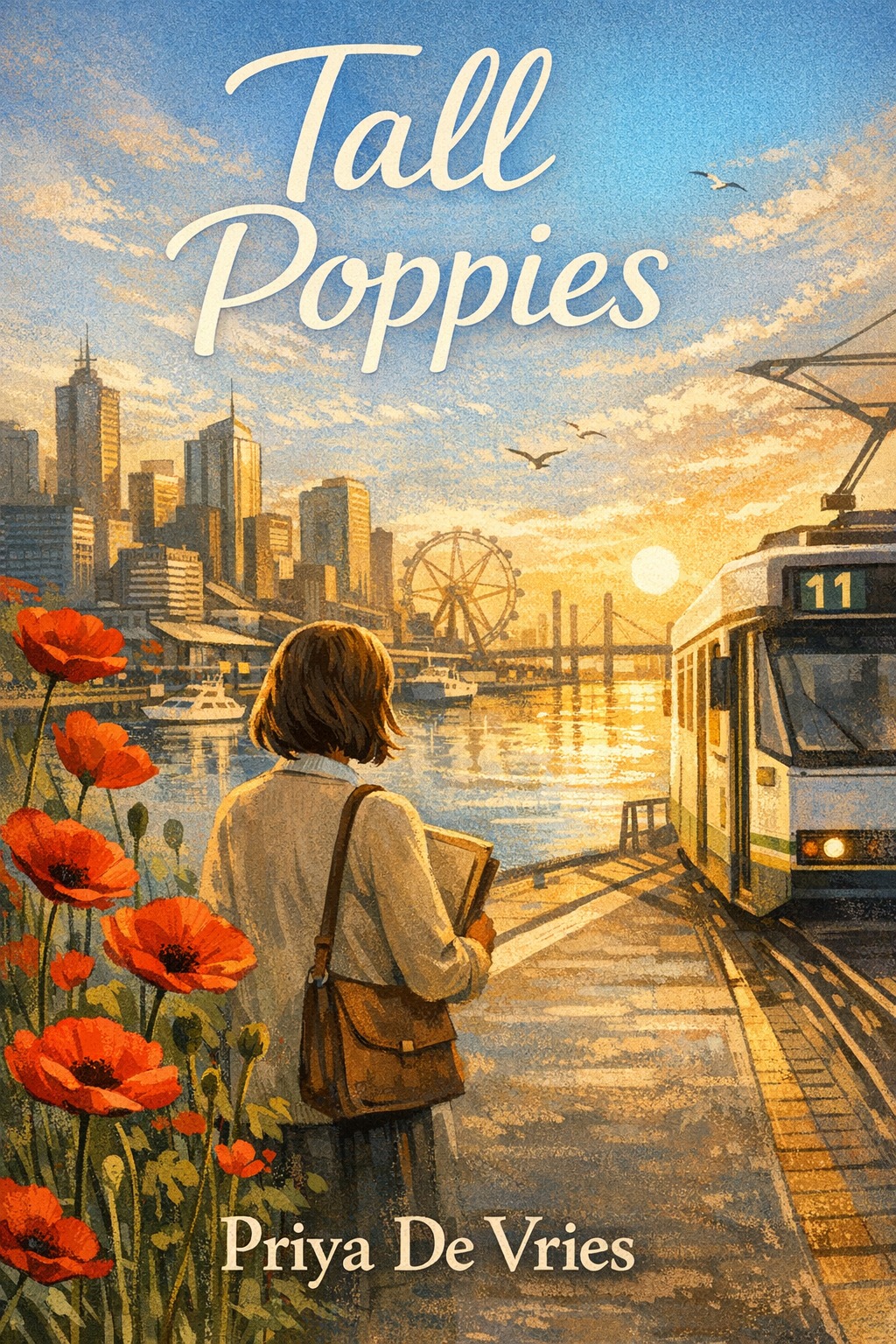
Photo of Priya De Vries

Priya De Vries is an Australian novelist and essayist whose work explores ambition, surveillance, and the quiet bargains people make to belong. Born in Pietermaritzburg to a Dutch-South African father and an Indian mother, she migrated to Perth as a teenager and later studied sociology and creative writing at the University of Western Australia. She completed an MFA at Victoria University of Wellington, and her essays and short fiction have appeared in Meanjin, Overland, Griffith Review, and The Saturday Paper.

Priya is the author of the novels The Algorithm of Forgetting and Glass Lantern Country, and her stories have been shortlisted for the Peter Carey Short Story Award and longlisted for the Stella Prize. She has taught narrative design at RMIT and volunteers with PEN Melbourne. She lives in Brunswick with her partner and an elderly whippet, and is at work on a collection about work and desire.

Ratings & Reviews

Silvio Marquez
2026-06-20

If Emma Viskic's city menace and Laura McHugh's intimate chills speak to you, this will too. The set pieces are small and eerie rather than grand, from a switched nameplate on Gertrude Street to the hum over poppy rows.

I admired the restraint and the way the text-thread mystery tutors a cautious mind toward risk. It is more puzzle than chase, and it lands quietly, but the atmosphere stuck with me.

Lydia Harcourt
2026-04-02

Tall poppies, tall buildings, tall risks. The book keeps asking what grows when control is pruned, and who holds the shears.

I liked the way it circles visibility and punishment, closing on the idea that "standing tall invites attention and aim." But the ethical undercurrent around the boardroom and the gallery swap skims when it could bite, leaving resonance more conceptual than felt.

Tao Nguyen
2026-01-15

Melbourne is mapped with care, from the glint of Docklands to laneways and galleries to a frost-lit farm near Monbulk. The surveillance texture is convincing, right down to the neighbor in the yellow raincoat and a drone buzzing over rows of bloom.

Yet the city never quite becomes a pressure system; scenes settle into a scavenger hunt that resets after each task, and the larger stakes stay hazy.

Meera Coulson
2025-09-07

In theory, Mara's caution flowering into defiance should crackle. On the page, her voice rarely deepens beyond measured observations, and the texts from TALL dominate her interior life.

Moments shine, like her pause under the stained-glass ceiling or the guilty tenderness toward a dying plant, but too often her choices feel administered rather than owned.

Gavin Lo
2025-05-29

The prose is clean and risk-aware, mirroring Mara's job. Chapters often end on directives, turning the book into a chain of permissions and refusals. The motif of pressed petals and the Polaroid breadcrumbs is elegant, though the middle third starts to loop. The effect is precise: deliberate, chilly, occasionally airless.

Shanice Pereira
2025-03-12

A clever hook loses potency as the dares blur together and the menace thins, leaving the poppy field and drone payoff feeling like one more checkbox.

Generated on 2026-07-05 12:02 UTC