Cover of Salt of the Earth

Salt of the Earth

Historical Fiction · 352 pages · Published 2025-09-17 · Avg 3.3★ (6 reviews)

In the summer of 1998, postgraduate archivist Mina Dar is handed a salt-stained trunk pulled from a brine pond beside the Khewra mines in Punjab. Inside, beneath a crust of glittering halite, she finds a ledger stamped Northern India Salt Dept., Khewra, 1931 and a packet of silk-wrapped letters written in Urdu and Gurmukhi. What begins as routine cataloguing opens into a concealed history: the clandestine courtship of Kuldeep Singh, a Sikh breaker who can read the rock like scripture, and Noor Jehan, a Muslim schoolteacher in Pind Dadan Khan whose handwriting is as steady as a surveyor's line. Their notes pass in lunch pails and beneath lamp wicks as the colony tightens Salt Laws and workers talk of stoppage.

As Mina translates the brittle pages, making trips from the Lahore Museum stacks to the mine's honeycombed tunnels, she is pulled into the undertow of her own family's Khewra past and her grandmother's unspoken years. The ledger's columns—tons, shifts, gas readings—narrow to a single day in 1931 when a sudden flood scythed through an underground gallery and the official report named the dead and the error as native negligence. But the letters trace other routes: evenings at the Capri cinema on Lahore's Mall Road, a monsoon train halted at Lala Musa, a halite charm Kuldeep carves into a crescent for Noor. Then Partition redraws the map. Names are changed, households split, and the mine, indifferent, keeps growing its salt chandeliers.

When a retired pit boy in Chakwal presents Mina with a dented tin tiffin etched K S and a seam of tally marks that match the ledger's discreet code, she begins to see how a planned work action became a catastrophe engineered to protect imperial quotas. From the Rawalpindi Telegraph Office's spools of brown tape to a colonel's water-stained file in Anarkali Bazaar, Mina assembles a story preserved by the oldest preservative on earth. As the country stages commemorations of the Salt March and discovers new uses for old myths, she must decide what truths to publish—and what to keep—in a love story chiselled into rock and paper, where the most ordinary element refuses to let memory dissolve.

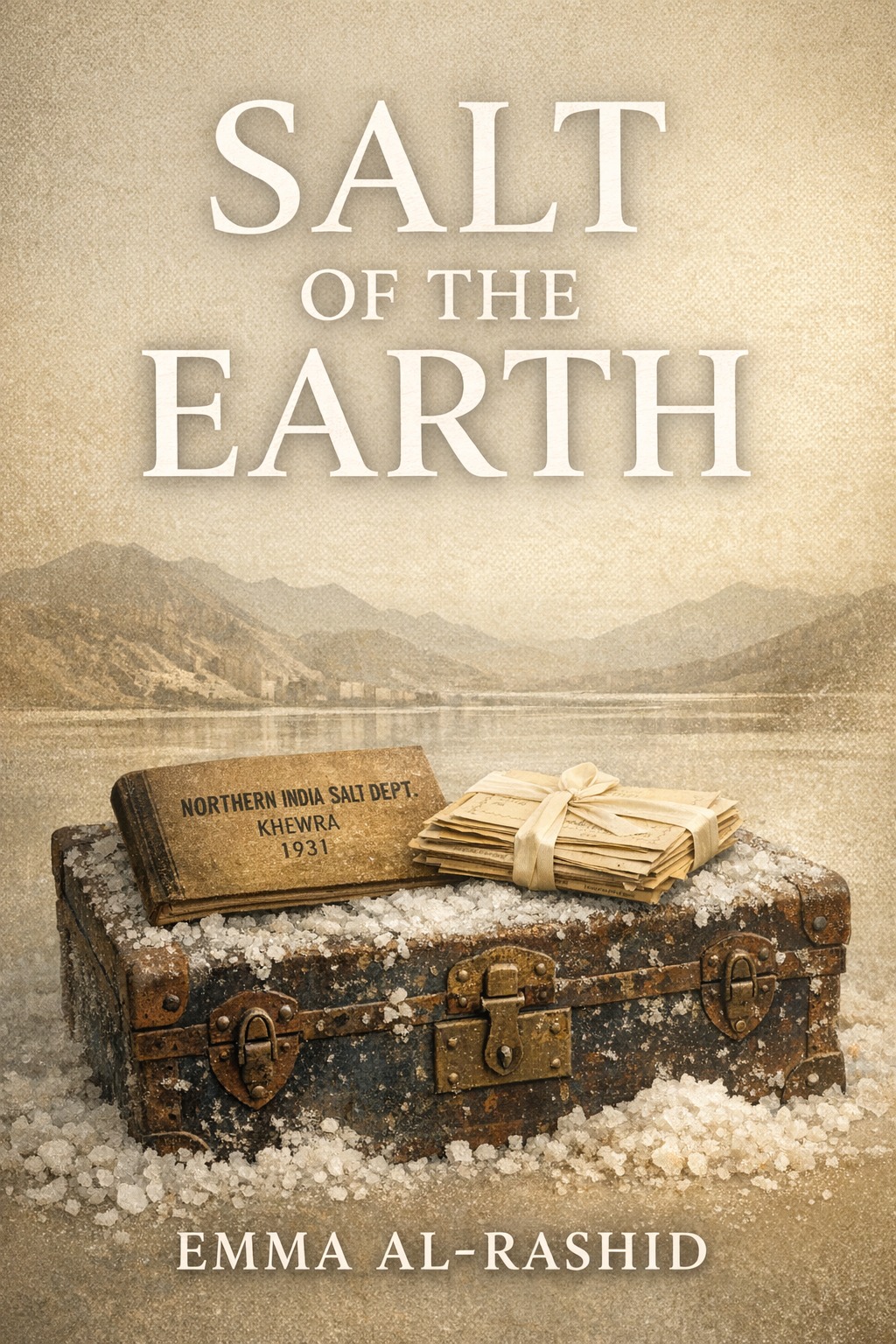
Photo of Emma Al-Rashid

Emma Al-Rashid is a British-Pakistani novelist and historian born in 1987 in Bradford and raised between West Yorkshire and Lahore. She studied South Asian history at the University of Edinburgh and earned an MPhil from the University of Cambridge on colonial print culture in Punjab. Her essays and criticism have appeared in Wasafiri, The Manchester Review, and the journal Punjab Past & Present.

Emma writes richly researched fiction that braids archival traces, oral histories, and intimate lives; her interests range across labor, borders, and the afterlives of documents, often blending historical inquiry with the textures of romance and memory. Her debut novel, Mutiny at Ravi (2024), explored canal colonies and colonial bureaucracy in the early twentieth century. Alongside her long-form work, her short fiction received the Calderdale New Voices Award and was shortlisted for the River North Prize.

She teaches part-time at the University of Salford and volunteers with an oral-history collective archiving South Asian diaspora life in the north of England. She divides her year between Manchester and Lahore and is continuing research for The Canal Ledger, a hybrid project about rivers, borders, and the printed word, while pursuing new historical narratives rooted in everyday lives and the records they leave behind.

Ratings & Reviews

Meera Bhalla
2026-07-01

Best fit for: readers who enjoy slow archival mysteries, epistolary threads, and South Asian labor history. Strong command of place, but the dense procedural detail and stop-start pacing will likely lose casual historical fiction readers.

Content notes for classroom or book club use include mining disaster descriptions, colonial repression, and Partition displacements. Consider pairing with oral histories or museum visits to contextualize the salt laws.

Isabel Duarte
2026-06-07

Se siente como la mezcla entre una novela industrial de mediados de siglo y un thriller de archivo contemporáneo. La documentación es impecable y la atmósfera salina atrapa, pero el avance es irregular y algunas revelaciones llegan con demasiada antelación para mantener la tensión.

Rohan Mukherjee
2026-04-28

Salt threads the novel as substance, currency, and moral test. Mina's act of reading becomes an argument about custodianship, while Kuldeep and Noor write against erasure as laws tighten and maps are redrawn. The tally marks, the ledger's bland columns, even the cinema tickets ask who gets to name a life.

It's a meditation on how archives resist decay, anchored by "the ordinary element that will not let memory fade."

Parveen Gill
2026-03-20

The book turns Khewra into a living system, from brine ponds that spit up a salt-stained trunk to honeycombed tunnels where lamps echo off mineral faceting; you can hear the clack of the Rawalpindi telegraph, smell coal-swept air, and ride a monsoon halt at Lala Musa while Capri flickers back in Lahore. The mine feels indifferent yet mesmerizing, and that contrast lets the love letters glow without drowning the labor history.

Neil Cartwright
2026-02-02

I kept waiting for the narrative to breathe, but the structure keeps tripping over itself between 1998 stacks and 1931 galleries.

Chapter after chapter parks us in measurements, gas readings, and cross-referenced files while the romance that should spark is rationed like salt coupons. I was frustrated.

The metaphors turn heavy. Salt crusts, chandeliers, preservers of memory; by the third repetition the imagery calcifies instead of illuminating.

The investigation into a possibly engineered catastrophe should tighten, yet scenes stall in archive logistics and minor waypoints. A key revelation is telegraphed early, then explained again.

I admire the ambition and the context, honestly, but the pacing sandbags the emotion. By the end I felt more processed than moved.

Ayesha Rahim
2026-01-15

Mina's translations open a quiet corridor into Kuldeep and Noor, and the book shines when it stays close to their pulse. The lunch-pail notes, the carved crescent, and the dented tiffin marked K S make their longing feel tactile without sentiment.

Even with the ledger ticking through tons and shifts, their voices are the counterpoint, steady and stubborn. I cared about how each chose to carry love across rules and rails.

Generated on 2026-07-04 12:02 UTC