Cover of Solder

Solder

Science · 432 pages · Published 2025-02-18 · Avg 4.2★ (6 reviews)

In this audacious and granular history of the material that quietly binds modern life, materials journalist and metallurgist Dmitri Kouassi advances a startling thesis about the origins of our electronics—and the people and nations that have bent themselves to its rules. Circuits do not flow on silicon alone; they move on solder. Every phone built in Longhua and Kunshan, every pacemaker tested in Fribourg, every smart meter clipped into a substation outside Pune is held together by microscopic bridges of tin, silver, copper, and rosin. In 2023, assembly lines from Penang to Guadalajara consumed rivers of SAC305 paste in Heller and Vitronics Soltec reflow ovens; boards left Shenzhen labeled to IPC J-STD-001 and J-STD-004, their joints x-rayed for voids before being swallowed by the global supply chain. Twenty-first century power rests as much on those bright beads beneath a BGA package as it does on code running above it. And yet, Kouassi argues, sovereignty over solder is an illusion. Long before RoHS directives in Brussels or reliability memos at NASA Goddard, the alloy had already made and unmade guilds and empires. No nation, factory, or king has ever truly set its melting point.

Reaching back five centuries and more, Solder follows a glittering, molten thread through unexpected places. In late medieval Cornwall and Devon, the Stannary Courts at Lostwithiel policed the tin that would become the lifeblood of Europe's pewterers and glaziers; at Chartres and York Minster, leaded came and soft solder fixed colored light into stone. In the Bohemian Ore Mountains around Jáchymov, miners who gave the world the thaler also hauled cassiterite out of seams that paid poorly and poisoned well. Venetian furnaces on Murano perfected fluxes that let silver adhere without collapsing the glass; in Edo-period Osaka, itinerant tinkers sealed kettles with alloys guarded like family recipes. Kouassi traces solder's path across oceans to Río Tinto copper in Huelva, to Potosí's silver that upended price ratios in Seville countinghouses, and to the wavering lines on assayers' ledgers in London's Royal Mint. He follows Indonesia's Bangka-Belitung dredges where PT Timah ships ingots through Singapore's Raffles Place, and he stands knee-deep in red mud outside Jos, Nigeria, where the price of tin once wrote the calendar. He listens to smelter foremen in Gejiu recite furnace temperatures from memory, to compliance officers in Hillsboro decipher conflict-mineral declarations from North Kivu, and to stained-glass restorers in Rouen who still stir rosin into pitch and mutter about capillary action as if it were a saint's favor.

The book crosses the moment when America discovered that its neatest standard, the eutectic 63/37 lead-tin beloved by every technician from Willow Run to Huntsville, was politically untenable. The 2006 RoHS bans did not merely replace one alloy with another; they shifted an entire civilization's heat profile. Lead-free solders—SAC105, SAC305, SAC405—cracked where 63/37 had flowed; tin whiskers reappeared like a rumor from the apocrypha of Napoleonic winters; underfills, nitrogen tunnels, and redesigned thermal profiles cascaded through late-night SPC charts from Jalisco to Juárez. As H-pad voiding met just-in-time inventory and a workbench in Hawthorne, California tried to replicate a pen-test from Aichi, the alloy's old sovereign—craft—ducked and resurfaced in new forms: stencil aperture tweaks in Porto, flux chemistries in Enschede, matte versus bright finishes debated in muted Teams calls that decide whether a satellite will power on.

At every surprising turn, Kouassi upends assumptions about materials and markets, drawing out the centuries-old tension between how solder is manufactured and whom it actually serves. He shows how a bar stamped with LME tin purity can enrich a trader on Bishopsgate while a village on Bangka's east coast watches its shoreline collapse; how a hermetic seal in Albuquerque funds a startup while a hospital in Accra struggles to repair an autoclave for lack of the right flux. Singular in its breadth, Solder dismantles the myth that engineers or regulators created, let alone command, the alloy that holds our age together. Through meticulous research and vividly rendered stories of miners, assayers, tinsmiths, and line operators, Kouassi reveals solder as modernity's most consequential export—one that prints wealth onto some boards and rust into other landscapes, even as the rest of our industries fracture along joints we prefer not to see.
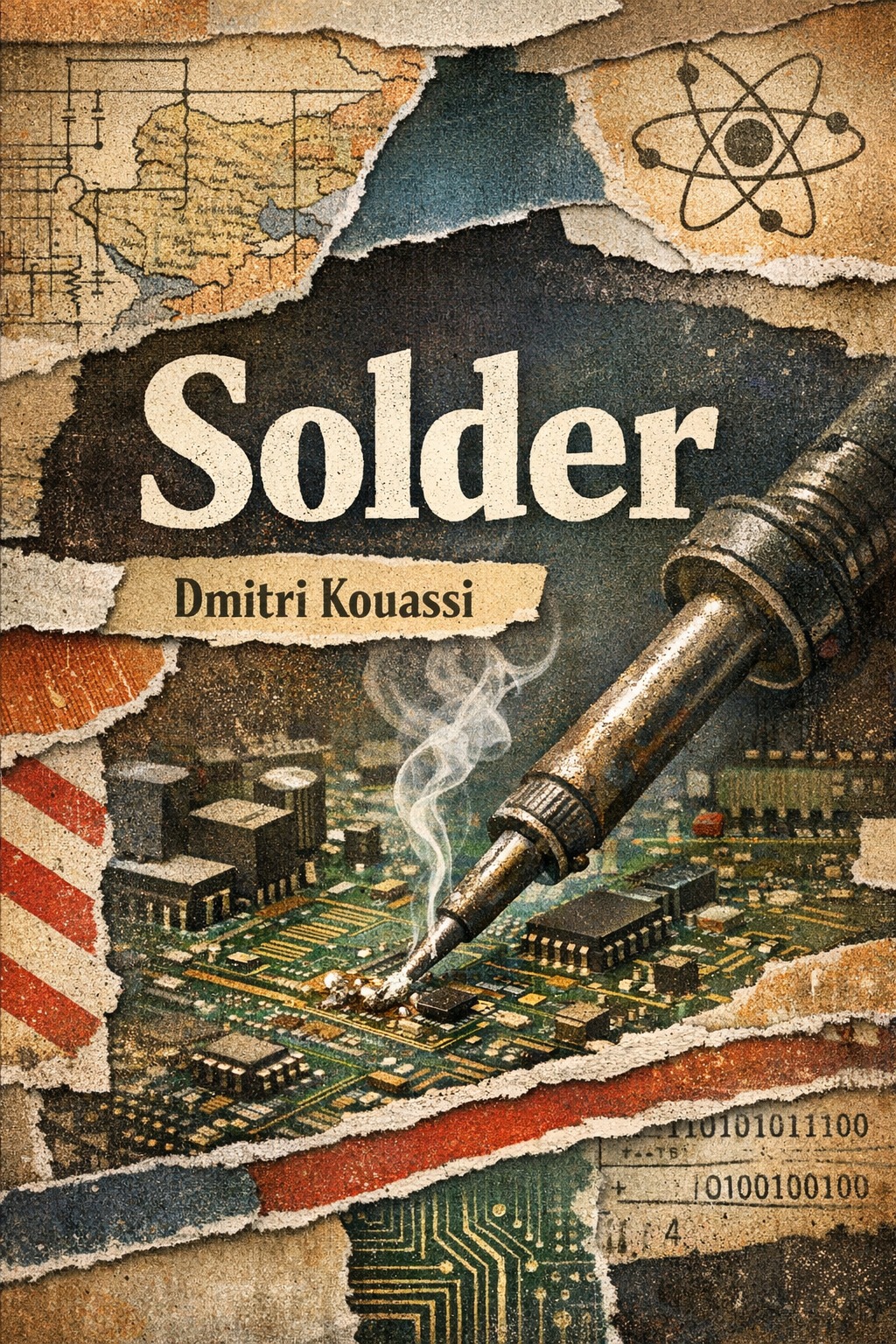
Photo of Dmitri Kouassi

Dmitri Kouassi is a materials scientist and journalist whose work explores the hidden infrastructures of modern technology. Born in Abidjan and raised between Odessa and Lyon, Dmitri studied metallurgical engineering at École des Mines de Saint-Étienne and earned a PhD in materials science from the University of Cambridge, focusing on intermetallic formation in lead-free solder joints.

He has led failure-analysis teams for contract manufacturers in Penang and Guadalajara, investigated mineral supply chains from Bangka-Belitung to North Kivu, and served as a consultant on reliability standards for aerospace programs in Toulouse. His essays have appeared in IEEE Spectrum, Nature Materials, and Le Monde, and he has lectured on joining technologies and standards (IPC J-STD-001/004) at TU Delft and Imperial College London.

Dmitri is the author of Flux: Joining, Heat, and the Hidden History of Making Things and Capillary: Inside the Physics of Everyday Bonds. He lives in Marseille, where he runs a small microscopy lab and teaches a seminar on materials, ethics, and global trade at Aix-Marseille University.

Ratings & Reviews

Sophie Delgado
2026-06-28

I came for the human vignettes and found many, but not always where I wanted them most.

  • Miners' voices in Jáchymov and Bangka are moving, brief, and memorable
  • Gejiu foremen and Rouen restorers feel vivid, then vanish too quickly
  • Some regions (Jos, North Kivu) get context but thinner on-the-ground scenes
  • Acronyms and standards occasionally crowd out the people holding the irons

When the book slows to let a technician or assayer speak, it shines. I just wished those moments were the rule rather than the exception.

Elias Boudreaux
2026-03-19

For engineers, conservators, and supply-chain nerds, this is the rare science history that smells of flux and hears the hiss of reflow.

Quinn Dorsey
2026-01-08

If The Box met The Alchemy of Air in a reflow oven, you'd get something like Solder. The narrative engine is industrial process itself, and Kouassi times his heat zones well, alternating archival vignettes with present-tense factory walks to keep momentum.

A few sections linger longer than needed on assay ledgers and price ratios, but the contemporary sequences — x-ray stations checking BGA voids, compliance teams decoding North Kivu declarations, engineers arguing matte versus bright — crackle. As narrative nonfiction about materials, this is unusually propulsive without cheap tricks.

Marta Giannini
2025-09-27

Kouassi braids centuries and shop floors with enviable control, moving from Stannary edicts to reflow profiles without losing the thread. The voice toggles between granular reportage and reflective history, and the chapter architecture keeps returning to the same core gesture — heat applied, bonds formed — until the metaphor feels earned. Acronym thickets do crop up (RoHS, SAC305, IPC standards), and a glossary would help newcomers; the pacing is brisk; a few annexes could have been folded into the main text. Still, the prose has a practiced, metallurgist's steadiness that leaves convincing seams.

Rohit Perera
2025-06-15

This book turns the globe into a bench-top, and every country into a component waiting to be joined. I could smell rosin, feel the flux bite, and see the bright meniscus forming under heat as if I were watching through a loupe.

We tour Cornwall and Devon where tin money carried laws of its own, step into Chartres where colored light is literally soldered into stone, and pause in Osaka with tinkers who treat alloys like family scripture.

The itinerary keeps expanding: Jáchymov's ore, Huelva's copper, Potosí's silver, Bangka-Belitung's dredges, Raffles Place invoices, Gejiu foremen reciting furnace temperatures from memory. Penang and Guadalajara put boards through Heller and Vitronics Soltec, then ship them toward a grid that forgets its own plumbing.

Kouassi writes with a maker's patience. Capillary action is a character, flux a voice coach, underfill a safety net. When RoHS upends the heat profile of an age, you feel how satellites, pacemakers, and smart meters all hinge on whether a bead wets a pad cleanly.

It's world-building without fiction and stakes without melodrama. If you live with electricity, you live inside this story.

Nadia Kline
2025-03-02

I finished Solder and immediately wanted to pry open a phone just to bow to the joints I never noticed. Kouassi's thesis hums with voltage: "circuits do not flow on silicon alone" becomes a manifesto that reframes power, politics, and craft in one molten sweep.

The historical passages glitter. Stannary Courts and pewterers, Murano furnaces and Edo tinkers, stained glass at Chartres and York — every scene is a workshop where law, faith, and heat strike a bargain.

Then we're back on modern lines, where SAC305 paste sprints through Heller ovens, IPC J-STD-001 stickers certify a fragile order, and x-rays hunt for voids under BGA packages like priests reading entrails. The jargon isn't window dressing; it's proof that the book knows the work.

The pivot around RoHS is breathtaking. The old eutectic 63/37 feels like a standard engraved in memory, yet lead-free cracks, tin whiskers, and nitrogen tunnels reconfigure entire factories. You can hear the muted Teams debates about matte finishes and flux chemistries, the late-night SPC charts from Jalisco to Juárez.

Ethics pulse through the circuitry. A trader on Bishopsgate clicks profit while Bangka's shore slumps; Rio Tinto copper and Potosí silver echo in today's conflict-mineral declarations; red mud outside Jos stains the calendar. The book never blinks.

By the end, sovereignty over solder truly looks like an illusion. What rules is capillary action, labor, and the stubborn ingenuity of craft. This isn't just materials history. It's a new way to read the modern world, bead by shining bead.

Generated on 2026-07-02 12:07 UTC