Cover of Fennel

Fennel

Fiction · 304 pages · Published 2024-10-08 · Avg 3.7★ (6 reviews)

How long can a scent keep you alive? When Lenke wakes on the tiled floor of the shuttered Saint Katalin Apothecary in the riverside town of Sárvár, she remembers only the taste of anise and smoke. The drawers are labeled in a hand she almost recognizes; one jar, Fennel, is sealed with red wax and a warning carved with a nail. A girl in a yellow coat sits behind the counter and claims she knows Lenke, yet offers no name. From the fogged glass, a dark-suited auditor taps and smiles without teeth; he comes whenever Lenke opens the wrong jar.

The town folds in on itself like a book, every street curling back to the apothecary. Lenke learns that scents shift the map: crush juniper to summon the floodgate, steep elderflower to call the ferry, burn fennel to remember a door that should not be there. But each memory brought back costs one she cannot choose. The clock above the mortars leaks brine, counting toward an hour that no one will name. To slip the circle, Lenke must gather four lost recipes scattered through strange rooms that masquerade as places: a peat cellar lit by glass bees, a linen factory that weaves wind, the abandoned thermal baths under Várkert, and a kitchen where knives recite prayers.

As she moves between those rooms, faces repeat, gestures loop, and names scrape at her like salt. The girl in yellow might be a sister or an echo. The auditor may be a debt she once owed herself. Beneath the floorboards, the fennel root knocks in time with her pulse. Unless Lenke can decide which memory to let go and which to plant, the jar will remain sealed, the town will swallow its own river, and the way out will sprout past her forever.

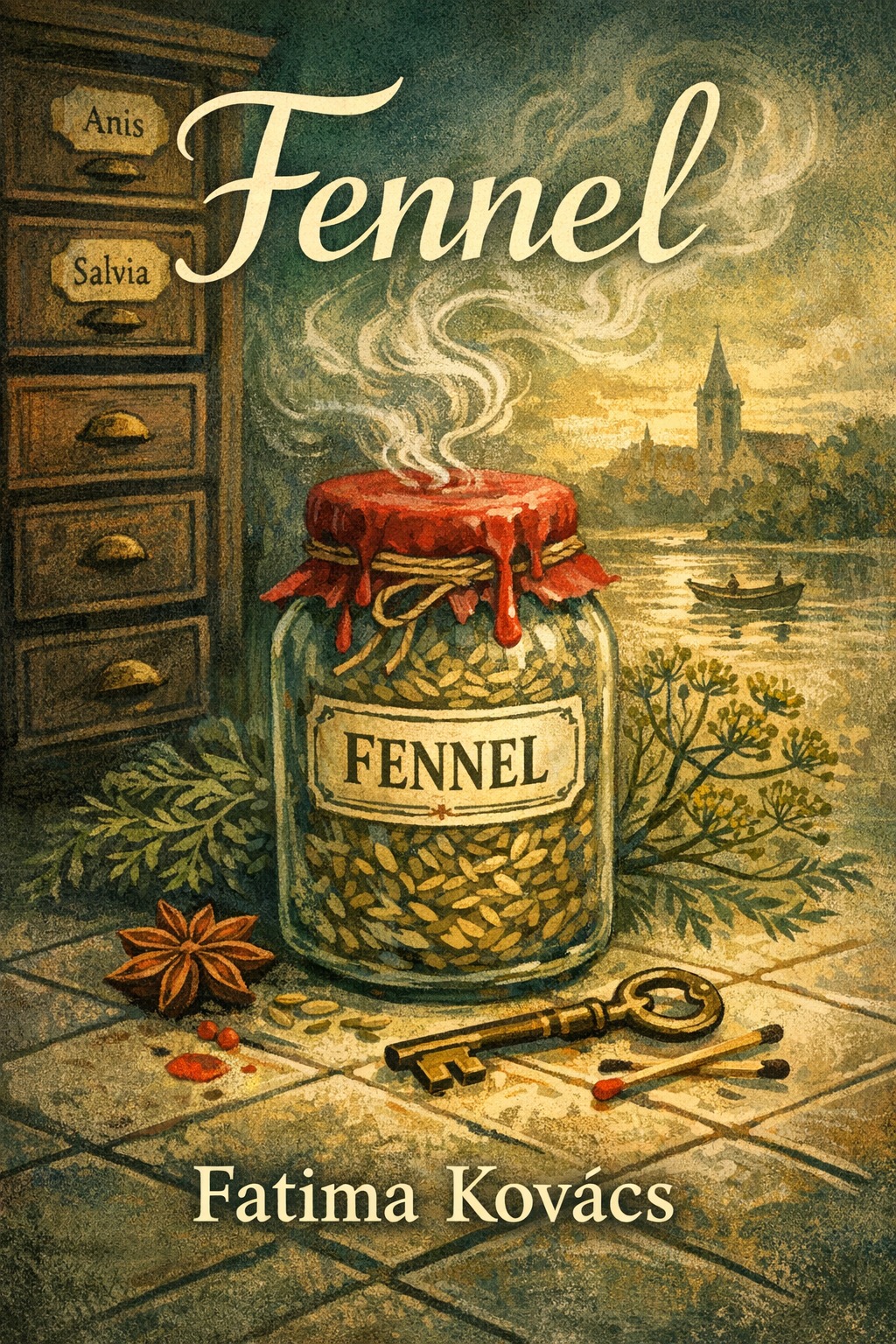
Photo of Fatima Kovács

Fatima Kovács is a Hungarian writer and translator whose work braids folklore, botany, and the uncanny. Born in 1986 in Szombathely and raised near the Őrség National Park, she studied comparative literature and ethnobotany at Eötvös Loránd University, later completing a residency at the Balaton House of Writers. Her fiction has appeared in Central European journals, and her earlier books include the story collection Salt for Sleep and the novel Paper Orchard. She has received the Danube Emerging Writer Prize and a Kis Duna translation grant.

Fatima Kovács translates from Croatian and Polish, and has brought contemporary eco-fiction into Hungarian. She teaches narrative craft at a community arts center in Pécs and tends a small herb garden on a south-facing balcony, where she grows fennel, rue, and thyme. When not writing, she travels along the old postal roads of Transdanubia, collecting place names and market recipes that seed her fiction. She lives in Pécs with a watchmaker and a one-eyed cat named Sütőtök.

Ratings & Reviews

Simone Hartwell
2026-06-20

I admire the ambition, but the spell kept slipping.

  • Lush scent lexicon
  • Haunting auditor figure
  • Loops that sap urgency
  • Puzzles gated by perfumes feel repetitive

Readers who crave clear progression may feel stranded at the counter.

Anders Okoye
2026-03-18

The novel turns memory into agriculture: what you harvest, you also lose. It teases questions of debt and self-forgiveness, staged in a town where streets "curl back to the apothecary" and every scent is a trade. The choice the book asks, what to plant and what to let rot, lingers past the last page.

Priya Bain
2025-12-05

I came for the apothecary puzzle and stayed for the physics of smell. Sárvár becomes a living instrument where burned fennel tunes the map, elderflower ferries you across missing water, and juniper brings the floodgate into sudden reach.

The four rooms are marvels: a peat cellar lit by glass bees, a linen factory weaving gusts, the drained baths under Várkert, and a kitchen whose knives whisper prayers. Stakes seep into the tile as the brined clock counts down, and the auditor's toothless smile keeps the tension elastic without breaking the spell.

Lucía Valdés
2025-06-30

Lo que me atrapó fue Lenke: no como heroína clásica, sino como conciencia herida que aprende a negociar con el olfato. La chica del abrigo amarillo y el auditor funcionan como reflejos torcidos de sus deseos y miedos, y sus diálogos, breves y afilados, dejan huecos que invitan a leer entre líneas. Algunas repeticiones de gestos son intencionales y poderosas; otras cansan un poco, pero la ambigüedad emocional queda intacta.

Gilbert Han
2025-02-14

The prose balances austerity and perfume; short beats snap into precise images before a sentence opens into smoke and salt. The four-recipe spine keeps the story aligned even as rooms masquerade as places, and the clock's brine-tick lends a quiet dread. Close focus on Lenke prevents the puzzle-box from thinning into riddle, though a few returns to the counter feel redundant.

Mara Ionescu
2024-11-02

An eerie maze of scents and loops, Fennel drifts through Lenke's relit apothecary with tantalizing puzzles, but the circular structure sometimes stalls the momentum as every street returns to the shop.

Generated on 2026-06-26 12:02 UTC