
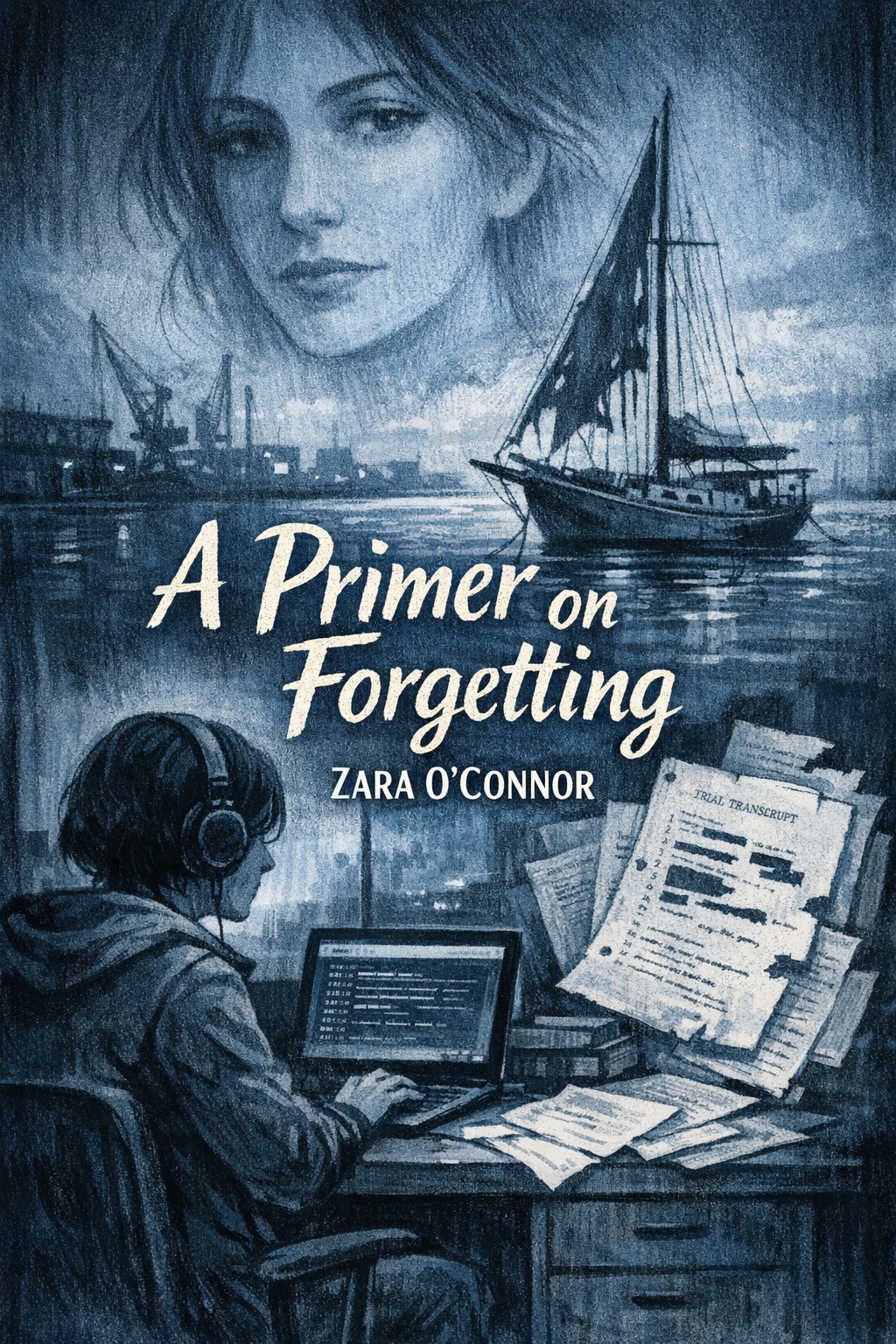

Cover of A Primer on Forgetting

A Primer on Forgetting

Graphic Novels · 192 pages · Published 2026-05-20 · Avg 3.0★ (6 reviews)

Rendered in charcoal panels and chartroom blues, A Primer on Forgetting follows Aoife Kelleher, a former court reporter now scrubbing marina Wi‑Fi logs in Dublin Port. When a Stock Island sloop drifts in without papers and a trial transcript she once typed resurfaces with pages missing, Aoife's marginal notes—tide tables, VHF call signs, GPS breadcrumbs—become her compass. With Malik Santos, a Cuban telecom tech, she chases a wake across Poolbeg light, a corroded sextant in her backpack. An encrypted thumb drive taped inside a bailer hints at a smuggling route calibrated to weather and night-shift boredom.

Each chapter splices courtroom shorthand, sonar pings, and canal graffiti into frames that read like a manual for erasing and recovering memory. As patrol boats and pop-up storms close their circle, Aoife trades favors for tide windows and learns which losses are chosen and which are engineered. Notes in the gutters—QR codes, patrol schedules, hand-drawn sextant arcs—invite the reader to navigate with her. What begins as a cleanup gig becomes a coastal procedural about love, omission, and the costs of vanishing well.

Photo of Zara O'Connor

Zara O'Connor is an Irish-born writer from Limerick whose work traces the charged borderlands between crime, technology, and the sea in fiction, nonfiction, memoir, romance, and graphic narrative. Based between Dublin and Key West, she crews on a friend's sloop out of Stock Island and brings the precision of a former court reporter and night-shift copy editor to everything she makes.

Drawing on criminology at University College Cork and later consulting for a Miami cybersecurity firm, O'Connor explores how digital footprints intersect with tide tables, patrol routes, and human incentives. Her books include the narrative nonfiction Sextant: A Chronicle (2024), the memoirs The Almanac (2025) and The Golden Mountain (2025, shortlisted for a Munster arts award), the coastal procedural romance Something About Mercury (2025), and the graphic novel A Primer on Forgetting (2026). She experiments with hybrid pages that layer nautical charts, code diagrams, and marginal transcripts, and lives between the Grand Canal and the Gulf Stream with a rescue terrier named Clove.

Ratings & Reviews

Marta G. Willis
2026-06-22

For readers who like hybrid reportage comics and maritime minutiae, especially those who enjoy scanning margins for QR codes and coordinates. I'd shelve it with procedural graphic nonfiction and puzzle comics. Content notes for trafficking context, surveillance, storms at sea, and a few tense chases. There is no graphic gore. Ages 16+.

Devon Chao
2026-06-17
  • Tense, salt-soaked atmosphere
  • Margin puzzles that slow the current
  • Trial fragments that skim instead of cut
  • Ending that gestures more than resolves
Lina O'Rorke
2026-06-10

Kelleher's Dublin Port is a whole weather system, from the hiss of marina Wi-Fi to the clack of patrol schedules, and the panels glow like wet rope under chartroom blues. The way Poolbeg light, VHF call signs, and hand-drawn sextant arcs interlock gives the smuggling line a tactile logic, and the sloop's absence of papers becomes a presence the book keeps testing.

It feels lived-in and slightly haunted.

Saira Qureshi
2026-06-03

Aoife's hush and Malik's prickly patience make a brittle partnership, intriguing in gestures but thin on confession.

Arturo Pineda
2026-05-29

I kept hoping the charcoal would open, that Aoife's notes would point to a pulse I could actually feel, not just decode.

The margins keep telling me this is "a manual for erasing and recovering memory", but too often it reads like homework scattered through fog. QR squares, VHF snippets, tide math, all clever, all cold.

I got tired of chasing breadcrumbs that dissolved in spray. The encrypted thumb drive is a neat hook, yet the chase drifts, and I was left staring at Poolbeg light like a stalled beacon.

Yes, the port feels specific, and Malik sparks when he shows, but the emotional wake is faint. I wanted consequence, not calibration.

Two stars for the ambition and the scratchy blues of the art. The rest left me seasick in a way that feels accidental, not designed.

Maeve Donnelly
2026-05-22

The book reads like a packet of evidence: clipped captions, off-frequency dialogue, and black-salt gutters. The splice of courtroom shorthand with sonar pips is intriguing, but the panel rhythm stalls when tide tables and radio logs take over. I admired the QR gambits in the margins and the grit of Dublin Port, even as the throughline feels like flotsam nudged between docks.

Generated on 2026-06-23 12:02 UTC