
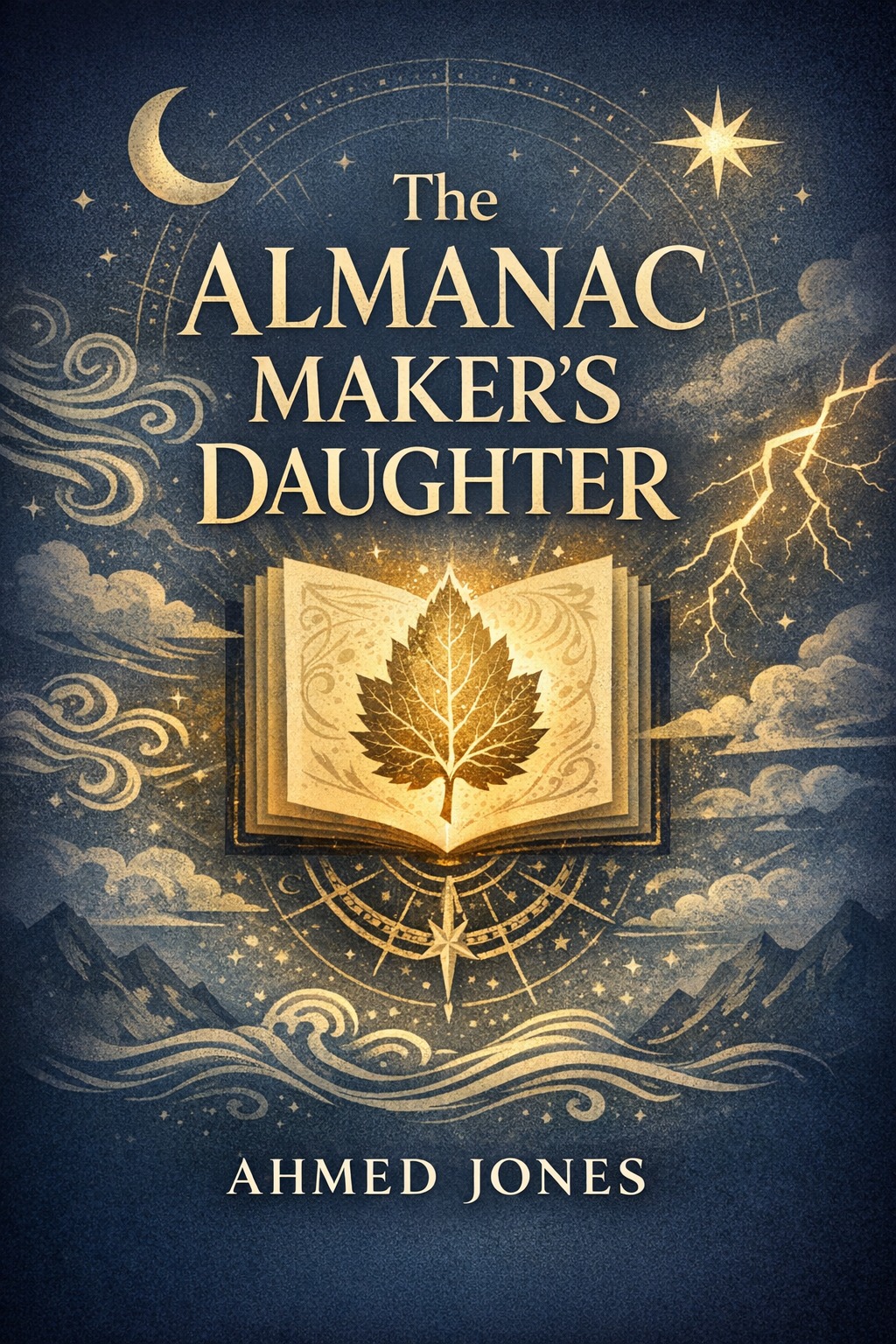

Cover of The Almanac Maker's Daughter

The Almanac Maker's Daughter

Fantasy · 432 pages · Published 2023-10-17 · Avg 3.3★ (6 reviews)

Regulus Vane, the Storm-Chancellor, has bound to his ledger the Seven Winds of Aveline – instruments with which he means to timetable the sky. All he lacks for dominion over seasons is the Prime Leaf – the page that names all weather – long hidden by Aldous Quince, Master Almanac Maker. In the bell-chimed market of Grafton Hollow, young Liora Quince awakens to a calling when her ailing father bequeaths her the Starwheel and a map of blank days. She must leave her stalls and trace forgotten observatories from Saltwick to Emberreach, compose a counter-calendar at the Furnace of Hours, and write the storms free before Vane inks the last horizon closed.

Photo of Ahmed Jones

Ahmed Jones is a British-Pakistani novelist and former climatologist, born in 1985 in Cardiff and raised between Swansea and Lahore. He studied atmospheric physics at the University of Leeds, worked with the UK Met Office on seasonal forecasting, and moonlighted as a bookseller before turning to fiction.

His work threads weather lore, diaspora memory, and quiet magic. He is the author of Salt Roads & Star Charts (2018) and The Thirteenth Isobar (2021), and his short fiction has appeared in small-press magazines across the UK. He has been shortlisted for the British Fantasy Award and the Kitschies. Ahmed lives in Bristol with his partner and a rescue greyhound; he builds handmade astrolabes and teaches community workshops on climate storytelling.

Ratings & Reviews

Rohan Malick
2026-05-19

This scratched a very particular itch.

If you liked the intimacy and craft-minded magic of The Observatory Gate by Elin Rowe or the map-soaked wandering of Salt Roads and Sky Charts by Bernard Kade, this fits right beside them. The bell-bright bustle of Grafton Hollow, the quiet ache of a father handing over the Starwheel, the audacity of a counter-calendar forged at the Furnace of Hours, the pilgrimage through Saltwick and Emberreach: it all coheres into a fantasy that privileges wonder and consequence over spectacle. The prose occasionally lingers, but the line-by-line pleasure is real, and the ending leaves a clean breath of possibility.

Nadia Farouq
2025-12-01

Beneath the quest ticks a clear thematic argument: time belongs to people, not ledgers. Liora inherits tools and duty, then spends her journey interrogating both, and the contrast between a schedule for the sky and the messy grief of a daughter gives the book its pulse. The phrase "the page that names all weather" becomes a question about who gets to name our days at all, and the act of writing storms free reads as resistance to tidy fates. It is occasionally ornate, but the motif of calendars turned to songs stuck with me.

María Espejo
2025-03-10

Apuntes rápidos después de cerrar el libro.

  • Mercado de Grafton con campanas: precioso inicio
  • Travesía entre observatorios se estira en tramos
  • Antagonista casi siempre fuera de escena
  • Final sugiere esperanza sin resolver todo
Callum Bryce
2024-09-05

The lore promises a clockwork cosmos, the Seven Winds ledgered and ready to tick, but the rules keep shifting like sand. Great concept, wavering execution.

When can the Storm-Chancellor actually bind a wind, and when does "the page that names all weather" trump him? The book gestures at costs without pinning them down, and the observatories from Saltwick to Emberreach feel like signs on a map rather than engines in a system.

Geography is hazy, distances elastic, and timekeeping itself is oddly imprecise for a story obsessed with calendars. I wanted consequences that felt measured, not vibes that said maybe.

There are bright sparks. The bell-chimed market in Grafton Hollow rings with life; the Furnace of Hours has atmosphere to spare. But my patience wore thin as each gorgeous idea slid away when I tried to hold it.

I left frustrated, convinced the premise deserved an engineer's precision and got an artist's shrug.

Kara Mendel
2024-01-12

I went in ready to love a book about calendars and storms and came out knotted with frustration. The prose keeps gilding every cloud with capitalized meteorology, and whole paragraphs drift into decorative mist while the story begs for clarity.

The journey built on a map of blank days never finds a steady gait. Scenes in Grafton Hollow sparkle, then the trek to Saltwick and Emberreach becomes a chain of errands, and when the set pieces arrive they land with a hush instead of a crack.

Point of view wobbles. Liora sometimes vanishes into the scenery, and the father's deathbed guidance curdles into syrup. Regulus Vane reads like a title rather than a presence, all portent with little pressure.

The Starwheel looks cool, yes, but its function feels opaque on the page, and the language keeps raining metaphors until the stakes blur. By the time we reach the Furnace of Hours I was begging for the counter-calendar to matter in a way I could feel.

I turned the last pages with exasperation. Such a potent premise, timetabling the sky, yet the book smudges its own lines until even the storms seem scheduled to be dull.

Lin Mei Tan
2023-11-02

What carried me was Liora herself. She begins as a market daughter counting coin and clouds, then shoulders a legacy without theatrics, listening hard to absence and learning when to mark a day and when to leave it blank. Her conversations with her ailing father feel tender without sugar, and her stubborn curiosity keeps the journey from becoming a checklist.

Even with the Storm-Chancellor looming, the book trusts quieter choices, and that choice lets small moments glow. I believed in her resolve to write the storms free, and I cared about the cost of every line she drew on that counter-calendar.

Generated on 2026-06-22 12:02 UTC