

Cover of Brine

Brine

Graphic Novels · 192 pages · Published 2025-10-14 · Avg 4.3★ (6 reviews)

Salt on the tongue, plastic under the strip lights: in a near-future Gothenburg where rising seas have pushed the wards into decommissioned ferries at Frihamnen, a Ministry of Hydration mandates treatments that keep bodies docile. Patients wear laminated brine-grade ID bands, interpreters are replaced by Speech Filters, and consent becomes a checkbox that never unchecks. Marta Nilsson, an anesthesiologist from Möllevången, and Iker Hernández, a dockworker-poet with a scar shaped like a fishhook, begin to trade contraband language across the sterile decks — tide charts annotated in pencil, lullabies in Spanish, pre-op forms revised to ask what you hope to keep.

Drawn with cool blues and rusted reds, Brine follows small acts of care as they swell into a current of refusal: a saline bag spiked with seawater, a choir humming in the MRI, a palliative ward that hides a radio under blankets. From Andra Långgatan to the Stena Line terminal and night markets phoned into Oaxaca, the story renders the suffocating hush of a medicalized police city and the stubborn pulse that resists it. With clinical clarity and tenderness, the book watches identity dissolve and re-form, finding a grammar of freedom in breath, in names, in the ebb and return of tide.

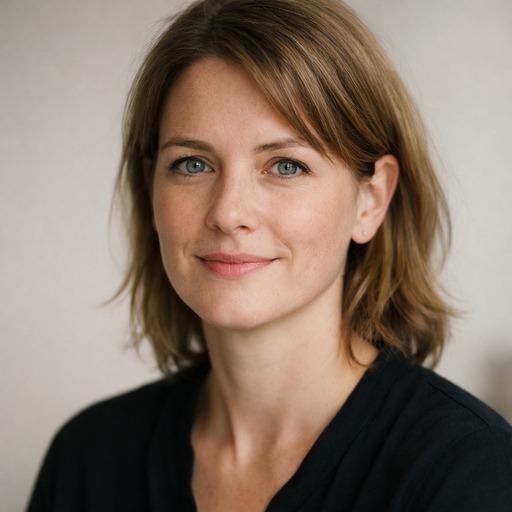
Photo of Emma Larsson

Emma Larsson is a Swedish physician and writer whose work explores care, language, and the borders between illness and daily life. Raised in Möllevången, Malmö, she studied medicine at Uppsala University and completed her anesthesiology residency at Sahlgrenska University Hospital in Gothenburg.

After additional training in palliative care and narrative medicine, Emma split her time between Sweden and southern Mexico, collaborating with community health organizations in Oaxaca and serving as a visiting clinician-educator. Her essays have appeared in Scandinavian newspapers and literary journals, and she has contributed reflective pieces on medicine and culture to Nordic public radio.

Alongside memoir and essay, Larsson works in graphic storytelling, collaborating with illustrators to bring clinical ethics, migration, and the textures of daily care into the comics form. She received a residency grant from the Swedish Arts Grants Committee for her nonfiction, and her talks on empathy in clinical practice have been presented at regional medical conferences. Emma lives in Gothenburg, where she teaches communication and ethics to medical trainees and tends a small balcony garden of rosemary, chilies, and geraniums. She is fluent in Swedish, English, and Spanish. Her publications include the memoir Ximena Robles.

Ratings & Reviews

Tariq Blanche
2026-06-01

For readers of politicized graphic storytelling who appreciate quiet resistance over spectacle, this belongs on classroom carts and community shelves. It pairs well with works that explore healthcare power dynamics and with city-specific comics that treat place as character.

Notes for educators and librarians: depictions of medical coercion, needles, anesthesia, and language suppression; no gratuitous gore. The narrative centers care practices and mutual aid, making it a strong pick for discussions about consent, institutional design, and translation. Older teens and adults will find plenty to analyze.

Runa Vikström
2026-04-22

A clear, briny protest narrative with steady momentum.

  • Luminous color logic of blues and reds
  • Tactile setting on the ferries
  • Occasional repetition in clinical walk-throughs
  • Ending cadence a touch abrupt
Owen Salvat
2026-03-05

Brine's composition is meticulous, with a clinical line that refuses sentimentality even as it sketches tenderness in the negative space. Structure-wise: the book braids Marta's sedation rooms with Iker's dock shifts, puncturing the sequence with forms, charts, and signage that read as both diegetic objects and rhythmic beats.

Occasional interludes linger a panel too long on corridor geometry, but those slowings teach you how to look, so when a saline bag is spiked with seawater or a radio glows under blankets, the image lands with earned resonance. Sharp, humane, and formally alert.

María de la Cruz
2026-02-09

Lo que más me atrapó fue la relación silenciosa entre Marta y Iker: miradas, papeles doblados, una canción tarareada para abrir paso al aire. Ella anestesia para que otros no sientan; él carga ferries que ahora son hospitales. Cuando comparten mapas de mareas y preguntas en los formularios, se sienten más vivos y más peligrosos. La paleta fría sostiene esa tensión sin melodrama, y la voz de ambos nunca se confunde aunque el sistema intente filtrarla.

Jasper Osei
2026-01-18

The worldbuilding here floods quietly and then all at once, and I am in awe. Decommissioned ferries shoulder the wards at Frihamnen; everything hums with compressors, strip lights, and rules that want to smooth people into silence.

Those laminated brine-grade bands, the Ministry of Hydration, the Speech Filters that swap out interpreters — the details feel chillingly ordinary, which is exactly why they land. You can smell saline and diesel. You can hear the gulls arguing with the sirens. It is so real it stings.

When contraband language slips the nets — tide charts pressed flat in a pocket, lullabies threaded between beeps — the panels loosen, like the ship itself is breathing. The stakes are not explosions; they are whether a name can be said without permission. That is monumental.

And the geography matters: Andra Långgatan to the terminal, phone calls bouncing to Oaxaca, corridors that remember every footfall. The book maps pressure and release with care, and every small act feels like a surge. I love this fiercely!

Leila Norberg
2025-11-02

I finished Brine with my heart hammering and my throat tasting of "salt on the tongue." What a charged, necessary hymn to breath and naming!

The book keeps circling consent as "a checkbox that never unchecks," and then it dares to imagine hands unchecking it together. A choir hums in the MRI, a radio whispers under blankets, and suddenly the sterile decks feel full of stubborn air.

I loved how the cool blues and rusted reds refuse to flatter the eye; they insist on truth. The panels are precise like instruments, yet they carry tenderness like warm palms.

Marta and Iker trade contraband language, and each penciled tide mark reads like a promise. The Speech Filters cannot dam what moves mouth to mouth, line to line. Yes!

By the end I felt the tide returning, not as spectacle but as a grammar of care. Brine believes our bodies can learn new currents, and it invites us to breathe with it.

Generated on 2026-06-20 12:02 UTC