Cover of The Strandveld

The Strandveld

Horror · 312 pages · Published 2025-09-23 · Avg 3.6★ (7 reviews)

When a violent autumn storm scours the Lake Michigan shore near Saugatuck, it exposes a wind-warped belt of pale shrubs and glassy succulents no one remembers seeing. Locals call it the Strandveld, and ex-EMT Evan Lauer, newly hired as night caretaker at a lakeside research station, is told to keep vandals away while botanist Dr. Naomi Pritchard catalogues the find. But the plants bleed brackish water, the old Big Red lighthouse tolls on windless nights, and a pattern of stitches appears in the sand like something has been suturing the beach closed.

Archive files point to a WPA-era sanatorium under the dunes, where bodies were interred with seed packets and medical thread during a contagion scare. As Evan's radios fill with whispers and Dr. Pritchard's notes rearrange themselves into tide tables, the Strandveld creeps inland, rooting in drywall and veins. With a nor'easter bearing down, Evan must choose between torching the seed bank—and the station with it—or letting the strand of patient names unspool through town. Either way, the lake is hungry, and it has learned to grow teeth.

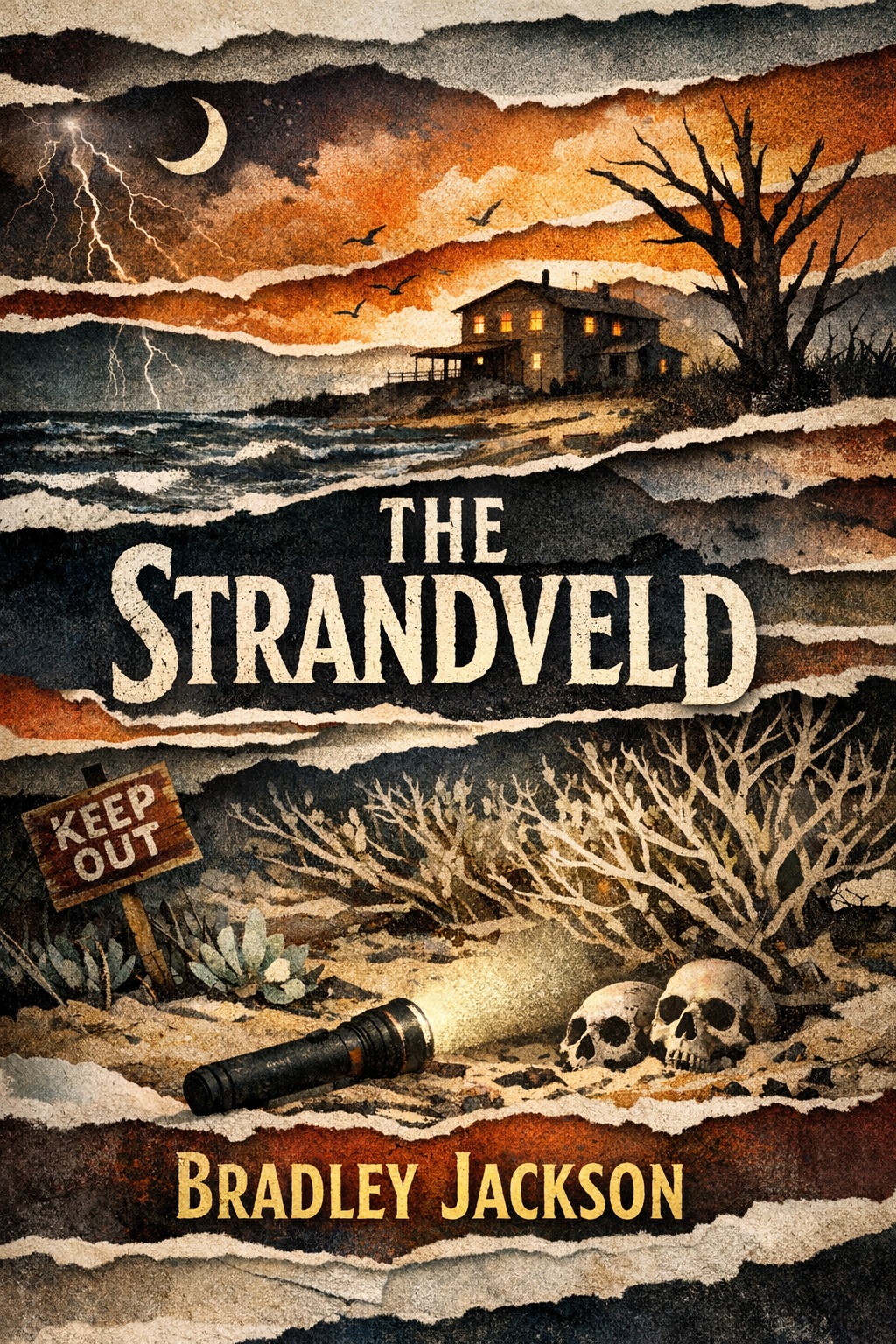
Photo of Bradley Jackson

Bradley Jackson is a Midwestern horror writer born in 1984 in Dayton, Ohio. He studied biology at Ohio University and worked nights as a hospital unit clerk before earning an MFA from the University of North Carolina Wilmington. A former EMT and volunteer crisis-line counselor, he draws on medical settings, Great Lakes weather, and rust-belt folklore to craft claustrophobic, slow-burn tales that increasingly blur into ecological and folk horror.

His short fiction has appeared in small-press magazines, and his novella Cold Storage won the 2019 Rust Lantern Prize. He is the author of the novels Eclipse of Sanity and The Strandveld, continuing a body of work that fuses bodily fragility, industrial decay, and the uncanny rhythms of coastal wilderness. Jackson lives in Grand Rapids, Michigan, where he teaches community writing workshops and hikes the dunes with a stubborn rescue beagle.

Ratings & Reviews

DeShawn Merrit
2026-05-22

Bleeding succulents, stitched sand, and windless bells linger; the story lands, but not as deep as its roots promise.

Lucía Valverde
2026-04-14

Se siente como si John Langan se encontrara con Priya Sharma en la costa del Lago Michigan: atmósfera densa, mitología inventada que parece verdad, y una naturaleza que exige su tributo. El faro de Big Red que suena sin viento y los archivos de la WPA bajo las dunas construyen una verosimilitud inquietante. Hay algunos baches de ritmo, sí, pero el conjunto planta sus raíces y aprieta. Ideal para quienes disfrutan del horror ecológico con filo poético.

Rowan McKee
2026-03-03

Uneven tide for me.

  • Lake lore and plant-bleed imagery
  • Middle third drifts, scenes repeat
  • Evan compelling, Naomi underused
  • Climax chaotic without payoff
Soo Min Park
2026-02-19

The book keeps threading names, records, and care into something like a moral rip current. The repeated whisper that "the lake is hungry" is less a monster call than a thesis about appetite: for bodies, for memory, for infrastructure that lets us forget where the dead went.

If a few motifs are spotlit a beat too long, the larger weave holds, binding environmental dread to medical history in a way that lingers like salt on the tongue.

Anika Petrov
2026-01-07

The coastal horror here grows from tactile lore: a WPA-era sanatorium swallowed by dunes, bodies interred with seed packets and medical thread, a careful line of stitches reappearing in the sand, and succulents that bleed brackish water while the old Big Red bell tolls without wind. Each detail obeys a rule you can almost name, which makes the stems creeping into drywall and veins feel horribly plausible.

I believed in this ecosystem, and that is why it scared me.

Jamal Rios
2025-11-12

Ex-EMT Evan Lauer reads as a man trying to outwalk a siren, clinging to procedure to shield himself from the weirdness along Lake Michigan. Dr. Naomi Pritchard starts crisp and clinical, then frays as the Strandveld creeps into her categories and her sleep. Their partnership stays a wary relay of duty, which I appreciated, but some dialogue is so clipped it muffles the heat, and I wanted deeper access to Naomi when the lighthouse tolls on windless nights.

Mira Colton
2025-10-05

The prose is briny and wind-bent, with lines that hiss like blown sand; the structure toggles between Evan's midnight rounds, clipped radio chatter, and archival fragments that steadily knot tighter. The countdown to the nor'easter lends momentum, and I loved how the field notes quietly reassemble into tide tables. A few middle chapters retrace the dunes one time too many, yet the last act lands with a wet thud and a cold shiver.

Generated on 2026-06-16 12:02 UTC