
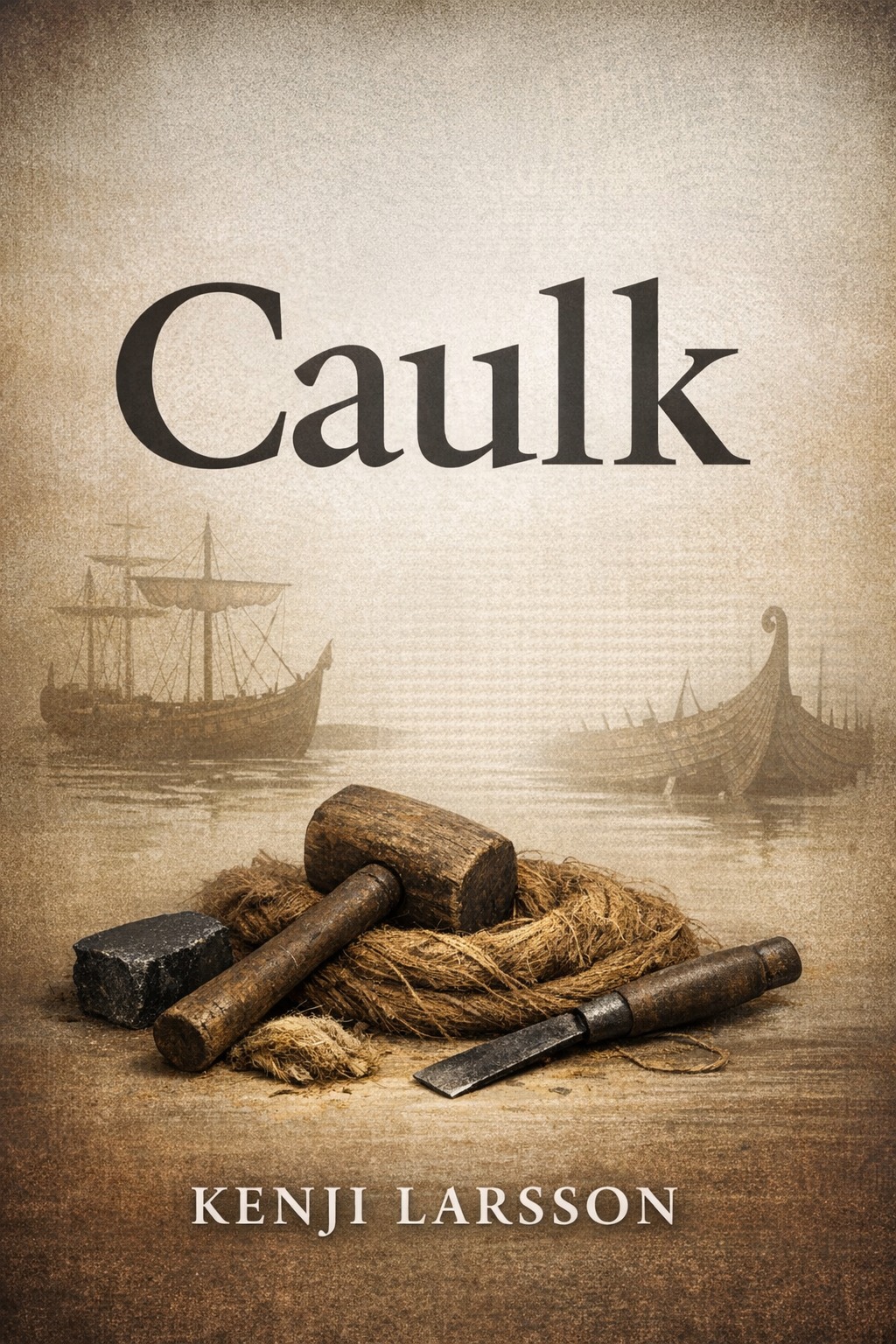

Cover of Caulk

Caulk

History · 312 pages · Published 2023-05-23 · Avg 4.5★ (6 reviews)

From Roman galleys at Ostia sealed with pine pitch and wax, to Viking longships excavated at Roskilde packed with tarred oakum, Caulk follows the humble filler that kept worlds afloat. Historian Kenji Larsson combs shipyard ledgers from Lübeck, Charleston, and Sur to trace fibers, mallets, and irons across empires and oceans. Along the way appear ropewalks, coopers' yards, and the pungent kettles that bound hull to horizon.

As steam and steel arrived in Chatham Dockyard and on the Tyne, caulking evolved—from hemp and bitumen to red lead putty and the ringing of caulking chisels along iron seams. Larsson interweaves the notebooks of Eleanor Brackett, a 1901 dockyard forewoman, with oral histories from Omani dhow builders and Japanese shipwrights of the Seto Inland Sea. In chapters that move from flooded rice barns in Ishikawa to wildfire-scorched log cabins in Minnesota, the book reveals how sealing a crack became a craft, an industry, and a language of resilience.

Photo of Kenji Larsson

Kenji Larsson (b. 1984) is a Swedish-Japanese historian of material culture whose research follows small technologies through big histories. Educated at Uppsala University (B.A.) and the University of Cambridge (Ph.D., maritime archaeology), he has held posts at the University of Gothenburg and the Roskilde Viking Ship Museum. His fieldwork spans dhow yards in Beypore and Sur, ropewalks in Chatham, and cedar shipwrights along the Seto Inland Sea.

Larsson is the author of the award-winning Lines in Water: A Microhistory of Rope and Timber Empires: Wood, War, and the Northern Seas. His essays have appeared in Past & Present and Mariner's Mirror, and he received the Skagerrak Prize for Maritime Studies in 2020. He lives in Malmö with his partner and an elderly terrier named Pitch.

Ratings & Reviews

Keiko Matsuda
2026-03-05

Eleanor Brackett emerges as a steadying presence, her notes clicking like tools laid in order.

Larsson lets Omani and Seto shipwrights speak in workmanlike cadences, never as ornament. The result reads as fellowship rather than hagiography, a chorus of practiced hands teaching patience across generations.

Aisha Montrose
2025-08-01

Larsson tracks how a fix becomes a philosophy, returning to tar, hemp, and iron as touchstones for endurance. The book treats caulking as "binding hull to horizon", a language of resilience that links flooded barns, wildfire-scorched cabins, and shipyards from Lübeck to Sur without sentimentality.

Hannah Olofsson
2024-07-20

A concise balance of strengths and small snags.

  • Immersive craft detail without fluff
  • Metalwork chapters occasionally dense
  • Eleanor Brackett's notebook threads keep momentum
J. P. Kwan
2024-02-15

Larsson orders his chapters like a shipwright at a bench, tools first then the practiced swing. The alternation between Eleanor Brackett's 1901 notes and field interviews is crisp; a few transitions jump too briskly from Roskilde trenches to Chatham shop floors, but the prose remains taut and clear.

Gregor Velasquez
2023-11-29

If you appreciate the measured sweep of N. A. M. Rodger's naval histories and the community-grounded lens of Lisa Norling, this will suit you. Caulk shares their archival rigor but adds tactile craftwork from Omani dhow builders and Seto shipwrights, turning seam and fiber into story without losing the scholar's clarity.

Maya Torrence
2023-06-10

From Ostia to the Tyne, Larsson makes the world smell of tar and salt while showing why sealing a seam meant survival.

Generated on 2026-06-15 12:02 UTC