
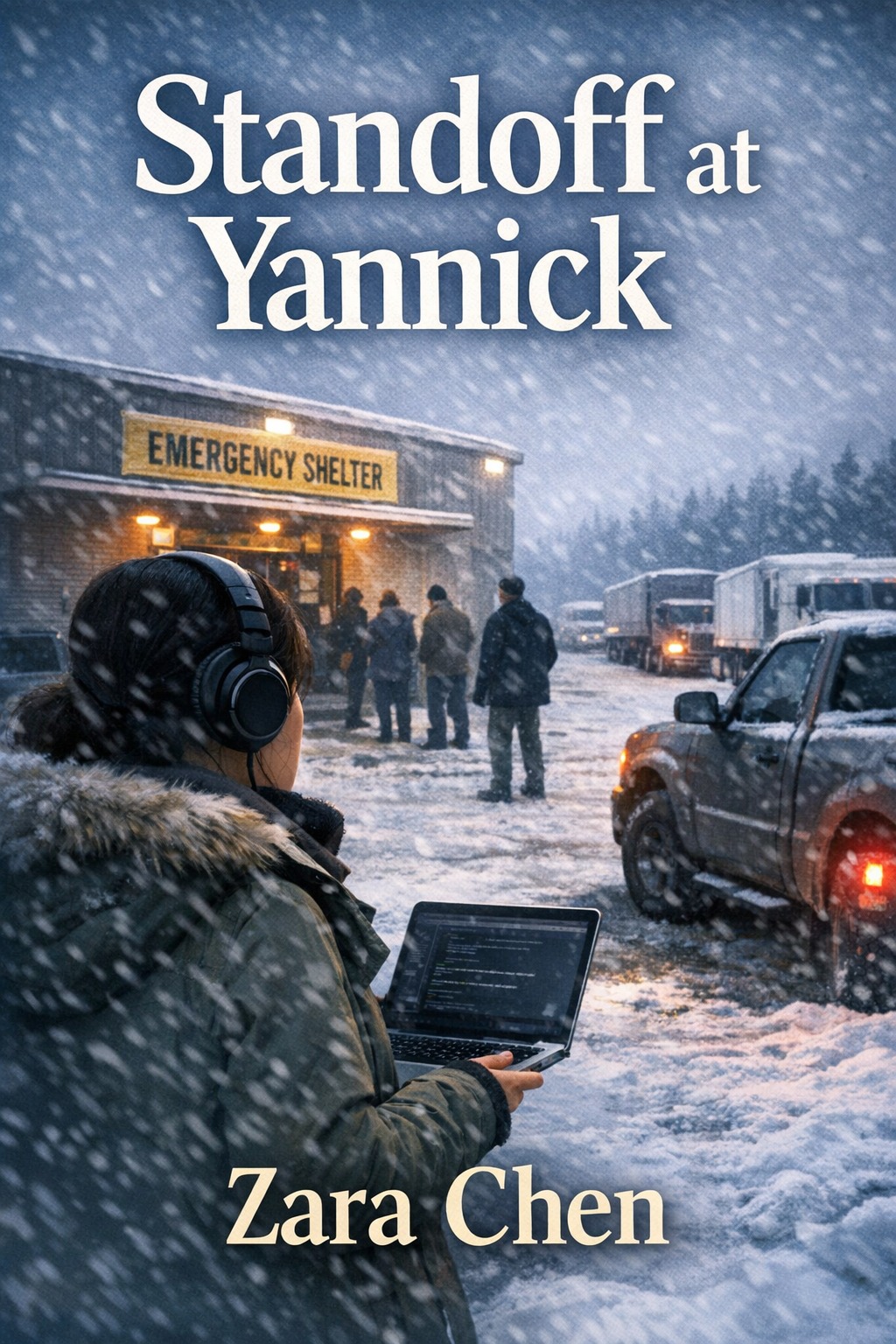

Cover of Standoff at Yannick

Standoff at Yannick

Suspense · 296 pages · Published 2026-05-01 · Avg 4.2★ (6 reviews)

When a winter blockade traps a convoy outside Yannick, a shuttered ceramics town at the edge of the Laurentians, freelance audio ethnographer May Zhang is stuck with a hard drive of interviews and a driver who won't say his name. In the municipal arena turned emergency shelter, rumors slither: a union vote gone bad, a missing mold-maker, and a set of MiniDiscs someone will pay to erase. Overnight, a corporate negotiator and a local matriarch jockey for control, while power cuts carve the rink into pockets of shadow.

As snow stacks against the doors, May uses the arena's PA, a broken clock, and three recordings—'Kiln 3 hum', 'Lunch bell', 'Andrew's laugh'—to map who is lying. The standoff tilts from civic to personal when a boy vanishes into the service tunnels connecting the plant to the river. Between blue ammonia light and the smell of gypsum, May realizes the only exit may be to stage a song: draw the hunters to where the archive can speak for itself.

Photo of Zara Chen

Zara Chen (b. 1986) is a Canadian journalist and biographer raised in Vancouver by Shanghai-born parents. A former music editor at The Walrus and contributor to The Wire, the Guardian, and the South China Morning Post, she has spent fifteen years tracing underground cultures from Montreal lofts to Guangzhou warehouses and factory towns. Her long-form features have earned two National Magazine Awards in Canada and a Digital Publishing Award for cultural reporting. She studied sociology at the University of British Columbia and ethnomusicology at McGill, and splits her time between Montreal and Taipei—still carrying a MiniDisc recorder in her bag.

Known for immersive, archive-rich reportage, Zara Chen writes across cultural history, oral tradition, and investigative nonfiction, following the lives of scenes, spaces, and objects—from experimental music and architecture to craft economies and labor. In recent years she has extended this approach to literary suspense and documentary fiction, building taut narratives from field recordings, contested memory, and the mechanics of making. She is the author of the essay collection Hum of the Spillways, the oral history Nine Ways of Listening to a City, and the narrative nonfiction works Dark House and Porcelain Revolts, which braid biography, place-making, and the ethics of work into human-scale stories.

Ratings & Reviews

Linh Kovarik
2026-06-10

Smart cold-weather suspense with an ear for detail, a touch long in the middle.

  • Snowbound arena politics that actually matter
  • Soundscapes with texture
  • Mid-shelter power plays run long
  • Best for readers who like industrial cold-case vibes
Cyrus Banerjee
2026-06-06

This is a suspense novel about labor memory as much as danger. The union vote, the vanishing mold-maker, and the arena politics are threaded into a study of who gets to define a town when the grid flickers.

Again and again May returns to sound as an ethic: she tries to "stage a song so the archive can speak for itself" instead of imposing a narrative. I loved how the three tracks echo through choices and how the corporate and the local keep trying to rename the same things. It all lands with the ache of thaw, the sense that testimony is both shelter and storm.

Maude Pelletier
2026-05-29

Yannick vit, gelé mais sonore. L'aréna municipal transformé en refuge, les poches d'ombre, la lumière bleue d'ammoniac et l'odeur de gypse composent un climat industriel qui colle à la peau.

Les couloirs reliant l'usine à la rivière ajoutent un suspense géographique, presque cartographique, que May trace avec le haut-parleur et ses trois enregistrements. Les rumeurs autour des MiniDiscs et du vote syndical épaississent l'air sans étouffer l'intrigue. Une atmosphère rare, tenue avec soin.

Marisol Greaves
2026-05-20

May is observant without cruelty, and her instinct to listen before acting makes each room in the arena feel charged. The driver who will not share his name is sketched in glances and engine noises, a foil who becomes a barometer for risk.

The negotiator and the matriarch circle one another with clipped, almost municipal politeness that slowly curdles, while the missing boy is never a device so much as a reminder of how fear travels. Even "Andrew's laugh" shifts from comforting loop to moral hinge as May decides how an archive should hold a living town. I believed every dialogue break and half-finished sentence. Five stars for character work that hums like Kiln 3.

Viktor Salim
2026-05-12

Zhang's audio-first framing gives the chapters a tactile pulse: scene cuts align with sounds, and the arena PA becomes a restless narrator. The book knows when to cut the power; scenes snap to black and resume in a new register. I loved how the broken clock timestamps tension without overexplaining, and how the MiniDiscs function as both evidence and temptation. A late section leans too hard on shelter politics and stalls the momentum, yet the closing set pieces in the tunnels feel earned. Precise prose, sharp structure, and a confidence with silence made this a winter story I could hear.

Keisha Norwood
2026-05-04

Snow seals Yannick and May Zhang turns the shut arena into a game board as she uses the PA, a broken clock, and three tracks ("Kiln 3 hum", "Lunch bell", "Andrew's laugh") to sift truth from the dark.

Generated on 2026-06-12 12:02 UTC