
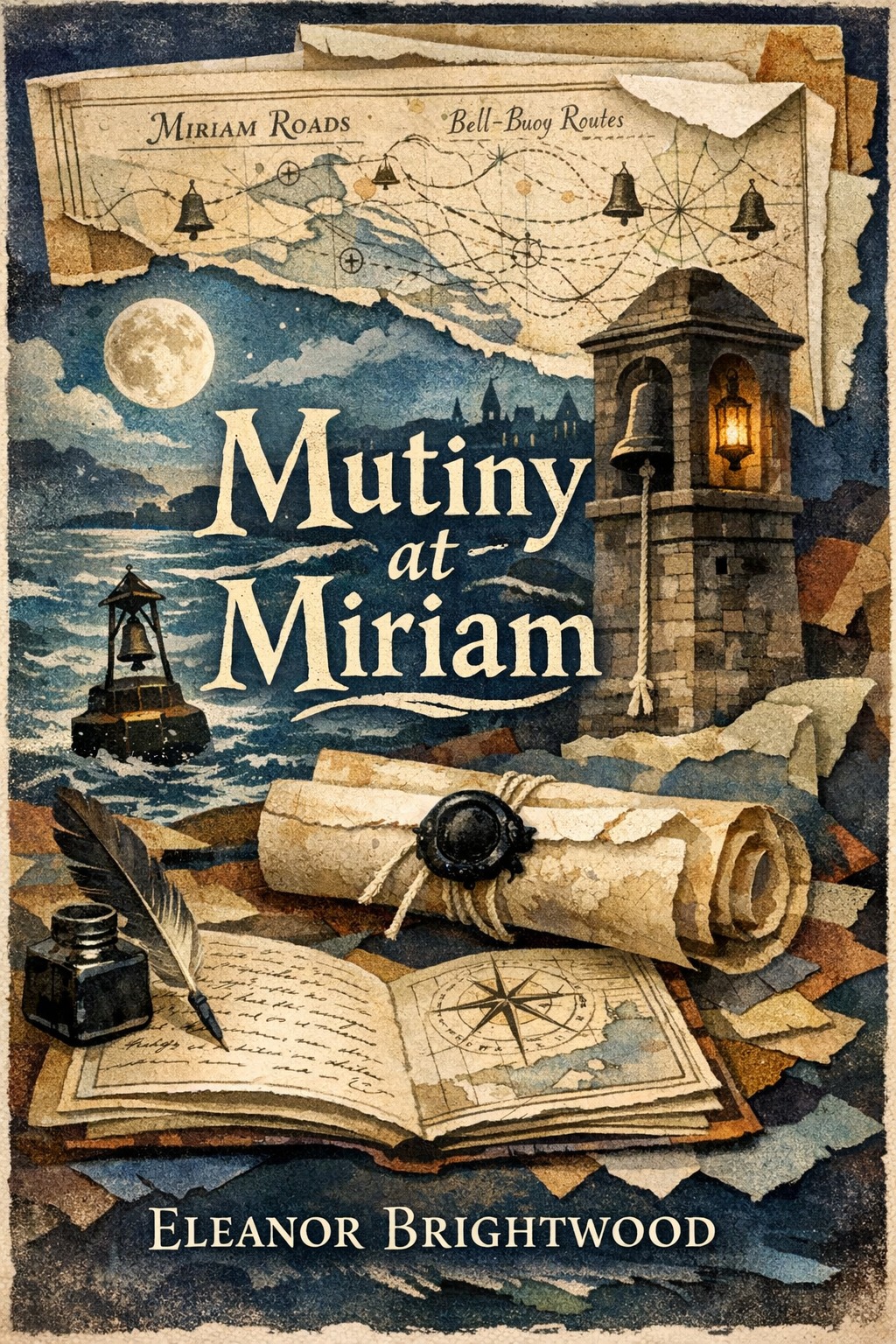

Cover of Mutiny at Miriam

Mutiny at Miriam

Fantasy · 368 pages · Published 2025-03-18 · Avg 3.2★ (6 reviews)

A fold-out chart of the Miriam Roads and bell-buoy routes is tucked behind the endpapers.

When the night bell at St. Miriam's Tidal Archive refuses to toll and the harbor notices arrive tied with salt-string and black wax, Wren Halley, caretaker of the bell and its ledger, finds that the town's kept histories are refusing to be kept. In Penwether, a weathered port between moor and sea, catalogues reorder themselves, rust-streaked logbooks exhale brine, and a child's toy skiff—tagged 1899—drifts from case to case as if searching for its crew. The Trustees would sooner lock the doors and call it damp. But Jonah Bude, retired lightkeeper of the Merran Shoal, and Seren Kellow, a folklorist from Exeter with mud on her boots, know the difference between rot and revolt. They whisper of the prison-hospital ship Miriam, scuttled just offshore, and of the mutiny whose names were scraped from the parish minutes. As equinox gales push the tide up the High Street and the great buoy Miriam rings at the wrong hour, Wren must choose between obedience to a silent charter and a salt-stirred uprising of memory. Keys go missing; the bell-rope knots itself into letters; the town's brass insignia—oystercatcher, bell, rope, and key around a stubborn M—turn up on doorsteps like summonses. Before the water falls away, she and her neighbors will have to unseal the record, right an old betrayal, and decide who gets to keep Penwether's story.

Photo of Eleanor Brightwood

Eleanor Brightwood is a British fantasy writer and folklorist from Cornwall, known for lyrical, place-rooted tales of inheritance, enchantment, and the quiet rebellions of caretakers, bell-tenders, archivists, and other keepers of the everyday. She studied English literature and folklore at the University of Exeter and worked as a librarian in Bath before writing full time. Her work has been shortlisted for the British Fantasy Award and the Kitschies, and she has contributed essays on regional myth, memory magic, shoreline traditions, and the politics of community archives to several folklore journals.

Eleanor Brightwood's stories braid coastal superstition with moorland myth, attentive to found objects, weathered places, and the ways communities keep or mislay their histories. She is the author of Ancestor's Enchanted Locket and the forthcoming Undertow, and her shorter fiction explores quiet, mythic fantasy through domestic spaces, tidal margins, and informal archives. She lives in Bristol with her partner and a perpetually muddy terrier, and spends weekends collecting sea-glass, seed packets, and stories from the harbors and high paths of the West Country.

Ratings & Reviews

Elliot Shore
2026-05-30

For a story so concerned with who speaks for a town, the people themselves often feel distant. Wren mostly reacts to phenomena rather than shaping them, and Jonah and Seren register as roles more than lives; I rarely sensed what they feared, wanted, or remembered beyond the job at hand.

Dialogue leans on murmury exchanges and gnomic lines, which keeps the mood but flattens voice. By the time the brass insignia start appearing on doorsteps, I craved a sharper sense of choice and consequence inside the characters, not just around them.

Lucía Carranza
2026-02-18

Para quién es: lectores pacientes de fantasía atmosférica con folklore marítimo y archivos vivos. Si disfrutas de ritmo lento, descripciones salobres y pequeños acertijos tipográficos, hay belleza aquí.

Como bibliotecaria, lo veo difícil para clubes generales. La jerga náutica, el mapa desplegable y las referencias a actas parroquiales pueden sentirse crípticos, y el tono brumoso tapa la tensión. Advertencias de contenido: ahogamiento implícito, hospitales barco, borrado institucional, ansiedad climática. Mi veredicto de colección es cauteloso, 2 estrellas.

Gideon Park
2025-11-10

At its nerve is a question: who gets to keep the story of a place? When "the harbor buoy rings at the wrong hour" and the archive refuses to behave, the book stages a conflict between tidy authority and tidal memory, with Wren caught between duty and a rising chorus of the kept and the forgotten.

I liked how the recurring emblems of rope, bell, key, and bird braid into that inquiry, and how the black-waxed notices critique institutional hush. I only wished the thematic throughline were a bit clearer in the early going, where symbol and plot sometimes blur like rain on glass.

Mara Leclair
2025-07-03

A moody harbor fantasy where the records revolt and a toy skiff goes wandering; the atmosphere sticks, but the plot slackens before the equinox surge.

Sanjay Kulkarni
2025-04-15

Marsh writes in clean, briny sentences that know exactly when to crest and recede. The chapters alternate between Wren's careful caretaking of the bell ledger and outward-looking glimpses of Penwether's altered records, creating a rhythm that mirrors the tide without feeling like a gimmick.

A few middle sections eddy as catalog minutiae stack up, and some readers may wish for swifter crossings between scenes, yet the book's architecture holds. I admired how the imagery threads repeat with purpose, how the fold-out chart is quietly echoed in the way clues are unfolded, and how the final movements resolve sound and silence into something earned.

Rhea Donnelly
2025-03-22

Salt in the spine, tide in the margins, bells that argue with time. Mutiny at Miriam soaked me through in the best way. The fold-out chart tucked behind the endpapers feels like secret contraband and a promise of depths to come.

Penwether is not just a backdrop; it is a sentient harbor, a sulking archive. Catalogues shuffle, rusted logbooks breathe brine, the tagged toy skiff noses along the cases as if checking roll call. Every detail smells of kelp and old ink, and I kept finding crystals of salt on the sentences.

The lore rings true and wild. A prison-hospital ship scuttled in shallow water, a mutiny vacuumed out of the minutes, the night bell refusing to toll while black-waxed notices arrive with salt-string burns on the knots. Then the buoy Miriam sings at the wrong hour, and you feel the town stiffen.

Wren Halley, Jonah Bude, Seren Kellow move like lighthouse beams through the fog, not as swaggering heroes but as keepers, listening. The bell-rope knots itself into letters, the oystercatcher and the stubborn M turn up like summons on the stoops, and the story lets the place speak for itself.

I could have lived in this weather forever. This is maritime folklore as uprising, an archive prizing itself open while the tide climbs the High Street. It is ravenous, generous, and luminous. Ring the bell, unseal the record, and let the town keep its story!

Generated on 2026-06-10 12:03 UTC