Cover of Pieter Jansz

Pieter Jansz

Horror · 352 pages · Published 2025-03-18 · Avg 3.3★ (6 reviews)

A Gothic horror rooted in Amsterdam's drowned history, Pieter Jansz threads ancient guild oaths and canal-rot into a tale of ghosts, grief, and women who refuse to vanish. When Mara Veen is dragged from the IJ beneath the iron ribs of Centraal Station with no family, no money, and no memories of how she fell in, the only refuge she finds is the mold-slick maze of the Jordaan. There, above a herring stall on Nieuwmarkt, she carves out a life as a ghost-talker for a salvage crew called "De Stilte," prying stories from rings, lockets, and waterlogged mouths recovered from the city's black arteries. The leaning houses of Brouwersgracht and the rope-scarred boats along Prinsengracht become her home and her haunt.

Then the past Mara can't recall sends up a relic: a warped oak panel hauled from the silt beneath Keizersgracht Bridge No. 31, its paint filmed with river-scum and signed in lampblack, "Pieter Jansz"—a name stricken from the Guild of St. Luke since the Egelantiersgracht fire of 1693. Almost at once, an unusually powerful ghost infest Amsterdam's waterways. Fog curdles on the Amstel locks; lovers on Magere Brug vanish mid-kiss; cyclists are yanked, screaming, from the narrow lip of Herengracht. The thing calls itself Jansz. It claims to have painted Mara "before you were born," to know the lullaby she hums and the crescent scar hidden beneath her hairline. It speaks of a studio that burned, a ledger of sitters with their names scraped thin, and a seal impressed in beeswax and blood.

Drawn into a deadly cat-and-mouse through warehouse lofts on Prinsengracht, midnight markets along Haarlemmerdijk, and under the stone shadow of the Oude Kerk, Mara reads the city the way she reads paint: smalt ground to dust, verdigris eating into gesso, pentimenti surfacing like bruises. Each clue knots to a procession of women erased—faces overpainted, throats stitched shut in underdrawings, signatures buried beneath fresh varnish. As the tides swell and the sluices choke, she begins to fear the monster stalking the canals is a portrait started with her own hand. To stop the drownings, Mara must unmake a painting that refuses to dry—and decide which life trapped in the varnish is allowed to set.

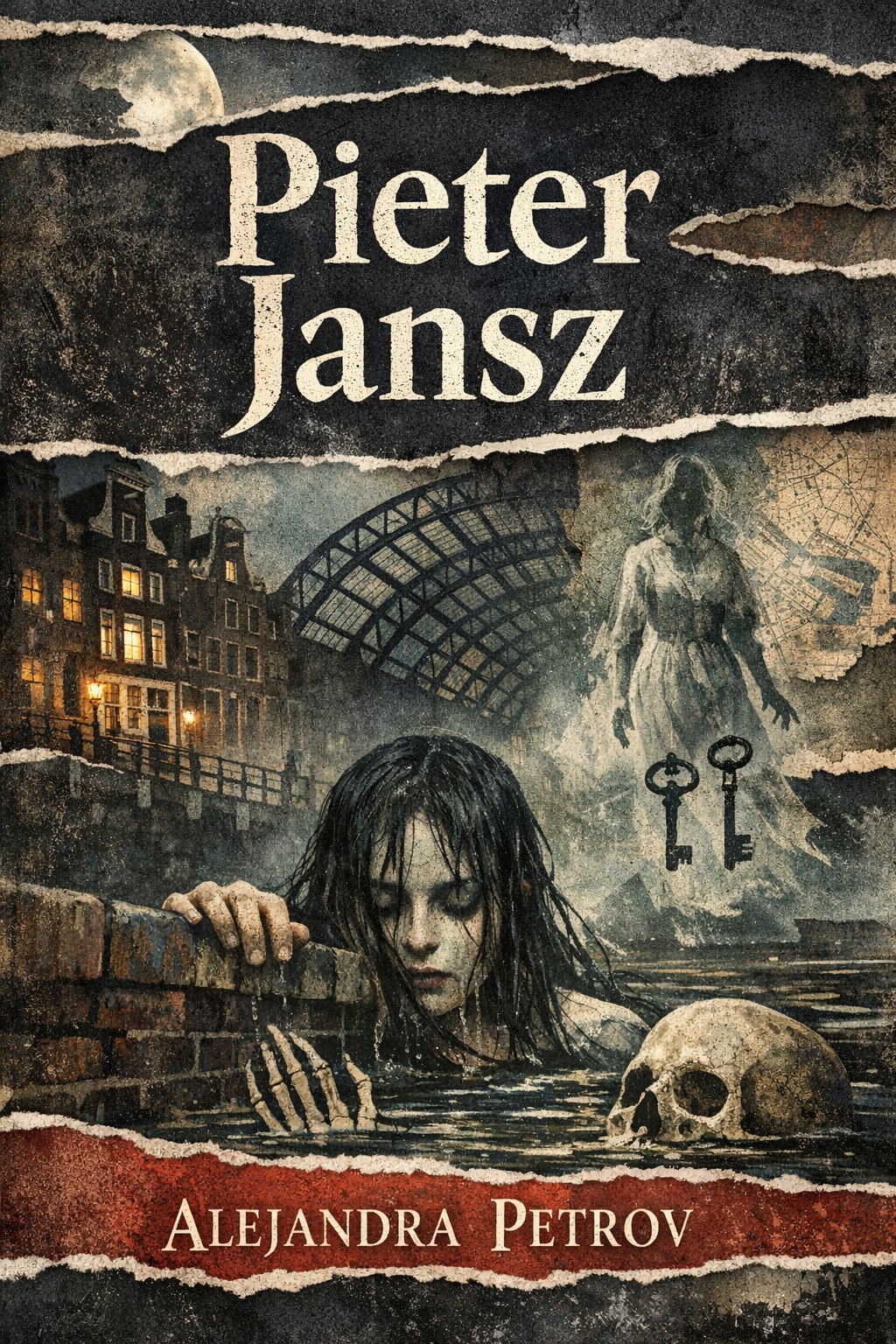
Photo of Alejandra Petrov

Alejandra Petrov is an Argentine-Russian writer and art historian whose work blends maritime folklore with the quiet terrors of museum basements. Born in Mar del Plata and raised between Buenos Aires and Kaliningrad, she studied conservation science at the University of Amsterdam and later worked as a registrar for small galleries along the Noordzeekanaal, cataloging shipwreck timbers and salt-bitten devotional panels.

Her fiction often explores the afterlives of objects and the bargains struck in damp places. She is the author of the gothic novels The Salt Bride (2019) and Winter Quay (2022), and a recipient of the Buenos Aires Book Prize finalist citation for emerging voices in speculative literature. Essays and short stories have appeared in the independent magazines Brackish Waters and Orbital Window. Alejandra Petrov lives in Utrecht, where she teaches workshops on material culture and narrative, and spends too much time in archives handling things that whisper when no one else is listening.

Ratings & Reviews

Sofia Almeida
2026-06-03

Hand this to readers who favor slow, fog-heavy horror rooted in real streets and who enjoy art history puzzles more than jump scares. The Amsterdam setting is specific enough to satisfy locals and accessible enough for travelers.

Suitable for adult collections. Content notes include drowning, body decay, water trauma, arson, and recurring themes of gendered violence and institutional erasure. Fans of moody canal noir and atmospheric salvage tales will find plenty to linger over, while impatient readers may chafe at the contemplative pacing.

Daniel Okoye
2026-04-10

The novel insists on the erasure of women as its drumbeat, from scraped ledgers to overpainted faces, and that is potent territory. But the motif is hammered so often that the more intimate griefs lose oxygen.

I liked the conceit of "a painting that refuses to dry" and the way pigments are moral choices, yet the argument gets spelled out when a little negative space would have invited the reader in. The story is strongest when it trusts the ghosted archives to whisper rather than explain.

Marit de Vries
2026-01-22

This book traps you on wet stone and warped planks. The Jordaan, Brouwersgracht, and the shadow of the Oude Kerk are rendered as a working map, all current and undertow.

The rules of the dead have texture. Objects become mouths, guild oaths bind across centuries, paint holds a ledger. De Stilte reads like a real salvage outfit, rope-burned and half superstitious, and the waterways become both hunting ground and witness. Horror grows from place, not from jump scares, and it seeps beautifully.

Priya Kulkarni
2025-11-03

Mara's voice lands in that taut space between numb and stubborn. Her amnesia is not a gimmick so much as a bruise she keeps pressing, and the ghost-talking talent lets us hear her empathy without long confessionals.

Jansz, as a presence, is both intimate and theatrical, needling at where names are kept and who gets to keep them. I wanted a touch more conversation among the living crew to offset the haunt, but Mara's choices feel earned, even when the canal fog closes in.

Arturo van Dijk
2025-07-15

The prose smells of algae and smoke, with sensory details that accrue like silt rather than shout for attention. Chapters meander through alleys and then tighten into sudden set pieces on the bridges, a rhythm that mirrors the locks and sluices. When the crew of De Stilte hauls up rings and lockets, the short interludes that follow read like marginalia from the city's ledger, brief and cutting.

A few late chapters feel overvarnished, revisiting the same revelation from adjacent angles, yet the line-by-line control keeps the mood intact. I admired how brushwork and pigment become verbs, how the storytelling treats stains and pigments as clues without turning into a lecture.

Lena Moss
2025-04-02

A lean, eerie chase through Amsterdam's canals where Mara Veen's salvage jobs turn into a puzzle of drowned women and a painter's revenant; the middle lingers, but the final image bites.

Generated on 2026-06-09 12:01 UTC