Cover of Fort Harrow

Fort Harrow

Science · 304 pages · Published 2024-10-01 · Avg 3.7★ (6 reviews)

Fort Harrow follows a photon's-eye passage through the polar ocean, charting how light threads ice, fog, and plankton to shape the colors and chemistry of our seas. Grounded in a winter spent at a makeshift sea-ice station nicknamed Fort Harrow off Nordaustlandet in Svalbard, Alexander Thompson blends field notes with first-principles physics to reveal how scattering, absorption, and reflection connect remote floes to weather forecasts, fisheries, and climate models. With scenes aboard the R/V Kronprins Haakon in the Fram Strait and under the dive huts of McMurdo Sound, he shows how hyperspectral instruments, ice cores, and simple pocket mirrors can resolve mysteries that satellites alone cannot. Intellectually rigorous yet written in clear, non-technical prose, this book assembles decades of ocean optics into a vivid framework for seeing the sea anew—and for understanding why a changing cryosphere matters far beyond the pack ice.

Chapters:
1. Why the sea is blue (and sometimes green)
2. The wanderers: photons and their paths
3. Winter glass: sea ice as lens and shield
4. The machine in the wave: scattering and absorption
5. Colors in contention: chlorophyll, CDOM, and dust
6. Hyperspectral eyes: building the instruments
7. Fort Harrow: a station on drifting ice
8. McMurdo blue, Fram green
9. The under-ice sky and the albedo puzzle
10. Plumes, fronts, and the edge of the pack
11. Light as currency: feeding polar food webs
12. Models that see: radiative transfer made usable
13. The long reach of light: feedbacks in a warming world

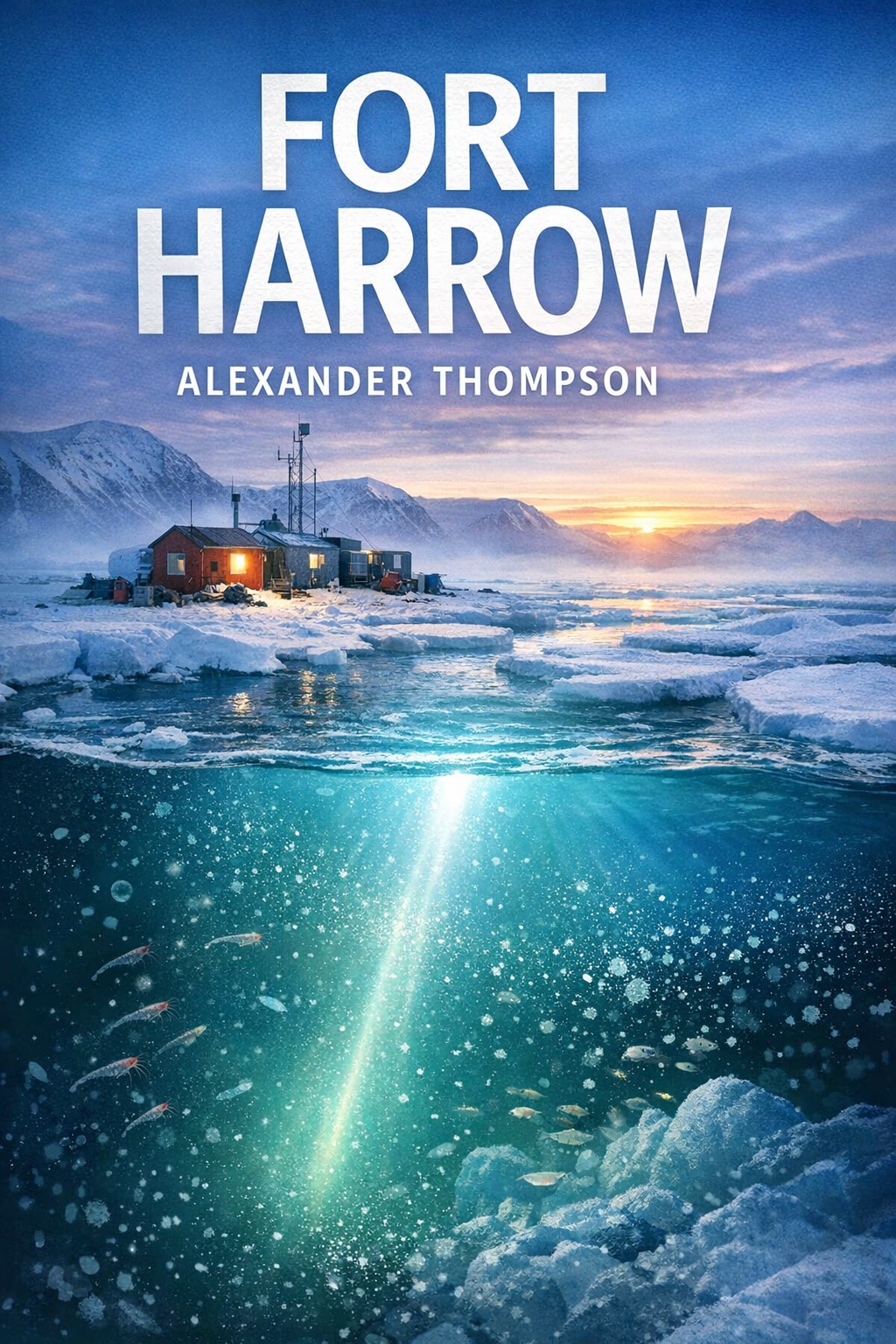
Photo of Alexander Thompson

Alexander Thompson (b. 1980) is an American physical oceanographer and science communicator whose research centers on light–ice interactions and ocean optics. He earned a B.S. in physics from the University of Washington and a Ph.D. in oceanography from Scripps Institution of Oceanography, where he specialized in radiative transfer in polar seas. Thompson has led field campaigns in McMurdo Sound and the Fram Strait, conducted ice-station work in Svalbard, and developed hyperspectral instruments for ships and sea ice. He is an associate professor of marine physics and a frequent contributor to national science magazines.

As a writer, Alexander Thompson bridges technical research and narrative science, bringing readers from the lab bench to the floe edge. His popular science books, including Reflections in the Crystal Sea (2022) and Fort Harrow (2024), explore how light structures marine ecosystems and how polar change ripples through global climate. When not at sea, he mentors early-career researchers and photographs coastal light phenomena near his home in Seattle.

Ratings & Reviews

Anika Bose
2026-05-29

As a presence on the page, Thompson is steady and modest, more guide than protagonist, and the most vivid "character" is the photon that wanders through brine channels, fog banks, and plankton blooms. Side voices from the R/V crew and divers flicker in with notes and jokes, but this is not a memoir in disguise, so readers seeking interpersonal drama will find mostly careful observation and a humane, curious voice.

Victor A. Ramos
2026-01-17

Imagine R. W. Preisendorfer meeting Eli Kintisch: equations in one pocket, polar anecdotes in the other. If you like rigorous field science leavened by quiet humor, this hits the mark, but casual readers may find the instrument-building chapter and calibration tangents a bit heavy. I admired the clarity yet felt little narrative tension, so I dipped in and out rather than reading straight through.

Nate O'Rourke
2025-08-09

Thompson returns again and again to reciprocity, showing how a single ray path can link micro life to model grids. I loved the recurring thread that measurement is a civic act, a way to "see the sea anew" without handwaving away complexity.

The motif of light as currency lands especially well in the chapters on polar food webs, and the ethical edge of a warming world is handled with restraint. A touch more on indigenous sea-ice knowledge would have deepened the conversation, but the thematic arc still resonates.

Marisol Vega
2025-03-21

What dazzled me was the sense of place and process. Fort Harrow emerges as a small human outpost holding back winter long enough to measure it, while the polar ocean becomes an optical system where ice floes act as lenses, fog as filter, and plankton as reactive dye. The connections to weather, fisheries, and climate are presented with unshowy authority, and the book convinces you that answering the albedo puzzle under drifting ice is not niche at all but central to how the planet works.

Colin Hart
2024-12-02

The braided structure of shipboard scenes, ice-station vignettes, and primer-level physics mostly works, but a few chapter pivots feel abrupt, like logbook entries stitched after the fact. Thompson is generous with concrete images and patient explanations, and the photon POV gives continuity when the timeline hops.

The prose is clean and often musical, yet the middle swells with instrument minutiae that slow momentum. I wished for a couple of sketches or tables to anchor the hyperspectral bits, though the closing chapters restore flow with lucid summaries of radiative transfer in practice.

Sana Idris
2024-10-15

A clear, briny travelogue of light that moves briskly from field notes to first principles, turning ice, fog, and plankton into waypoints rather than hurdles.

Generated on 2026-06-08 12:02 UTC