Cover of Flight from Pieter

Flight from Pieter

Crime · 352 pages · Published 2025-10-14 · Avg 3.8★ (6 reviews)

On a wind-burned January afternoon along the Black River flats, the brand-new private cargo hub locals call Pieter Field hums like a hive. Built at breakneck speed on the bones of a decommissioned Guard base outside Lorain, Ohio, it promises jobs, tax abatements, and fast fortunes. Then, right after an overnight 737 freighter from Halifax taxis to Hangar 4, the radio chatter dies and the day splits clean in two.

Cassie Blanchard, a ground operations lead whose clipped checklists keep the place from veering into chaos, fails to pick up her four-year-old son from the daycare off West Erie Avenue. Her partner arrives to find Cassie's Civic parked beneath the tower, her ID badge still pinging a reader by a service stair, her laptop open on the ops desk, her phone charging next to a battered VHF set. Her keys hang from their labeled hook. Except Cassie is nowhere. The cameras over the hangar doors play the same one-minute loop. The foreman who swears he saw her is suddenly on leave.

Nate Golding, a reporter for Midwest Dispatch and a former structural engineer who once stamped drawings for trusses just like the ones groaning over Hangar 4, gets a call from a union steward who doesn't trust the fast-talking suits of Pieter Logistics. What starts as a missing-person bulletin widens into a ledger of vanished invoices, shell bids routed through Rijn Holdings BV, and a safety report that reads like a ghost—references to tests no one can produce, signatures that stutter. A steelworker named Jamar Teague fell from a catwalk during construction last spring; the county labeled it misadventure, but Jamar's cousin shows Nate a photograph of a bent gusset plate the size of a dinner tray and a text about a last-minute substitution in the node assemblies.

With every hour that Cassie is gone, Pieter Field's story of itself unravels. The cargo manifest from Halifax arrives as a stack of blank pages. A flight data card vanishes from a cockpit, and a subcontractor's box truck is found idling near a stormwater outfall that drains under the perimeter fence toward the river. The sheriff's office blames outsider theft rings; the FAA blames supply chain fraud; Pieter's PR man blames rumor. Meanwhile, the condo blocks pitched to airfield staff as safe, smart, and surveilled feel suddenly porous, and neighbors who cheer-led the project can't explain why their garage doors are being reprogrammed at 2 a.m.

As winter grips the Lake Erie shore and rumors spin—trafficked cargo, statehouse kickbacks, a European buyer with a Dutch name and an Ohio PO box—Nate peers into the one place no one has measured: the tunnels under the runways where meltwater and secrets both drain. To find Cassie, he'll need to read the airfield the way he once read concrete, to trust the whistleblowers who can't talk on record, and to decide how much of his own past on public works he's willing to exhume. Flight 417 left Halifax and touched down at Pieter. What left Pieter in its wake is the crime everyone is trying not to see.

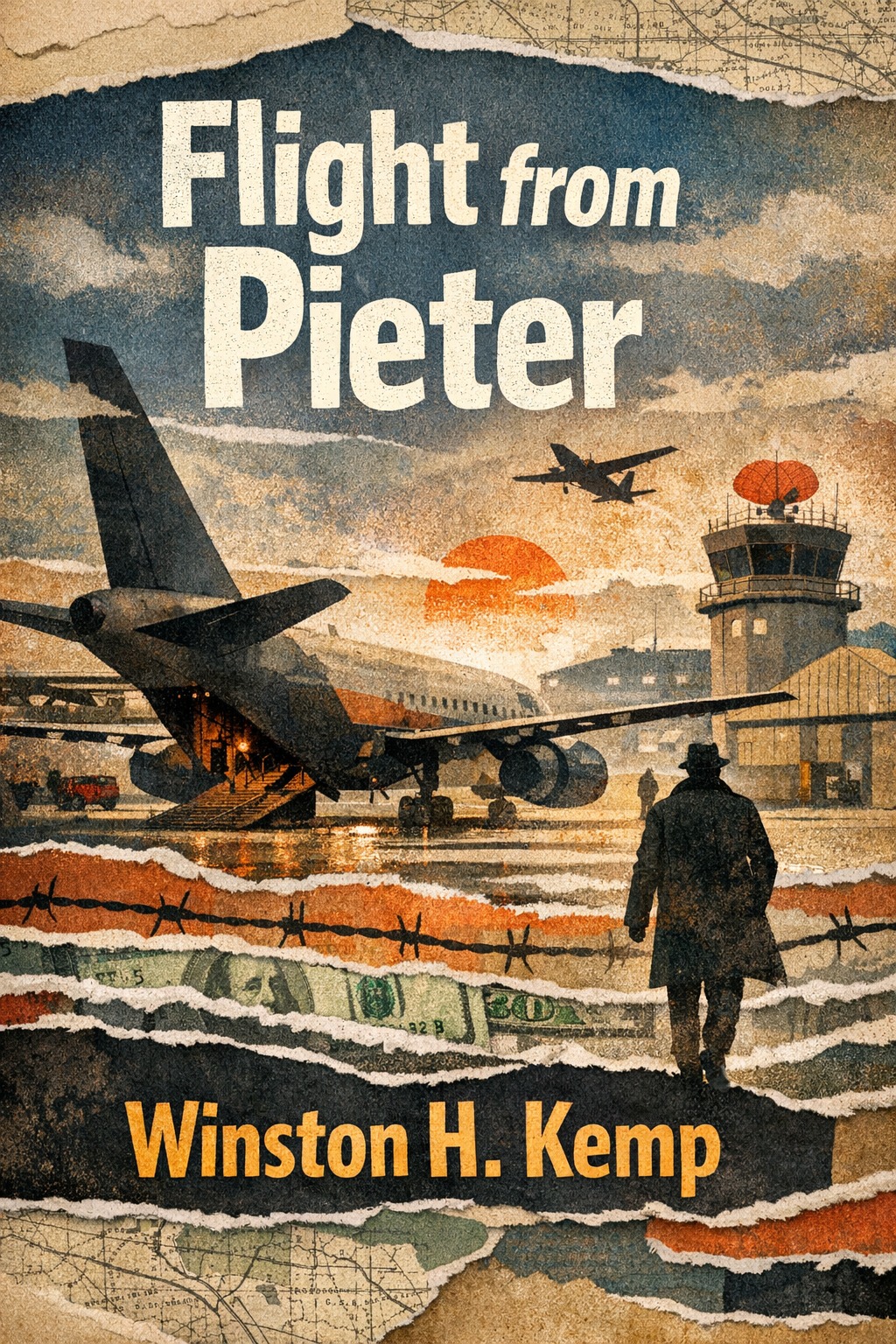
Photo of Winston H. Kemp

Winston H. Kemp is an American investigative journalist and former structural engineer. Born in 1979 in Toledo, Ohio, he earned a B.S. in civil engineering from The Ohio State University and spent a decade on bridge and transit projects around the Lake Erie basin before retraining in journalism at Northwestern's Medill School. His reporting on public contracting, industrial safety, and the shadow world of infrastructure finance has appeared in the Cleveland Plain Dealer, Midwest Dispatch, and ProPublica, garnering a Sigma Delta Chi Award and a Livingston Award finalist nod.

Kemp's work bridges the blueprint and the byline. Drawing on field inspections and procurement files, he writes crime-driven narratives that trace how money, metal, and municipal power collide—whether in reported features or in fiction that keeps one steel-toed boot in the facts. His books, including Blueprint of a Scandal, follow workers, whistleblowers, and officials through the opaque systems that shape Midwestern life, from decommissioned waterways to fast-tracked megaprojects.

He has taught longform reporting at Kent State, testified before the Ohio House on procurement transparency, and continues to mentor young reporters on document-driven investigations. Kemp lives in Cleveland Heights with his partner and a retired greyhound, and he still can't pass a bridge without checking the gusset plates.

Ratings & Reviews

Mateo Robles
2026-05-26
  • Strong sense of work on the ground at an airfield
  • Tangible engineering details that inform the mystery
  • Middle sag with procurement jargon, payoff is clean
  • Best for readers who enjoy newsroom procedurals and regional noir
Sylvia Han
2026-04-15

Much of the book turns on public trust and the stories cities tell themselves about jobs and speed. This is less about whodunit than about systems failing in plain sight: contracts, cameras, and the wish to believe in easy growth. The echoed line that "the day splits clean in two" keeps surfacing in paperwork that deletes itself and in residents who learn how surveillance cuts both ways. I wanted a touch more clarity on the European money angle, but the theme of accountability lands.

Arjun Patel
2026-03-07

The book nails place. From the wind off Lake Erie raking the Black River flats to the quick-and-cheap bones of a repurposed Guard base, every part of Pieter Field feels provisional and risky. Hangar 4 groans, the condos promise safety that leaks at the edges, garage doors jitter at 2 a.m., and a blank cargo manifest somehow weighs a ton. When Nate follows meltwater toward the tunnels, the stakes expand from one missing mother to a whole region built on sped-up promises.

Renee Carbone
2026-01-18

Cassie is a compelling absence. Her checklists, the keys on the hook, the ID pinging a reader, all sketch a person whose order is her armor.

Nate's mix of reporter instinct and builder's caution reads true, especially in conversations with the union steward and Jamar Teague's cousin. Dialogue stays spare and local, and even the PR man reveals seams under pressure, so the cast feels rooted without grandstanding.

Malik Herrera
2025-12-10

Golding's chapters run on crisp, workmanlike prose that mirrors the ops world, and the alternating beats between newsroom digging and airfield shifts mostly lock together. The middle third leans hard on invoices and shell bids, which flattens momentum, and some acronym-heavy passages ask the reader to slow down. Still, the final act tightens, and the structural engineer's eye for load paths shapes a neat, earned escalation.

Dana Cho
2025-11-02

A smart, wind-gnawed thriller where Cassie vanishes between an idling box truck and a looped camera feed, and Nate races the cold to map the tunnels under Pieter Field.

Generated on 2026-06-02 12:06 UTC