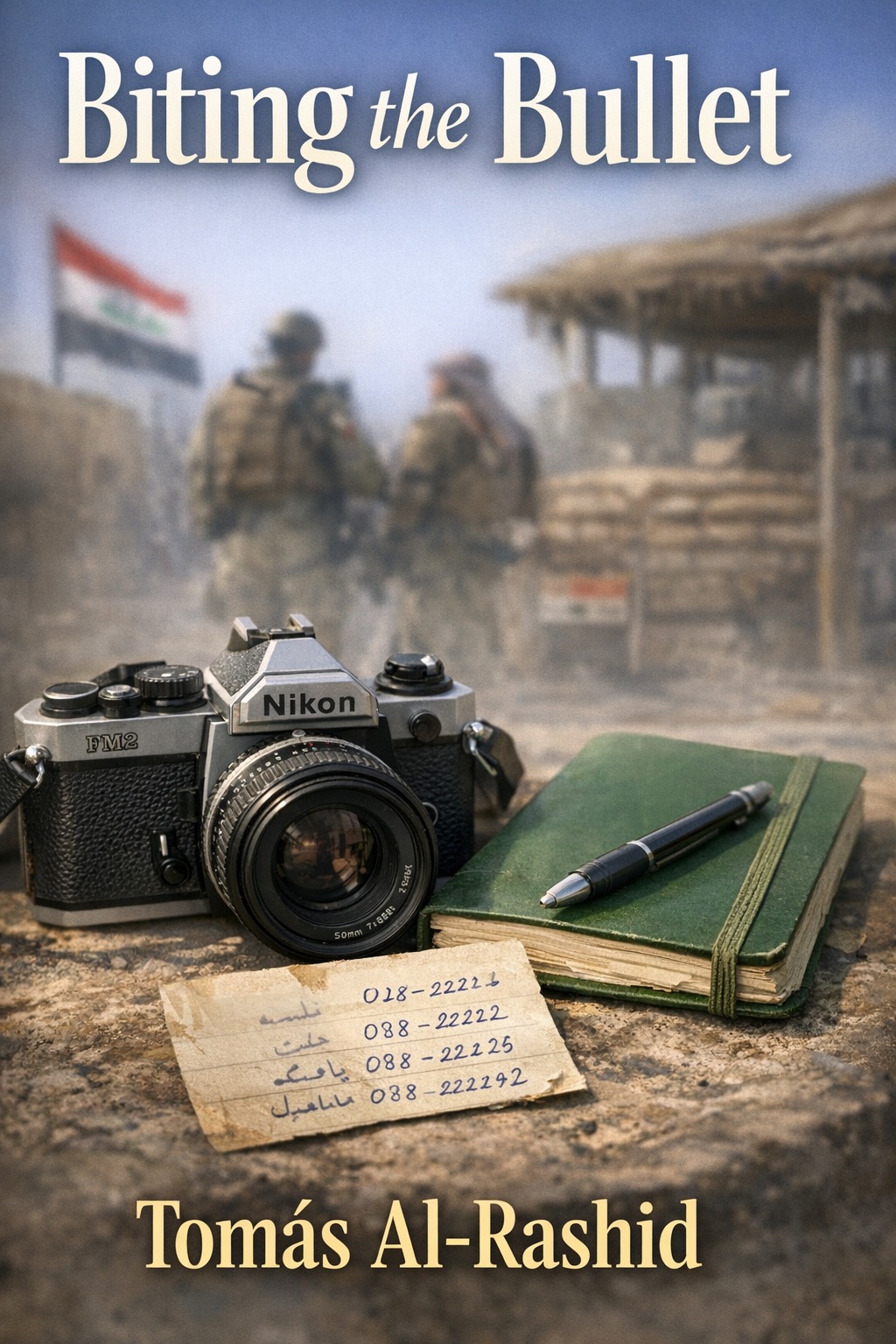
Cover of Biting the Bullet

Biting the Bullet

Memoir · 288 pages · Published 2024-10-08 · Avg 4.5★ (6 reviews)

At nineteen, Tomás Al-Rashid left Sevilla for Baghdad with a battered Nikon FM2, a green Moleskine, and phone numbers his Basran cousins had scribbled on a postcard. In hotel lobbies and at checkpoints along the Nineveh Plain, he learned to translate more than words, shuttling between soldiers, nurses, and families while cataloging the objects they carried. When a fragment of metal lodged in his molar during a market blast, he began to measure time by dental x-rays and the tastes of iodine, tea, and dust.

In Biting the Bullet, he returns to rooms and roads that held him together: the dim corridor of the Hotel Palestine, a prefab clinic in Idomeni, and a fourth-floor walk-up on Calle de Atocha. Through vignettes about fathers and field guides, first aid kits and faith, he maps how care travels across languages and borders. The memoir is an inquiry into witness and repair, as he decides whether to keep the shard in his tooth or finally let a Madrid dentist grind it free.

Photo of Tomás Al-Rashid

Tomás Al-Rashid is a Spanish-Iraqi writer and interpreter born in 1985 in Sevilla and raised between Andalucía and Basra. He studied Arabic and journalism at the Universidad de Granada and worked as a fixer and translator for international reporters in Iraq from 2007 to 2011, later coordinating community health projects on Lesbos and in Idomeni. His essays have appeared in El País Semanal, The Guardian, and Revista 5W, and he was a finalist for the Ortega y Gasset Journalism Award.

He is the author of the essay chapbook Maps We Carry (2019) and the photo-text exhibition Borrowed Light, shown at La Casa Encendida in Madrid. Tomás Al-Rashid teaches narrative non-fiction workshops, splits his time between Lavapiés and Cádiz, and volunteers with a neighborhood mutual aid network. He speaks Spanish, Arabic, and English, and is currently developing a radio series on objects that outlive wars.

Ratings & Reviews

Javier Montes
2026-03-08

Un cuaderno verde, una Nikon vieja y una muela marcada por metal; con eso, Tomás traza un mapa íntimo de cuidado entre Sevilla, Bagdad y Madrid.

Mina Hartwell
2025-09-14

Readers who gravitate toward the reflective travel writing of Teju Cole and the witness-driven memoir of Samar Yazbek will find a kindred cadence here. This is not frontline choreography so much as a study of attention, translation, and the small logistics of care.

If you want a strict, chronological narrative, the mosaic form may ask you to recalibrate. But if you value essays that braid objects, places, and choices into a quietly urgent throughline, Biting the Bullet rewards you with scenes that linger like dust on the tongue.

Caleb Okafor
2025-06-20

What I loved most was how place operates as an emotional climate. The corridor in the Hotel Palestine narrows our breath; the Nineveh Plain checkpoints expand and contract hope depending on who waves you through; the prefab clinic in Idomeni hums with fluorescent fatigue; the Atocha walk-up stacks city noise under a ceiling of decision. The book's geography is not about borders on a map but about thresholds—who is allowed to cross, who waits, who translates the waiting into something survivable. It reads like a field guide to carrying care across rooms.

Mara El-Khoury
2025-01-12

What a blazing, tender memoir. Al-Rashid doesn't posture as a hero; he assembles a vocabulary of care and attention, and it floored me.

The rooms return like touchstones: the dim corridor of the Hotel Palestine, checkpoints where objects and names get weighed, the prefab clinic in Idomeni with its humming lights, the Madrid walk-up where fatigue climbs the stairs too. He keeps cataloging what people carry and what they set down, and somehow that inventory becomes a way of loving the world without looking away from its wounds.

The tooth is the book's metronome. X-rays stand in for calendars, and "the flavors of iodine, tea, and dust" become a way to count time and doubt. I found myself rooting for the shard to stay, then to go, then to stay again, because the argument here is not about toughness but about what we owe to our past selves and to those who patched us together.

Fathers, field guides, first aid kits, faith. The litany keeps returning, and each repetition opens a new door. His translation work is not just language; it is presence, hospitality, a kind of secular prayer said at makeshift desks and triage stations. The restraint of the voice makes the feeling hit harder.

By the end, I felt both steadied and undone. If memoir is a long act of witness, this one remembers how to repair as well. I will be pressing it into the hands of friends who think care is small work. It isn't. This book proves it.

Sofia Benitez
2024-12-02

Tomás emerges as a listener before anything else, which is rarer than it sounds. He takes in the clipped jokes of soldiers, the careful questions of nurses, the exhausted gratitude of parents, and allows their rhythms to shape his own sentences without ventriloquizing them.

What deepened my attachment was the ambivalence around the metal in his tooth. It is emblem and irritant, memory and maintenance. The choice to keep it or grind it free becomes a conversation with fathers and with the self that left Sevilla with a Nikon and a green notebook. That delicate interior weather—curiosity, guilt, duty—feels honest, never staged.

Owen Carlisle
2024-11-05

A meticulous, image-forward memoir that trusts white space and the reader's patience. Al-Rashid writes with a cameraman's patience: he holds on the detail until meaning blooms.

The vignettes create a mosaic whose grout is made of lists—first aid items, transit routes, the objects tucked into pockets. At times the Idomeni sequence drifts and the connective tissue feels thin, but the recurring tooth motif and the return to Madrid tighten the arc in a quietly satisfying way.

Generated on 2026-05-31 12:02 UTC