Cover of The Sextant

The Sextant

Science Fiction · 544 pages · Published 2024-08-13 · Avg 4.5★ (6 reviews)

The Meridian Compact has shattered, leaving eight hundred threaded corridors to drift under a hundred small flags and one long shadow. Something older than language is moving in the gaps between jumps—the Undertide, a blind computation that erases causes and leaves only effects, eating histories like salt eats iron. In the frost-burned cinder of the Nerezza system, exo-cartographer Dr. Faye Laghari captains a desperate observatory aboard the derelict lighthouse Ark Hecate, trying to reconstruct the long-forgotten bearings that once kept the corridors stable. Her only workable instrument is a myth retrieved from a museum vault on Ilex Prime: the sextant, a star-geometry engine that requires six entangled human minds and a lattice of folded glass to read the universe's true angles, even if using it means threading her own cognition and the orphaned hollow-brain apprentices into a single, dangerous chorus.

Across the freeholds of human space, Auditor Caio Brant pursues a vanished navigator whose last course plots a path no ship should fly, while contraband carrier Kade Ibarra and the crew of the cutting sloop Heaviside Drift barter, salvage, and quietly build a commons charter from the wreckage of collapsed treaties. On the monastery-station Lazuli Gate, Sister-Mathematician Mireille Sun sings probability into coherent weather to hold back riots as corridor-lights stutter and days skip. The farther they travel and the stranger the errors grow—unborn cities appearing in old survey files, crews remembering lives they never lived, ships arriving before they depart—the more certain it becomes that the Undertide is not invading so much as correcting a flaw that humanity exploited.

As incomprehensible pressures gather to shear minds from bodies and make every corridor impassable, Faye discovers a last, improbable configuration: link six ancient lighthouses into a hexagram across the dark gulf called the Hunter's Jaw and let the sextant fix a common bearing for every inhabited world, collapsing the market for war, smuggling, and lies by making position—political and physical—unforgeable. The promise is a civilization that can finally navigate itself without borders, without secret routes, without false maps. The cost is that the sextant must be finished with six living anchors who will never come home again, and its calibration will overwrite the private asymmetries that make a person a person. To save what people are together, someone will have to give up who they are alone—and the ocean that wants to drown them may be the only thing that can hold the line long enough to choose.

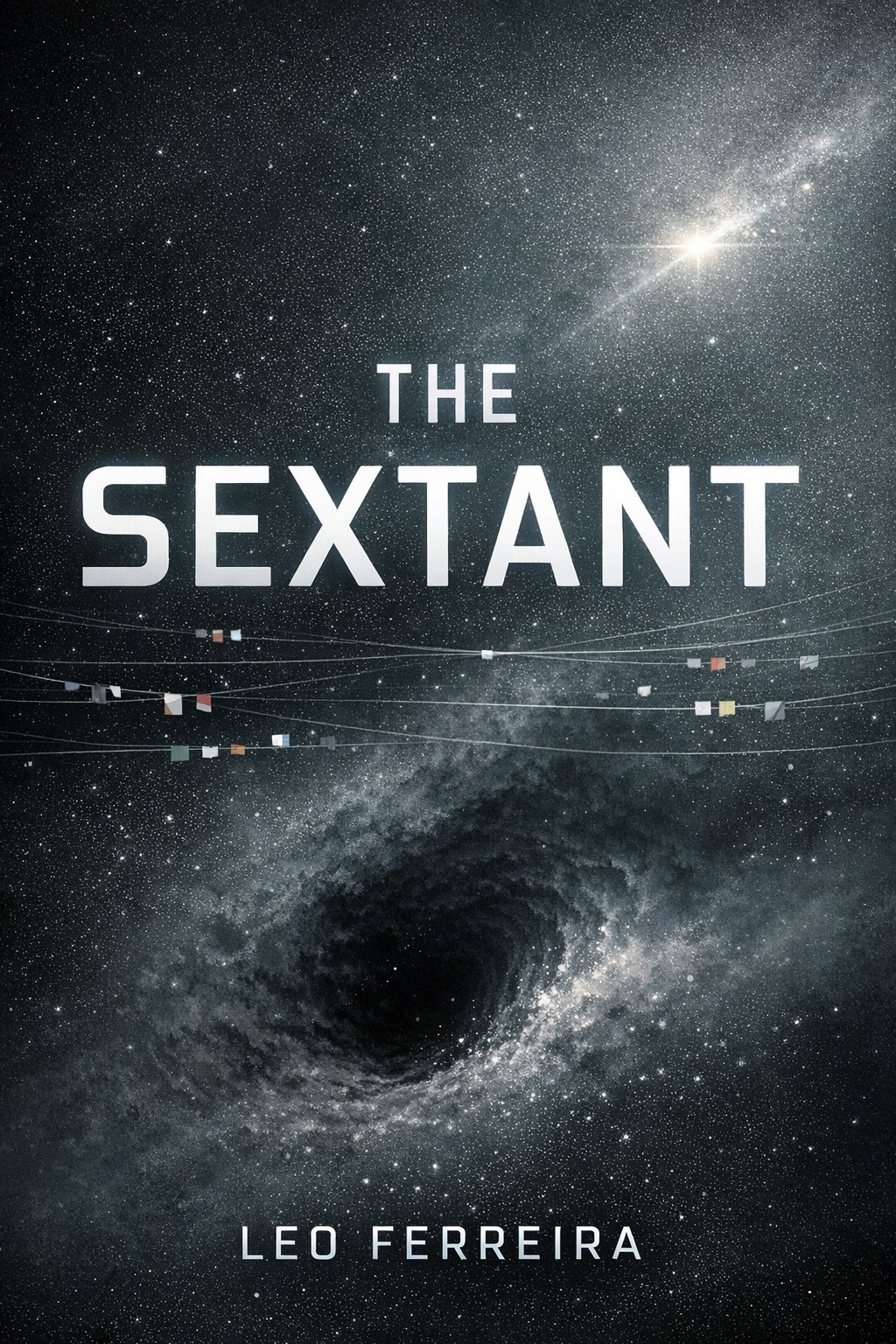
Photo of Leo Ferreira

Leo Ferreira is a Brazilian-born, Lisbon-based science fiction writer and translator whose work often explores navigation, memory, and the mathematics of belonging. Raised in Recife and educated in computational physics, Leo spent a decade modeling orbital debris and probabilistic routing for a European space-traffic consortium before turning full-time to fiction. His short stories have appeared in Portuguese- and English-language magazines across the Atlantic, and his translations have introduced several Lusophone futurists to new audiences.

Ferreira's debut novel, Salt on the Hinge, was shortlisted for the Estação Medal and established his blend of rigorous science and lyrical, character-driven narratives. He followed it with The Sparrow-Map and the novella Glass Choir, earning a devoted readership for work that balances big-canvas speculation with intimate stakes. When not writing, Leo volunteers with open-archive initiatives, teaches workshops on speculative cartography, and hikes the Arrábida trails with a well-traveled field notebook and a secondhand star atlas.

Ratings & Reviews

K. J. Mire
2026-05-18

Bracing, beautiful space ethics as corridors stutter, the Undertide rubs out causality, and a sextant of six minds races to fix a common bearing before the lights go dark.

Amara Delaney
2026-03-22

Faye Laghari anchors the book with tireless compassion edged by stubborn math. Her bond with the hollow-brain apprentices feels tender yet unsentimental, and when the sextant stitches them into a chorus, the shared diction turns eerie and humane in equal measure.

Caio chases the paperwork shadows of responsibility, Kade negotiates between need and principle, and Sister Mireille sings order into air made riotous by skipped days. Dialogue snaps without quips, more like careful tool use; motives scrape against circumstance until sparks become choices.

Liang Mora
2025-12-10

If Karl Schroeder's Lockstep taught you to love audacious logistics and Sue Burke's Semiosis taught you to respect alien systems, The Sextant marries those instincts to an ethics engine. Big-idea SF that never forgets whose nerves are paying the toll.

The hexagram gambit astonishes, but the book endures because its communities feel earned. I closed it grateful for science fiction that rebuilds navigation as a shared conscience.

Sergio Pineda
2025-08-03

El universo de corredores roscados y faros antiguos se siente funcional y extraño a la vez. La Compacta del Meridiano rota en cientos de banderas, el Undertide borra causas y deja efectos, y en medio de esa deriva el Ark Hecate, Lazuli Gate y la Heaviside Drift forman un triángulo de cultura, fe y subsistencia.

Me fascinó cómo el sextante exige mentes entrelazadas y vidrio plegado para fijar ángulos verdaderos, y cómo esa física social plantea un mercado nuevo de verdad. A veces el argot técnico se acumula y me sacó del trance, pero la coherencia interna y el pulso de amenaza cósmica sostienen la lectura.

Greta Okafor
2025-01-12

I finished The Sextant at 3 a.m., pulse loud, because I half-expected the lights in my apartment to stutter the way the corridors do in the book.

This is a novel about truth-as-navigation, about how we try to wall off the infinite with tidy borders. The Undertide isn't a monster; it is "blind computation" sweeping away the stories that made our cheats feel natural, and asking what remains when the shortcut goes extinct.

Faye's impossible choice hums with moral voltage. What do we owe each other when the price of a common bearing is our private asymmetry? The hexagram of lighthouses reads like an act of mercy and revolt at once, a geometry that refuses lies.

The chorus of minds inside the sextant shivers with beauty. Sentences tilt, loop, and accrete until they resolve into angle, and the structure teaches you to read the signal without ever scolding. I kept pausing, not to rest, but to honor the precision, then rushing back in because the song would not let go.

I love science fiction that counts ethics in measurable units. This book is a compass and a dare. Five stars, loud and bright, and I will reread whenever the world gets noisy again.

Noah Villiers
2024-09-02

Formally, this is a braided logbook: Faye's observational dispatches, Caio's audits, Kade's deals, Mireille's sung math. The prose calibrates by iteration, favoring refrains and mirrored clauses; it can be luminous, and it occasionally luxuriates when a cleaner cut would do.

Still, the structure earns its risks, especially in the sextant sessions where syntax tightens like rigging. A few late expository interludes feel overlong, but the final alignment clicks with satisfying inevitability.

Generated on 2026-05-25 12:07 UTC