Cover of Whose Turn Is It

Whose Turn Is It

Science · 336 pages · Published 2024-12-01 · Avg 2.8★ (6 reviews)

Every planet spins, but not every creature gets an equal share of the turning. In Whose Turn Is It, chronobiologist Sarah Al-Rashid invites us to read Earth as a time ledger—a living schedule in which insects, seabirds, shift nurses, algae, cities, and satellites negotiate the 24-hour day. Drawing on years of fieldwork and a storyteller's eye, she shows how life has always been a choreography of queues: krill rise when light softens; bats pour from Omani date groves at dusk; corals along Egypt's Ras Mohammed Park release their gametes on a moonlit cue precise to the minute; and human societies draft clocks, prayers, and policies to apportion hours among work, sleep, worship, and wander.

Following a line of light from Riyadh's ring roads to Cornwall's darkened coves, Al-Rashid braids personal notes with clear science. We ride with ambulance crews in Glasgow tracking melatonin dips on ActiGraph bands; climb a Muscat rooftop with a handheld spectroradiometer to measure the spectral spill of new LED billboards; and watch VIIRS night-light maps redraw the Gulf every Ramadan as night economies bloom. Case studies range from Berlin robins that sing at 2 a.m. under cool-white lamps to hatchling turtles at Ras al-Jinz confused by resort glow, from Saharan locusts that march by temperature pulse to London fulfillment centers where algorithmic rosters collide with circadian biology.

The book reframes history as the politics of timing: water clocks in Abbasid Baghdad, the Ottoman Telegraph Office standardizing noon, British railway timetables, Daylight Saving's wars and truces, and the blue-lit revolution of smartphones. Al-Rashid asks what happens when we privatize night, outsource vigilance to machines, and edit sleep itself—through chronomedicine, spectral engineering, and even gene tweaks that tug at our PER clocks. She offers a practical ethics of time: urban dark corridors, seasonal curfews for light, shift designs that honor biology, and lunar-aware fisheries. Urgent yet hopeful, Whose Turn Is It argues that sharing darkness—like sharing water or land—is a public good, and that the future depends on learning, once again, how to take turns.

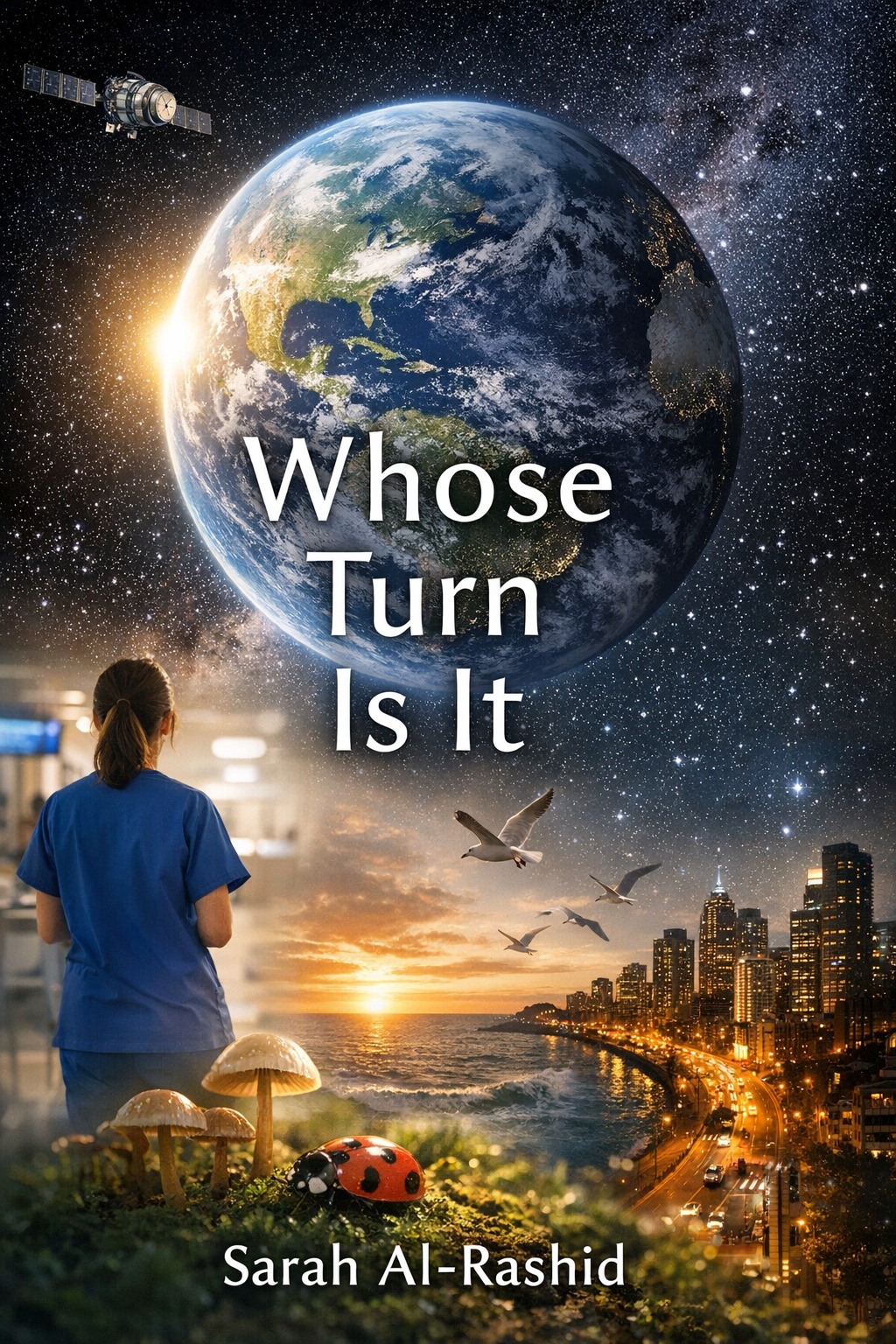
Photo of Sarah Al-Rashid

Sarah Al-Rashid (b. 1983, Riyadh) is a Saudi-born chronobiologist and science writer whose research explores artificial light at night, ecological physiology, and how societies apportion time. She studied biology at King Saud University, earned an MSc in neuroscience at University College London, and completed a PhD in integrative biology at the University of Glasgow, where she used actigraphy and spectroradiometry to study melatonin rhythms in shift workers and urban bats.

Al-Rashid has advised DarkSky International and collaborated on field campaigns using NOAA VIIRS night-light data across the Arabian Peninsula and North Atlantic. A former lecturer at Sultan Qaboos University, she now directs the Night Ecology Lab at the University of Exeter's Penryn Campus, where her team investigates spectral ecology, chronomedicine, and policy solutions for 24/7 cities. Her essays and reported features appear in Nature and Aeon, and her narrative science writing bridges chronobiology with urban planning, cultural history, and environmental ethics. She is the author of The Midnight Garden (2025) and other works on the biology of darkness and the politics of time. Al-Rashid divides her time between Cornwall and Muscat.

Ratings & Reviews

Diego Álvarez
2026-04-27

Los retratos de enfermeras de turno, pescadores y planificadores urbanos me parecieron vivos, y la ciencia del sueño y de la luz está explicada con claridad en escenas desde Glasgow hasta Muscat.

Lina Kovacs
2026-02-09

File this between Night Shifted by Ellen Prowse and The Luminous City by Tomer Halivni: a blend of field jottings and policy nudge, more grounded than the former, less granular than the latter. Readers curious about light pollution, shift work, or marine spawning cues will learn plenty, though the Glasgow-to-Gulf arc can feel stitched rather than woven.

Hollis Byrne
2025-11-22

I wanted this to change how I schedule my life, but the theme work lands like a sermon.

The central image of Earth as a "time ledger" is promising, then repeated until it turns into a slogan.

When the prose talks about "privatizing night" and "outsourcing vigilance" I hear a thesis, not an argument tied to data. The Ramadan sections glow on the maps, yet the moral claims about night economies feel scolding rather than interrogative.

Even the policy ideas I like - dark corridors, lunar-aware fisheries - arrive as lists with thin attention to cost, labor, or enforcement. The conclusion hints at gene tweaks tugging at PER clocks, then retreats to uplift.

I am convinced timing politics matter. I am not convinced this book earns its urgency, and that mismatch kept me frustrated cover to cover.

Rami Chandra
2025-07-18

As a tour of nocturnal systems, this is persuasive. VIIRS maps paint the Gulf's seasonal glow, Berlin robins sing under cool-white lamps, turtles at Ras al-Jinz take wrong headings, and krill rise when the surface softens.

Where it feels thinner is in the global connective tissue. The book gestures at light as a commons and at "sharing darkness" as policy, yet the municipal case studies stop short of real tradeoffs or funding mechanisms. I left with awe for the biosphere and only a sketch of the stakes for city halls.

Owen MacLeod
2025-03-30

Al-Rashid's voice is lucid and calm, and the book's braided structure mostly holds: anecdote, methods, implication. Her metaphors are fresh; a few are fussed over. I admired the Muscat rooftop scenes and the ActiGraph glimpses, but the chapter transitions sometimes stack like research notes rather than scenes.

Keisha Morton
2025-01-12

A bold idea, Earth as a time ledger, but the pacing often feels like a queue that never quite moves.

  • Clear explanations of circadian basics
  • Memorable field vignettes (Glasgow ambulances, Ras Mohammed corals)
  • Meandering middle with undercooked policy chapters
  • Repetitive light pollution stats, and too many detours to smartphone "blue light"
Generated on 2026-05-18 12:02 UTC