
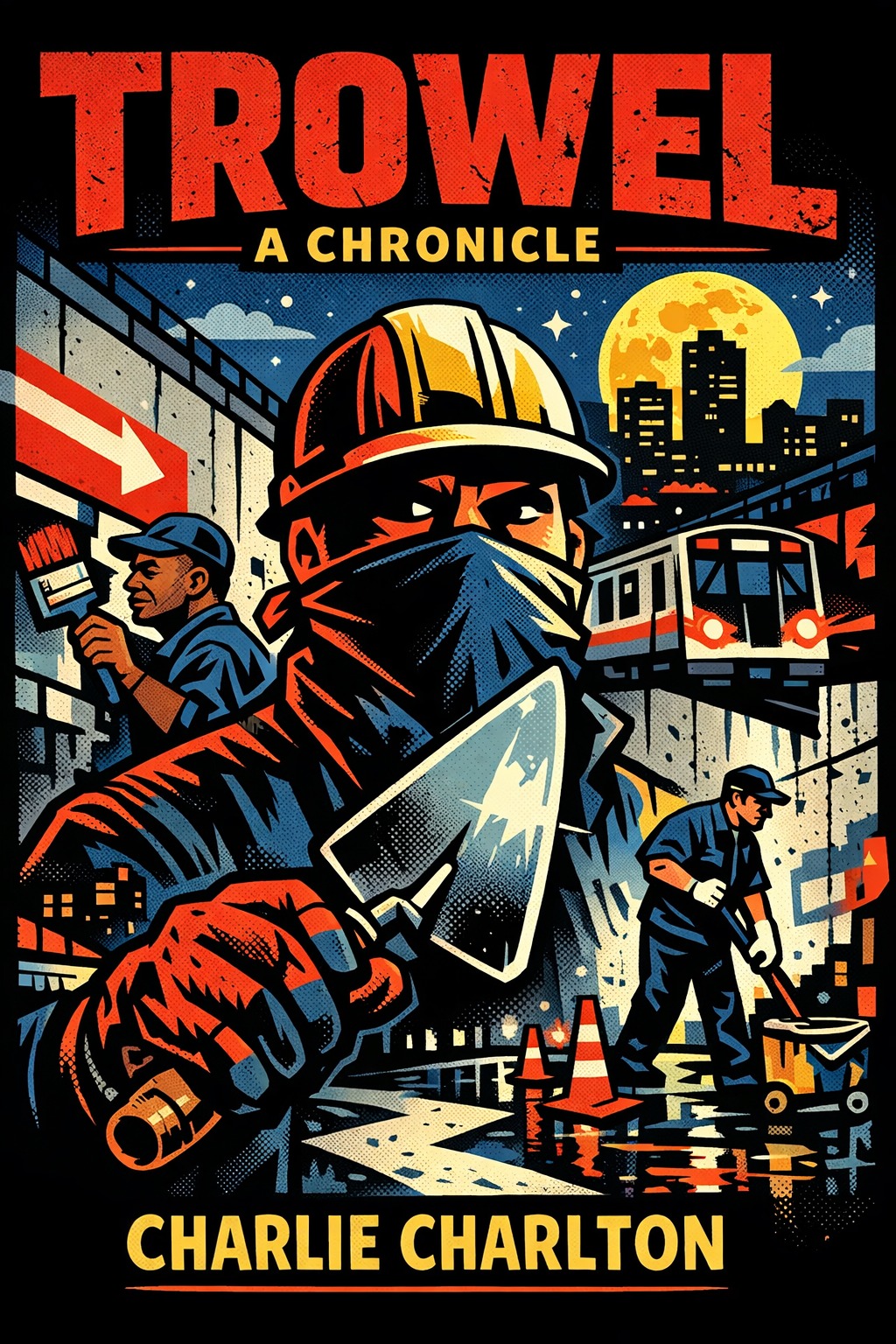
Cover of Trowel: A Chronicle

Trowel: A Chronicle

Comics · 176 pages · Published 2025-11-18 · Avg 3.7★ (6 reviews)

When the Northgate Rail Extension split Fort Worth's warehouse belt, the city papered over the wound with slurry walls, repainted arrows, and a hundred quiet deals made after last call. The caretakers of those fixes—a moonshift guild of sign painters, slab-whisperers, and janitors who call themselves the Trowel—keep their ledgers in a locked room beneath the decommissioned Panther City Bus Yard. Disguised as facilities staff and bar-backs, they steward the talismans that stop parallel streets from colliding and keep ghosts from tripping catenary at dusk. But when the cornerstone of Atlas Lofts is pried loose and the chalkline registry is scraped to dust, the union's calm fractures: the heirloom trowel, a nicked steel tool etched with grid coordinates, vanishes, and a sinkhole opens in the exact shape of a clock.

As storms stack over the prairie, it falls to Etta Parnell—fare inspector by day, the Trowel's elected Reader of Surfaces by night, reformed abatement officer with a mean red-tag—to trace the fault through Tower 55's throat, the Hemphill tunnel, and a shuttered platform at the T&P Annex. Are the culprits Cricket Knox, demolition foreman and collector of copper boxes; Velvet Seven, a tag crew that 'liberates' statues; or Morrow of the Plat, a brittle archivist who files love letters by parcel ID? Following misprinted tickets, boot tread in green-cure, and the beep codes of cranky validators, Etta dredges up a map that hums under sodium lamps and a story everyone paved over. The boundary fails in seventy-two hours; the city will fold unless someone mends the seam.

Collecting: Trowel: A Chronicle 1–5

Photo of Charlie Charlton

Charlie Charlton (born 1987 in Arlington, Texas) is a comics artist and writer whose work braids urban folklore, transit nerdery, and slice-of-life humor into punchy panels and sprawling nightscapes. After studying sequential art at SCAD, Charlton storyboarded for indie animation shops in Austin and taught comics workshops at Dallas Makerspace, where they are known to ink with a ticket stub as often as a brush.

Their risograph zines Cyclone Alley and Median Strip built a regional following and led to newspaper-style serials for a Fort Worth weekly. In longer form, Charlton maps the seams where trains, ghost stories, and municipal bylaws meet, in books like Monsters in the Metroplex and Gramophone: A Fable. Across reportage-inflected shorts and expansive graphic fables, they favor clear lines, tactile sound effects, marginalia that reads like engineering notes, and endpaper maps you can actually use to get lost on purpose.

Charlton lives in Fort Worth's Near Southside with a partner and a pit bull named Juno, usually catching the last train home when ideas will not quit. When not at the drafting table, they chase field recordings under bridges, ride the TRE for reference, and host community sketch nights about wayfinding, signage, and the stories that live between stations.

Ratings & Reviews

Devin Arriaga
2026-05-15

Leí este tomo como si un zine de servidumbres urbanas se cruzara con un cuaderno de folclore industrial: mapas que zumban, señales repintadas, fantasmas peleándose con la catenaria. El trazo anguloso y la paleta de sodio funcionan con la premisa, y la rotulación juega con los pitidos de los validadores sin chistar. Para lectores que disfrutan del fantástico cívico y de cómics sobre trabajo invisible, esto es un acierto; quizá algunos recodos explicativos pesen, pero el pulso general es firme.

Soraya Nguyen
2026-05-05

The book keeps asking a civic question: who maintains the fix after the ribbon-cutting? It answers by foregrounding labor and care, framing the Trowel as stewards whose victories are quiet enough to be ignored.

There is moral heft in seeing a city "papers over its wounds" while workers keep stitching, but the thematic throughline wobbles when late revelations lean on conspiracy flavor. Even so, the meditation on maintenance lingers, equal parts elegy and blueprint.

Mateo Griggs
2026-04-10

This series treats municipal maintenance as a secret magic system, and it rules. The Trowel guild of sign painters, slab-whisperers, and janitors tends talismans that stop parallel streets from kissing and keep ghosts off the catenary at dusk, and every rule feels welded to a tool.

The art leans into infrastructure textures: sodium-lamp palettes, scuffed decals, stencil fonts, and rain that beads on paint. A couple of lore blocks read like manuals, but most of the world seeps in through ladders of signage and the neat horror of a sinkhole shaped like a clock.

Priya Heffernan
2026-03-03

Etta Parnell is a delightfully specific lead: fare inspector posture, pocket notebook smudged with slurry, a reader of scuffs and scabs who treats footprints like testimony. Her dialogue lands in clipped, blue-collar measures, and the art catches her micro-expressions with tiny shifts in eyebrow and boot angle.

Around her, Cricket Knox, Velvet Seven, and Morrow of the Plat feel like hazards and helps rather than exposition machines. Their motives spark in subtexty exchanges, from a glance at a peeled sticker to a nervous shoeprint in green-cure, and the comic trusts you to connect those tells without arrows.

Jamal Escobedo
2026-01-15

The premise is killer, but the execution had me grinding my teeth. I kept waiting for the story to settle into a rhythm and it never did.

Scene transitions lurch. Captions swamp the panels, explaining what the art already shows, then veer into jargon that reads like a permit application.

The panel choreography goes muddy at night: gutters collapse, figures crowd the foreground, and balloon tails point nowhere. I had to reread spreads just to follow who was yelling at a validator.

Etta deserves a clearer lane. Her voiceover repeats the same "beep codes" bit across issues, and her best deductions get buried beneath side-character dossiers that arrive like stalled trains.

I love city lore, but the chalkline registry and the talisman rules get dumped twice, then revised, then contradicted. The clock-shaped sinkhole is teased as a ticking terror and then disappears for long stretches.

By the time the ledger room finally matters, my patience was shot. Great ideas, fumbled structure, and an exhausting wall of text.

Lina McCord
2025-12-01

Clock-shaped sinkholes, a stolen heirloom trowel, and Etta punching transfers by day while reading concrete at night; the miniseries cuts smart between Tower 55, the Hemphill tunnel, and the shuttered T&P Annex with tight beats, deft visual clues, and municipal weirdness that hums.

Generated on 2026-05-16 12:02 UTC