
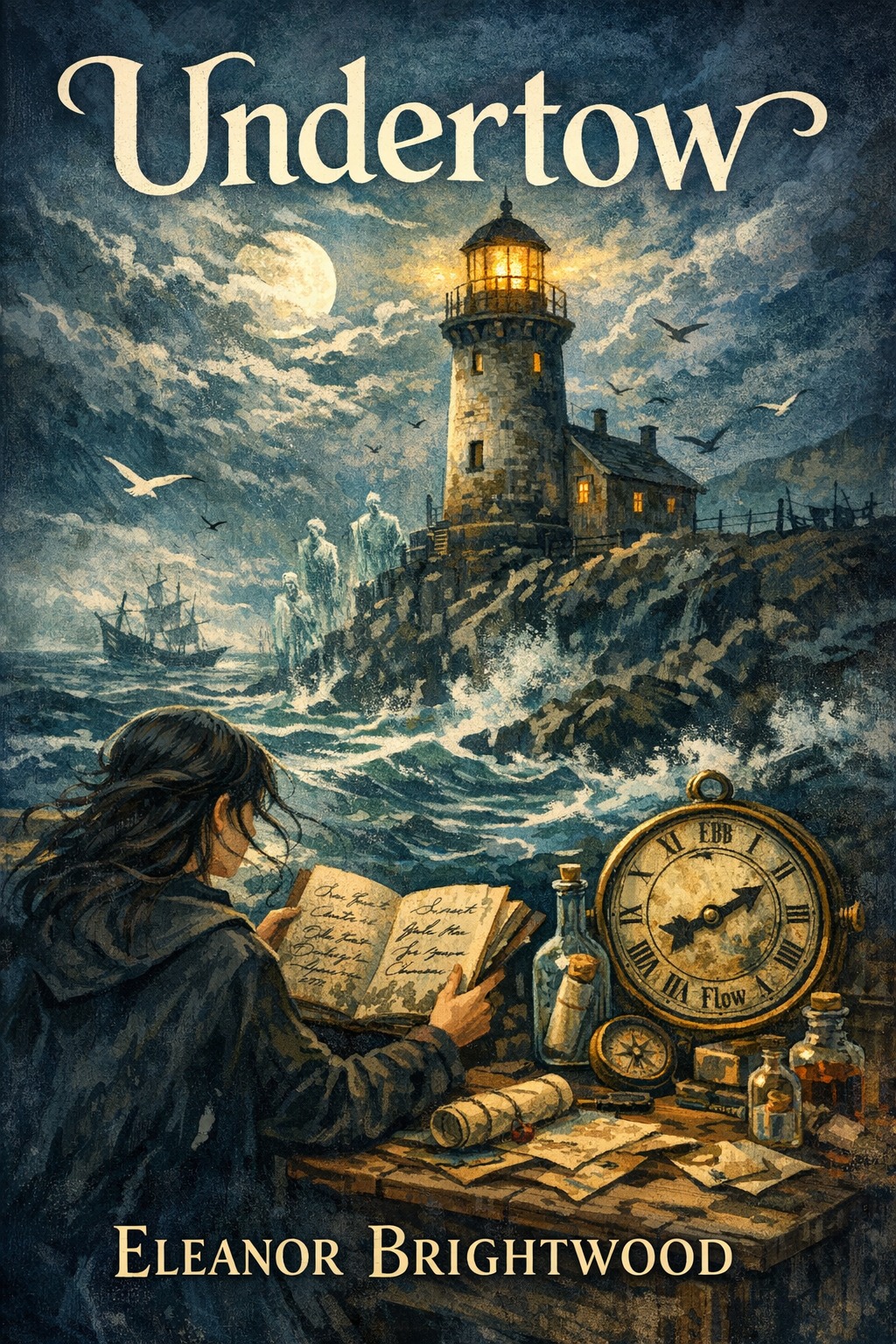

Cover of Undertow

Undertow

Fantasy · 336 pages · Published 2025-11-04 · Avg 2.6★ (5 reviews)

At the decommissioned Gull Point lighthouse on the north Cornish coast, Mara Tregarron tends the Tidal Archive—crates of bottle letters, storm-wrecked charts, and a brass tide-clock that sometimes runs backward. A sodden ledger, written in tidewater ink and signed by men long drowned, arrives with the spring equinox and begins to change its own handwriting with the moon. As the village of Porthwen wakes to an unsettling undertow—lost objects washing up whole, voices heard under the pier—Mara realizes the ledger is a summons as much as a record.

With apprentice bell-founder Ewan Penrose and her wry aunt Tamsin, a hedge-witch who trades in weather and willow, Mara follows a salt-pricked map of drowned parishes and church bells that only ring underwater. To unmoor the curse binding Porthwen to its vanished fleet, they must bargain with the sea's own memory and decide which stories to keep and which to let slip, like eels, through their fingers. The deeper they read, the stronger the pull: not toward death, but toward an inheritance no keeper can carry alone.

Photo of Eleanor Brightwood

Eleanor Brightwood is a British fantasy writer and folklorist from Cornwall, known for lyrical, place-rooted tales of inheritance, enchantment, and the quiet rebellions of caretakers, bell-tenders, and archivists. She studied English literature and folklore at the University of Exeter and worked as a librarian in Bath before writing full time. Her work has been shortlisted for the British Fantasy Award and the Kitschies, and she has contributed essays on regional myth, memory magic, and shoreline traditions to several folklore journals.

Eleanor's stories often braid coastal superstition with moorland myth, attentive to found objects, weathered places, and the ways communities keep or mislay their histories. She is the author of Ancestor's Enchanted Locket and a handful of short fictions that explore quiet, mythic fantasy through domestic spaces, tidal margins, and informal archives. She lives in Bristol with her partner and a perpetually muddy terrier, and spends weekends collecting sea-glass, seed packets, and stories from the harbors and high paths of the West Country.

Ratings & Reviews

Cerys Dunne
2026-05-05

I came for the big, tidal themes and left feeling like I had skimmed the surface while the real current slipped away beneath my feet.

Memory as an ocean is a potent idea, but the book tells me this truth more than it lets me feel it. Scenes circle the same image, and the resonance blurs into repetition rather than deepening.

When the village starts hearing "voices under the pier," I braced for a clash between private grief and collective history. Instead, the moments that should crack open settle into hush and mist.

The choice about which stories to release should sting. It mostly reads like careful bookkeeping, tidy where it needed to be messy.

There is beauty in the premise, and I respect the gentleness, but the thematic swell never quite crests. I closed the book dry-eyed and frustrated.

Ibrahim Patel
2026-03-02

Mara, Ewan, and Aunt Tamsin have roles I can map easily, but their inner weather felt foggy. Dialogue trends toward elliptical quips and hints, which keeps the mood intact but limits connection. Ewan's apprentice angle is promising and Tamsin's dry wit brightens scenes, yet motives often arrive as pronouncements instead of discoveries. I wanted more friction between the trio as the ledger tugs at them, not just shared solemnity.

Leonie Marsh
2026-01-15

As a coastal fantasy, this sings. The decommissioned lighthouse, the Tidal Archive's bruised crates, and that contrary tide clock make the setting feel lived-in rather than staged.

The drowned-parish lore and the notion of bargaining with the sea's memory are fresh and oddly gentle, even when the undertow turns unsettling. I loved how the underwater bells work as both rule and omen, and how found objects become breadcrumbs for the village's long history.

Gareth Okoro
2025-12-01

I wanted more tide and less tedium.

  • Ghostly bells concept is eerie
  • Porthwen atmosphere comes through salt and rust
  • Plot meanders with long detours in the Archive
  • Stakes feel abstract until very late
Nadia Bell
2025-11-10

The prose rolls like the sea, full of salt-stained nouns and weathered verbs, and it asks for a slow reading that sometimes comes at the cost of urgency. The structure leans on alternating present-day scenes with fragments from the ledger: it creates nice echoes but also halts momentum. Point of view stays cool and distant, and the recurring tidal image begins to feel like padding by the middle. Still, the bells, maps, and flotsam thread the chapters together, and the last stretch gathers a steadier beat.

Generated on 2026-05-11 12:01 UTC