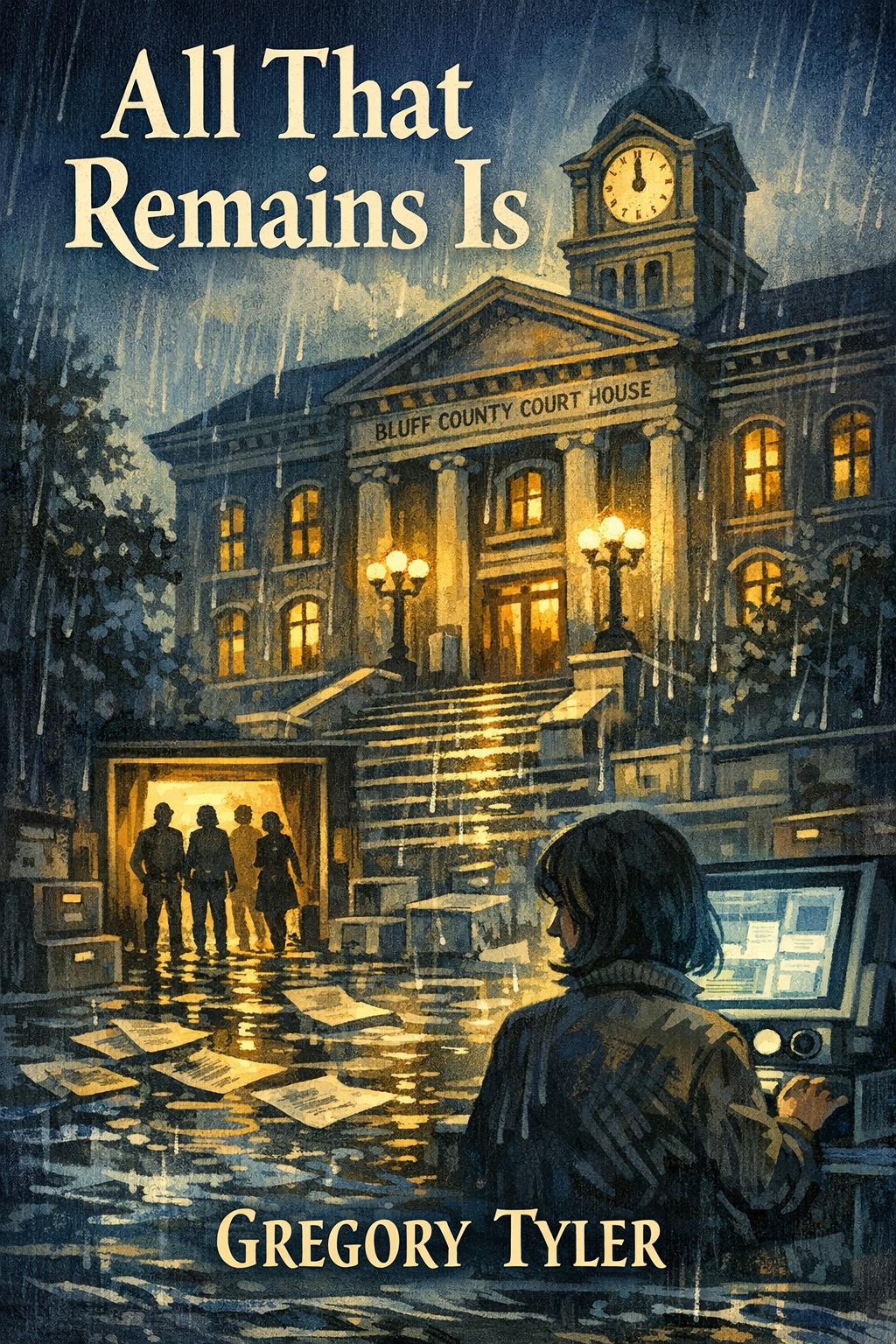
Lake-effect wind slicks the courthouse steps in Bluff County, Ohio, the night a burst pipe floods the records basement and sends four strangers into one room after midnight. Margo Dills, a county archivist who knows every wobble of the microfiche reader by heart, is tasked with triaging what can be salvaged. Deshaun Kitt, the junior engineer from the county water department, has the keys to every door nobody thinks about. Hazel Polaski, a former nun now apprenticing at Favreau & Sons Funeral Home, volunteers gloves and bleach. And Finn Calder, a repo driver moonlighting as a pirate radio host, drifts in with a thermos and offers to lift boxes while his late-night show hums in his pocket. Inside a sealed steel cabinet that isn't on any inventory, they find a gasketed cooler, a string of loose toe tags, a rusted cemetery key, and a brittle ledger page hand-lettered with the refrain: "All that remains is—".
The phrase threads through a wormy lattice of minutes, probate notices, and relocation charts from 1971, when St. Adalbert's Cemetery was uprooted for a reservoir. Someone's careful crossings-out turn whole families into dashes. Chain-of-custody forms are photocopied to snow, and a box of Polaroids blooms white salt where faces should be. Hazel recognizes a mortuary shorthand that shouldn't be in county hands. Deshaun's flood maps, laid over land-bank acquisitions, reveal a hollow under a condemned bungalow right where the old drainage tunnel bends toward Sandusky Bay. Margo, who has built a life on making the misfiled legible, hears the echo of that line—"All that remains is"—in a clerk's margin note, a Port Authority memo, and the church bulletins from a funeral that never listed a body.
They have their reasons. Margo wants a proof that can't be shredded—a way to show the county her job is not quaint but spine. Deshaun's culvert model puts a choke point under Sheriff Lionel Page's former hunting lodge, and the last time Deshaun brought up a public hazard, the meeting got very quiet. Hazel suspects her boss signed off on transfers that never happened. Finn turns his "Deedline" AM broadcast into a deposition diary, reading parcel IDs and dates like scripture. But Bluff County closes ranks. A brake line hisses empty under Margo's sedan. A dead muskrat appears on Hazel's stoop, wired to a rosary. Deshaun finds blue survey tape looped around his doorknob. An envelope of nondisclosure agreements lands on Finn's dashboard with a note: Don't drown.
The ledger's refrain leads to one name kept as a rumor: Inez Parnell, a foster kid who vanished in 1999 after a 911 call from a pay phone near the shuttered amusement pier. Her case file, what's left of it, has been padded into annual reports but never closed. The trail pulls them to a mothballed salt barn, a dentist's basement darkroom, and finally the Chapel of Rest, where the mausoleum's back wall rings hollow. Behind it: the cooler from the cabinet, lined with newspaper from 2001, a denim jacket no adult could wear, and a toe tag that matches the reservoir relocation charts. When a squall knocks power countywide and the flood sirens trip, Deshaun and Margo are pinned in the drainage tunnel while Hazel wrestles a hearse through standing water and Finn broadcasts coordinates on AM 1390 to anyone with a portable radio and a conscience.
Morning brings a podium on the courthouse lawn and a phrase—"legacy irregularities"—that irons decades into a headline. The four of them are not heroes. They are workers who have to go back inside, to jobs that ask them to pretend paper is perfect and water follows orders. What they have is a set of names that survived the indexer's eraser, affidavits someone will have to sign, and a key that still turns the lock at St. Adalbert's. In a farmhouse outside Ashtabula, a small box is finally delivered and a mother who never stopped writing letters picks a headstone. In a place that files its past in damp cabinets, the question that remains is whether a town can stand when its ledgers are a story people agreed to tell—and if not, how to rewrite it before the lake takes the rest.