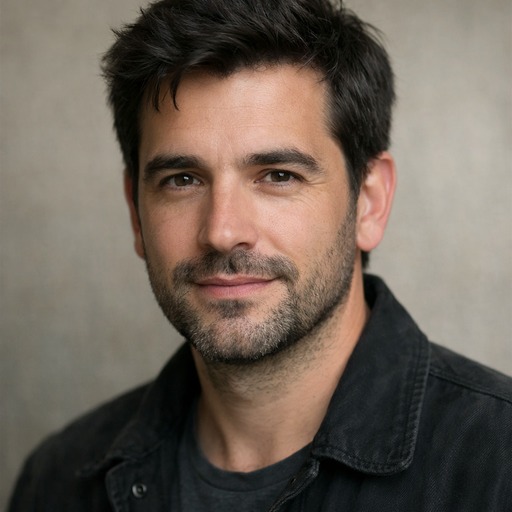
Cover of The Ledger Maker's Daughter

The Ledger Maker's Daughter

Suspense · 352 pages · Published 2025-10-14 · Avg 4.3★ (6 reviews)

On a rain-slick October night in Porto, the Alfândega warehouse on the Douro throws open its iron doors for a restoration gala and a high-profile auction of maritime relics. Among the lots sits a red leather folio sealed with wax and stamped with a tiny copper die: the final work of Luís Vale, the city's obsessively precise ledger maker, who once balanced the books of men no one dared confront. His daughter, Catarina Vale, has returned from Dublin to sign off on the estate and toss a handful of ashes into the river she fled. She expects pomp, port, and speeches. What she gets is a note in her father's microscopic hand—buried in a drawer of drafting pens and brass dividers—urging her to "find what I couldn't balance."

As cameras flash off azulejo tiles and rabelo boats drift like ghosts outside, the room fills with people whose names once threaded her father's columns: Duarte Silveira, heir to a port empire; Dr. Ilda Moura, the museum's fox-eyed director; Tomás Nogueira, Catarina's ex and a journalist who never learned to whisper; Miguel Brás, an auctioneer with a smile like a blade; and Rui Teixeira, a union man with more scars than suits. A sudden toast lands too personal, a lot number is mysteriously swapped, a flight case appears dented, and someone slips a folded page into a clutch before the lights stutter. The fog presses in from the river. The steel shutters grind shut. Phone signals flatten to nothing.

When the power lurches back, a body lies facedown in the archive vault, a tie cinched with binder's thread. The red folio is gone. In the ledger room that smells of vellum and old smoke, a single page has been torn out, leaving a ragged, glowing absence. Catarina, the ledger maker's daughter, must read the city the way her father taught her—by its margins, not its headlines—to find a debt that refused to die. Who is editing Porto's past one entry at a time, and why does balance demand blood?

Photo of Seamus Ferreira

Seamus Ferreira is an Irish-Portuguese novelist whose atmospheric crime fiction maps the fault lines where cities keep their secrets. Born in 1983 to a schoolteacher from Galway and a shipwright from Aveiro, Seamus grew up between Connemara's wind-scoured harbors and Porto's steep, tile-bright streets. He studied comparative literature at Trinity College Dublin and later worked as a forensic auditor for an NGO investigating municipal corruption—an experience that sharpened his fascination with paper trails, silences, and the stories numbers tell.

Ferreira's work has been published in English and Portuguese. His breakout novel, Saltglass (2017), was followed by The Drowned Key (2020) and Nightjar's Claim (2022), both shortlisted for the Irish Book Awards Crime Novel of the Year and longlisted for the CWA Gold Dagger. He has contributed essays on Lusophone noir to the Journal of European Crime Writing and taught a seminar on urban secrecy at the Universidade do Porto. Seamus divides his time between Lisbon and Galway, researches in archives more than is probably healthy, and still writes first drafts with his grandfather's fountain pen.

Ratings & Reviews

Inês Duarte
2026-04-27

Suspense enraizado no lugar certo: Porto surge com nervo e melancolia, como nos romances do inspetor Jaime Ramos de Francisco José Viegas, mas com um brilho de museu e arquivo que lembra os mistérios de Vigo de Domingo Villar. A metáfora do livro-razão sustenta tudo, desde a nota do pai até a página rasgada, e Catarina navega entre elites do vinho, sindicalistas e curadores com uma lucidez que nunca vira sermão. Elegante, tenso, e muito específico do Douro.

Marta Johansson
2026-03-10

Quick take.

  • Porto mood for days
  • Cast with sharp motives
  • Mid-gala lull during a speech
  • Last turns satisfy without tidy bows
Ruben Ortiz
2026-01-28

This reads like a meditation on what a city chooses to remember. Catarina is asked to "find what he couldn't settle," and the book treats balance as more than math: it is ethics, grief, and civic bookkeeping. The repeated move from headlines to margins reframes power, showing how tiny acts of recording can anchor or erase whole lives. The torn-out page becomes a thesis on absence, and the Douro fog feels like collective denial finally condensing.

Sofia Kline
2025-12-15

A smart structural conceit runs through the novel: chapters tally motifs like entries, recurring images aligning until the pattern clicks. The prose is meticulous without feeling fussy, packed with tactile nouns and precise verbs. A middle stretch lingers a touch too long in gala protocol, but once the vault door swings and the folio vanishes, the pace tightens into a clean, propulsive stride.

It adds up.

Evan Whitaker
2025-11-03

Catarina Vale had me from her first quiet inventory of pens and dividers. She reads people the way her father read columns, noticing stray decimals in posture and speech, and that talent becomes both shield and blade.

The supporting cast glints at sharp angles: Miguel Brás smiles with edges, Dr. Ilda keeps her cards so close you can hear them whisper, Rui Teixeira carries history in the way he stands, Duarte Silveira understands legacy like a birthmark, and Tomás Nogueira still talks as if truth is a dare.

Dialogue lands like discreet stamps, small impressions that add up to something seismic. Even the toasts feel loaded, a public ritual with private arithmetic beneath the bubbles.

I cared, which in a story about debts is dangerous. The book lets Catarina make choices that feel costly and human, and by the end I was cheering for her clarity as much as her courage.

Lara Mendonça
2025-10-20

The Alfândega doors groan open, the tiles shine like wet fish scales, and I swear I smelled salt and brass as the red folio took center stage. The book renders Porto as labyrinth and ledger, fog curling through corridors where cameras flare and secrets breathe.

I could hear the Douro breathing.

Every surface invokes memory and money; the warehouse becomes a character. When the steel shutters clamp down and the phones go flat, the river city seems to tilt, and I felt that tilt in my stomach.

The details crackle: binder's thread biting into a tie, a dented flight case, a note in microscopic hand that becomes a compass. I was all nerves as the lights failed, then surged, and the story began to count what can't be counted.

This is atmosphere you can taste, a city balanced on margins and ghosts, and the final image of a torn page glowing in the ledger room will haunt me every time rain hits stone.

Generated on 2026-05-02 12:02 UTC