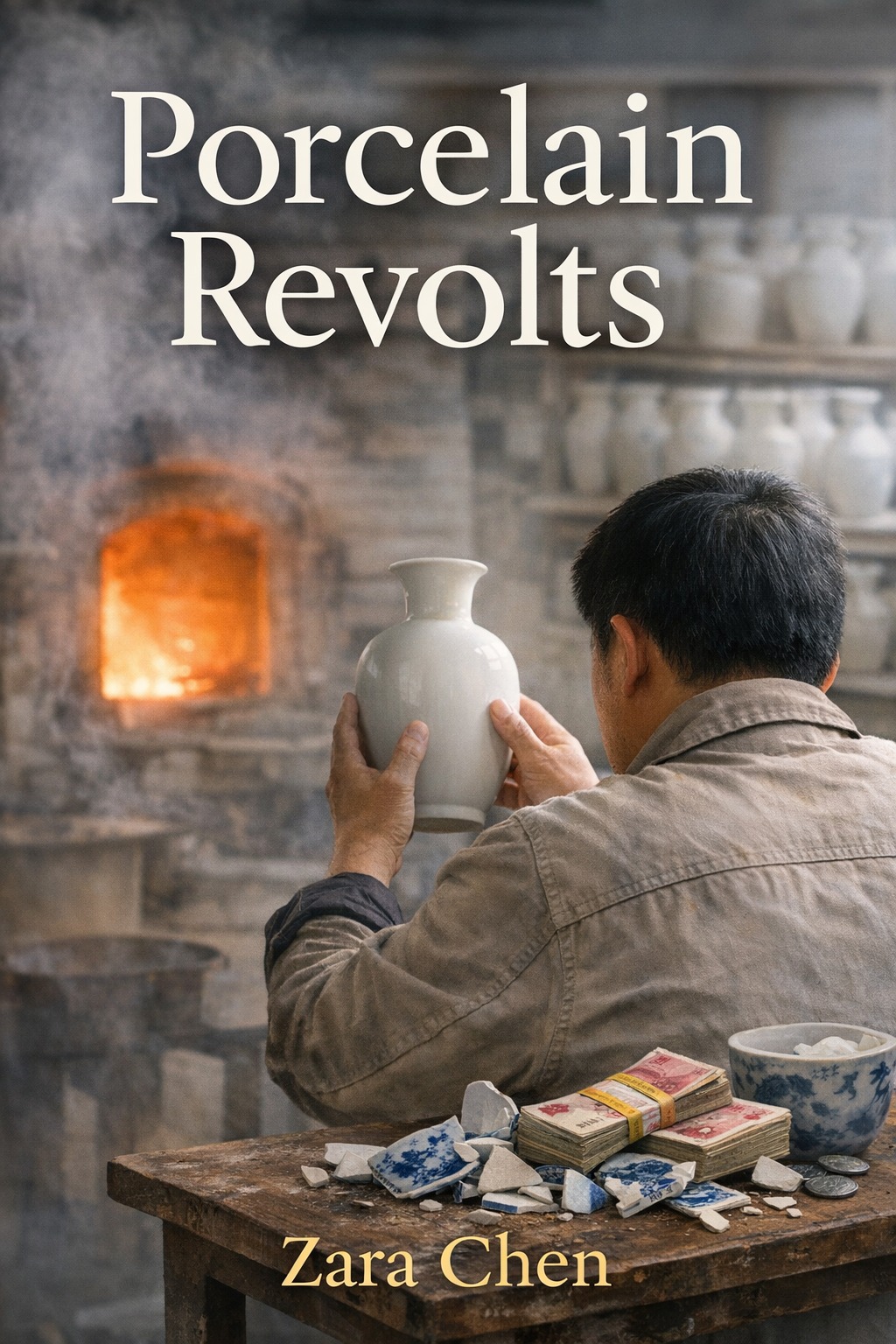
In Porcelain Revolts, journalist Zara Chen brings to life the charged decade when China’s porcelain capital, Jingdezhen, convulsed with closures, co-ops, and counterfeiters. The narrative pivots between Lin Suyin, a soft-spoken kiln engineer who, after the 2008 collapse of the state-run Hongli Factory, rallies apprentices and retired mold-cutters to reopen a derelict brickworks on the banks of the Chang River, and Hao Juncheng, a dapper restorer who turns weekend lectures at Sanbao village into a front for a globe-spanning forgery network. Lin’s challenge is immense: scavenging refractory bricks from shuttered workshops, wheedling gas allotments from municipal cadres, and teaching a generation raised on decals how to pull ash glazes and build a downdraft kiln that burns clean. Under the banner of a worker-led collective they call White Tiger, she orchestrates a sequence of night firings, produces nonfunctional, gleaming toilets as protest sculpture, and draws musicians from Guangzhou warehouses to play drone sets between warm kilns. Hao, meanwhile, buys old shards by the kilo, learns the smell of raw Jiangxi kaolin, and perfects a recipe of cobalt and manganese that crazes just so, then rides soft-sleeper night trains to hand off replicas of Yuan blue-and-white dishes to brokers in Shenzhen and Macau.
Chen’s reporting, stitched from shipping manifests, court records, and years of field notes collected on a MiniDisc recorder, tracks the moment when these worlds collide: an exhibition in the Belgo Building in Montreal where a White Tiger piece is pulled minutes before opening after an Oxford thermoluminescence test and a retired glaze chemist from Jingdezhen Ceramic University unravel its provenance. Along the way appear auction cataloguers and customs agents, a Taipei architect reimagining public bathhouses in the wake of the Toilet Revolution, and the humid back rooms of Hong Kong dealers where labels are steamed from crates. With the pacing of a caper and the intimacy of oral history, Porcelain Revolts reveals how a material as humble as bathroom porcelain can carry a city’s utopian experiments and a market’s darkest opportunism, and how the heat of a kiln can be both a commons and a cover.