Cover of Ximena Robles

Ximena Robles

Memoir · 288 pages · Published 2024-02-06 · Avg 3.2★ (5 reviews)

On a winter morning in Gothenburg, with sleet worrying the tram wires over Södra Vägen, a young anesthesiology resident named Emma Larsson folds into a seat and feels her chest cinch, as if the world has slipped a notch. By dusk, she is staring at the green numerals of a pulse oximeter in the emergency bay of Sahlgrenska University Hospital, listening to her own lungs rasp through a stethoscope she bought as a student in Uppsala. A diagnosis with a long, barbed name—pulmonary arterial hypertension—slides across a desk. Overnight, the instruments of her work become the instruments of her days: syringes in the kitchen drawer, pill organizers beside the kettle, a wheeled oxygen tank she nicknames "Astrid" for luck. What does skill look like when the body that learned it begins to falter? How do you keep practicing attention when attention turns homeward, to the strained hush inside your own ribs?

Months later, between clinics and breath tests, Emma takes a leave to study palliative care in Oaxaca, Mexico, following a thread that has tugged at her since an exchange year in Veracruz: language as a kind of medicine, medicine as a kind of language. She learns the word acompañar on a shady street off Calle García Vigil, a verb that means to go with, to keep pace. At Hospital Civil "Dr. Aurelio Valdivieso," where the corridors smell of bleach and limes, she meets a seamstress from Santa María Atzompa: Ximena Robles.

Ximena comes to clinic in a denim jacket stippled with thread, a spiral notebook in her lap, the bone-lantern outline of illness under her cheekbones. Metastatic sarcoma has scattered itself through her lungs and spine. She jokes that she could sew a hem across the horizon if only her hands didn’t tremble; she tapes paper butterflies to her IV pole and tucks a silver milagro in Emma’s palm. In the pages of the notebook she has drawn small boxes, each a beginning: a yellow dress still pinned and waiting, a recipe for caldo de piedra from her grandmother in San Felipe Usila, the phone number of her sister in Tlalpan that she dials but never lets ring. Between chemo drips, they count steps to the cafeteria, sit on a benched curb near the mercado watching buses lurch and sigh, and trade stories of work—of how a stitch is placed, how a tube is threaded.

"If your days were a spool," Ximena asks one afternoon, tracing circles in condensation on a plastic cup of limeade, "what would you save for last?" Emma catalogues what steadies her: a lapis-blue stethoscope; a cracked Sony voice recorder with an obstinate red light; the way attention, paid in full, seems to stretch a minute until it has edges. She writes letters to the resident she used to be, to the patient she has become, and to a future self she cannot picture clearly. As her own breath ebbs on the stairwells of Oaxaca’s steep streets, she learns to move more slowly, to measure not only vitals but silences.

When Ximena shifts to hospice at her mother’s courtyard—walls painted the color of a ripe papaya, a laundry line strung with cotton dresses like flags—the city thins around them. There are small ceremonies: tucking needles into a pin cushion shaped like a tomato; tasting a thimble of mezcal as rain darts through sunlight; reading aloud the labels of milagros in a tin tray (pierced hearts, tiny feet, a sewing machine with a missing handle). One weekend, they ride a colectivo to Santa María del Tule to stand under the cypress whose trunk swallows decades. Briefly, standing there, the rush of measurements loosens its grip.

In the end there is the hush of a room at dusk, the steadying hands of women who learned to bind and bathe their dead, the resin scent of copal clinging to hair and clothes. At the velorio, under a corrugated roof, a radio in the next house plays a song about returning. Later, back in Sweden, Emma steps onto tram 5 again, pockets a single milagro, and returns to the hospital as both physician and witness. She teaches residents how to speak of pain without naming it only by numbers; she learns the art of staying without fixing. Some names alter the air when spoken; some lives recalibrate what a day can hold. Ximena Robles is a book about what work means when time narrows, about the grammar of care in two languages, and about the difficult, luminous act of keeping company—through the ordinary, through the beautiful, through the failing and the fierce—until the last stitch is set.

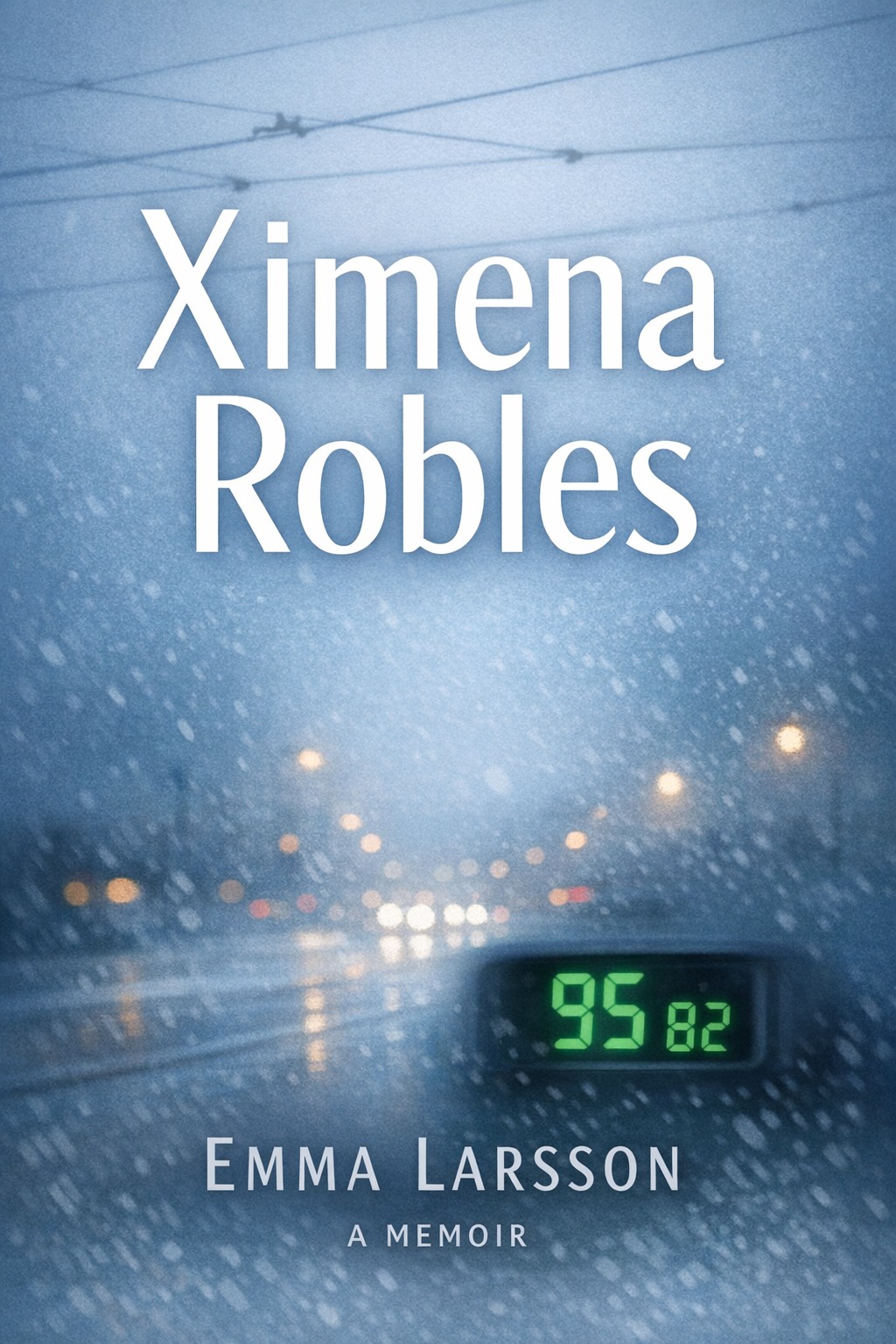
Photo of Emma Larsson

Emma Larsson is a Swedish physician and writer whose work explores care, language, and the borders between illness and daily life. Raised in Möllevången, Malmö, she studied medicine at Uppsala University and completed her anesthesiology residency at Sahlgrenska University Hospital in Gothenburg.

After additional training in palliative care and narrative medicine, Emma split her time between Sweden and southern Mexico, collaborating with community health organizations in Oaxaca and serving as a visiting clinician-educator. Her essays have appeared in Scandinavian newspapers and literary journals, and she has contributed reflective pieces on medicine and culture to Nordic public radio. She has received a residency grant from the Swedish Arts Grants Committee for her nonfiction and has presented on empathy in clinical practice at regional medical conferences.

Emma lives in Gothenburg, where she teaches communication and ethics to medical trainees and tends a small balcony garden of rosemary, chilies, and geraniums. She is fluent in Swedish, English, and Spanish, and continues to volunteer with cross-cultural palliative care initiatives.

Ratings & Reviews

Jonah Mendes
2026-02-18

Thoughtful, quiet, and anchored in clinical reality, this will suit readers who lean toward reflective medical narratives and cross-cultural memoirs. The Swedish and Oaxacan settings are rendered with sensory restraint, and the medical content is frank without gore. I would hand it to health sciences students, caregivers, and anyone curious about palliative care.

  • Terminal illness, hospice scenes
  • Medication schedules, needles, oxygen
  • Spanish words, brief context clues
  • Gentle pacing, reflective tone
Priya Kulkarni
2025-11-06

This memoir keeps asking a plain, persistent question: what do we owe one another when fixing is no longer possible?

Larsson traces the grammar of care across two languages, letting small ceremonies carry weight - butterflies taped to a pole, a milagro palmed, a thimble of mezcal in the rain. The pacing is deliberately spare, the chapters brief and echoing, which allows motifs of breath and attention to accumulate without melodrama. I finished feeling that time had been stretched and given edges, as if a minute could be held longer simply by naming it.

Dylan Shore
2025-01-19

Emma's interior voice is meticulous, even tender, as she inventories syringes by the kettle and tapes her own pulse oximeter readings into memory. Ximena arrives like a current of wit, the butterflies on the IV pole and the denim jacket stippled with thread cutting through the clinic hush. Their conversations about craft - a stitch or a tube - are the strongest pages. Yet Emma's training keeps her in command of the frame; she notes, measures, narrates, sometimes at the expense of Ximena's spontaneity. A late visit to the cypress and a few courtyard rituals suggest reciprocity, but the imbalance remains. I admired the honesty and felt the restraint, hence the middle rating.

María Cortés
2024-07-10

Un retrato sereno del cuerpo y del lugar, donde la nieve de Gotemburgo y la cal de Oaxaca se entrelazan mientras un tanque de oxígeno llamado Astrid rueda al margen, y la observación paciente vuelve compañía lo cotidiano.

Harriet Lund
2024-03-01

From the opening morning in Gothenburg, sleet stinging the tram wires, to the lime-bright corridors of Hospital Civil, the book signals emotion rather than earning it. Scenes are lined up like case notes, pristine and oddly airless.

The prose leans on talismans and instruments. The lapis stethoscope, the cracked recorder with a stubborn red light, the named oxygen tank compel attention, yet they recur so predictably that tension drains away. The lyricism starts to feel ornamental instead of revealing.

Structure is a collage of letters and brief set pieces, the repeated question "what would you save for last?" surfacing like a refrain. Instead of deepening, it circles. I wanted the collage to surprise; it catalogues.

Most troubling is the vantage. Ximena flickers in and out, funny and fierce, but the memoir keeps pulling the lens back to Emma measuring her own breath, explaining "acompañar" while still authoring the terms. The milagros feel more like props than gifts.

The subject matters, the labor of staying matters, but this rendering felt fixed in place, polished to a high sheen, and emotionally evasive. I was exasperated!

Generated on 2026-04-29 12:02 UTC