Tough sell for me.
- Glossy violence without space to breathe
- Clue mapping feels preordained
- Rain sheen repeats until it dulls
- Might click for fans of museum procedurals
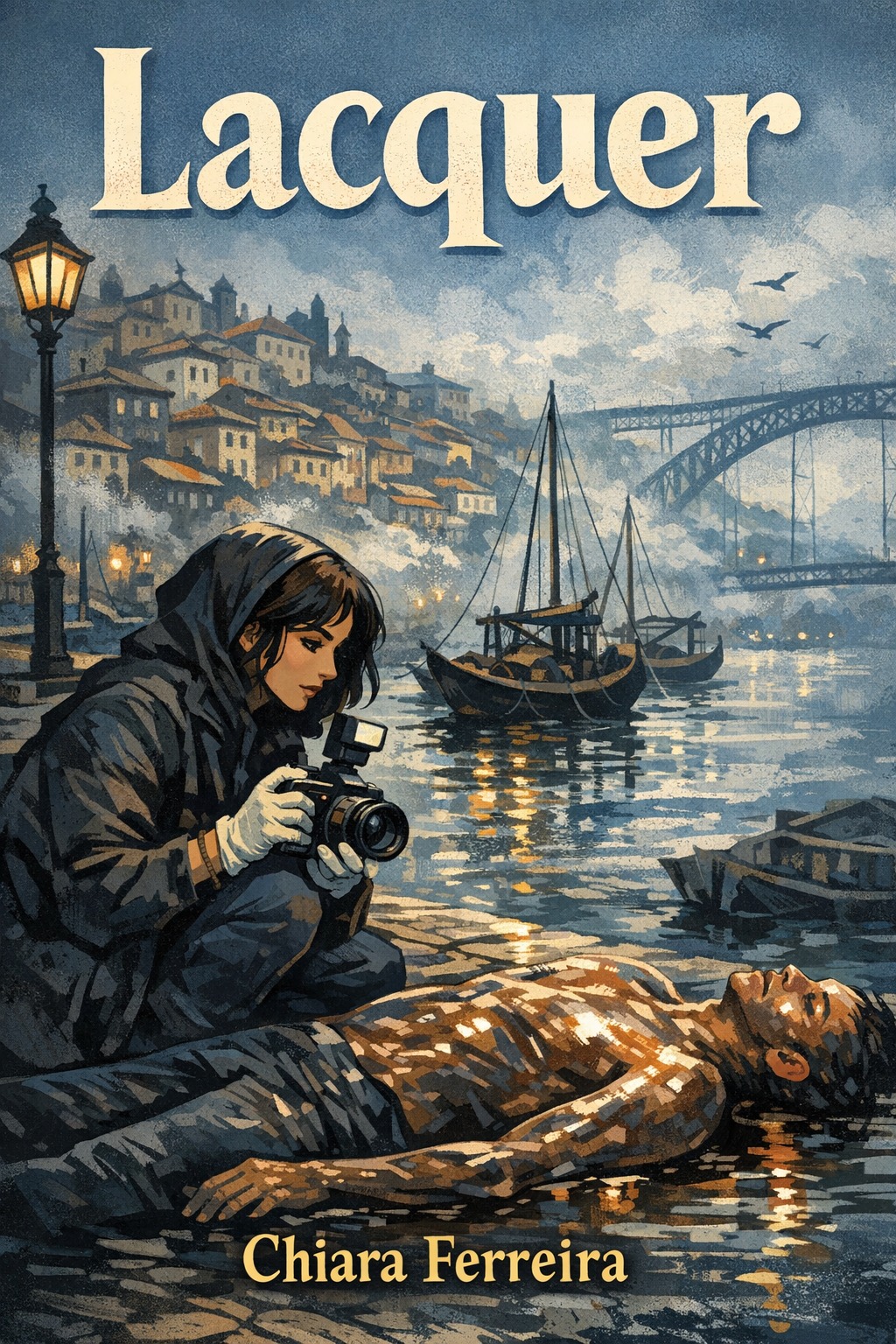
From the fog-slicked quays of Ribeira to the boat sheds of Afurada, Porto wakes to bodies posed like restoration studies, their wounds sealed beneath hard, glistening coats of marine varnish. The press calls the phantom "O Verniz"; Inspector Duarte Salgado calls in rookie forensics photographer Inês Vale, whose eye for micro-scratches and solvent halos turns crime scenes into puzzles of light. Each victim is left with surgical incisions meticulously lacquered to staunch bleeding without mercy, stretching pain into hours and turning flesh into artifact.
As Vale maps drips and brushstrokes, a second pattern emerges: fragments of azulejo glaze embedded in the finish, GPS tags lined along Tram 1, and dates that mirror fires buried in municipal archives. It isn't only sadism. Someone is preserving a story the river keeps washing away—reassembling a burned chapel's vanished panel, a civic alibi, a family erased by redevelopment. The trail threads through the Soares dos Reis Museum's conservation labs, a nail salon off Rua de Santo Ildefonso, and a derelict warehouse that still smells of linseed and turpentine.
Set at the start of Vale's career, this graphic noir plunges her into choices that strip the gloss from her ideals as the case drags her under the Arrábida Bridge and into a storm of resin and salt. Painterly inks by Leonor Baptista render rain, sheen, and river light with forensic texture while the city becomes both gallery and crime scene. When the final layer cures, the portrait it fixes—of guilt, witness, and what we choose to keep—tests every rule she thought would keep her whole.

Tough sell for me.
The preservation theme is bold but often stated rather than enacted, so scenes that should ache turn into tidy museum labels. I see the intent to ask what a city chooses to keep, yet the human cost feels sealed under too many coats.
One line that stuck with me paraphrases the pitch here: "the city is both gallery and crime scene." I just wanted the argument to breathe between panels instead of being brushed on so thick.
This book pinpoints Porto with working-class specificity, from the boat sheds of Afurada to the echo under the Arrábida Bridge, so the city reads like a lab bench dunked in rain.
The maritime chemicals, tram schedules, and archive fires lend rules to the world, raising the stakes without resorting to grand conspiracy, and the river keeps time like a witness.
Inês Vale reads rooms by looking for what light refuses to let go of, and that sensibility shapes every choice she makes on the case. Her dialogue with Salgado is clipped, wary, and humane in the margins, letting the rookie-professional dynamic feel earned without melodrama.
I loved how the camera eye becomes conscience. Micro-scratches, solvent halos, and embedded glaze turn into a lexicon for trust. It is a rare noir that lets empathy be a technique.
Panel-to-panel rhythm is meticulous, with Baptista staging reflections so evidence blooms out of shine; panes, puddles, and varnish act like light traps.
Some transitions flatten urgency as scenes hop from museum lab to nail salon to warehouse, and the captions sometimes over-explain what the art already nails, but the forensic visual logic holds.
Lacquer charts Vale's pursuit of O Verniz through rain-lit docks and tram lines as a taut puzzle where each brushstroke lands clean.