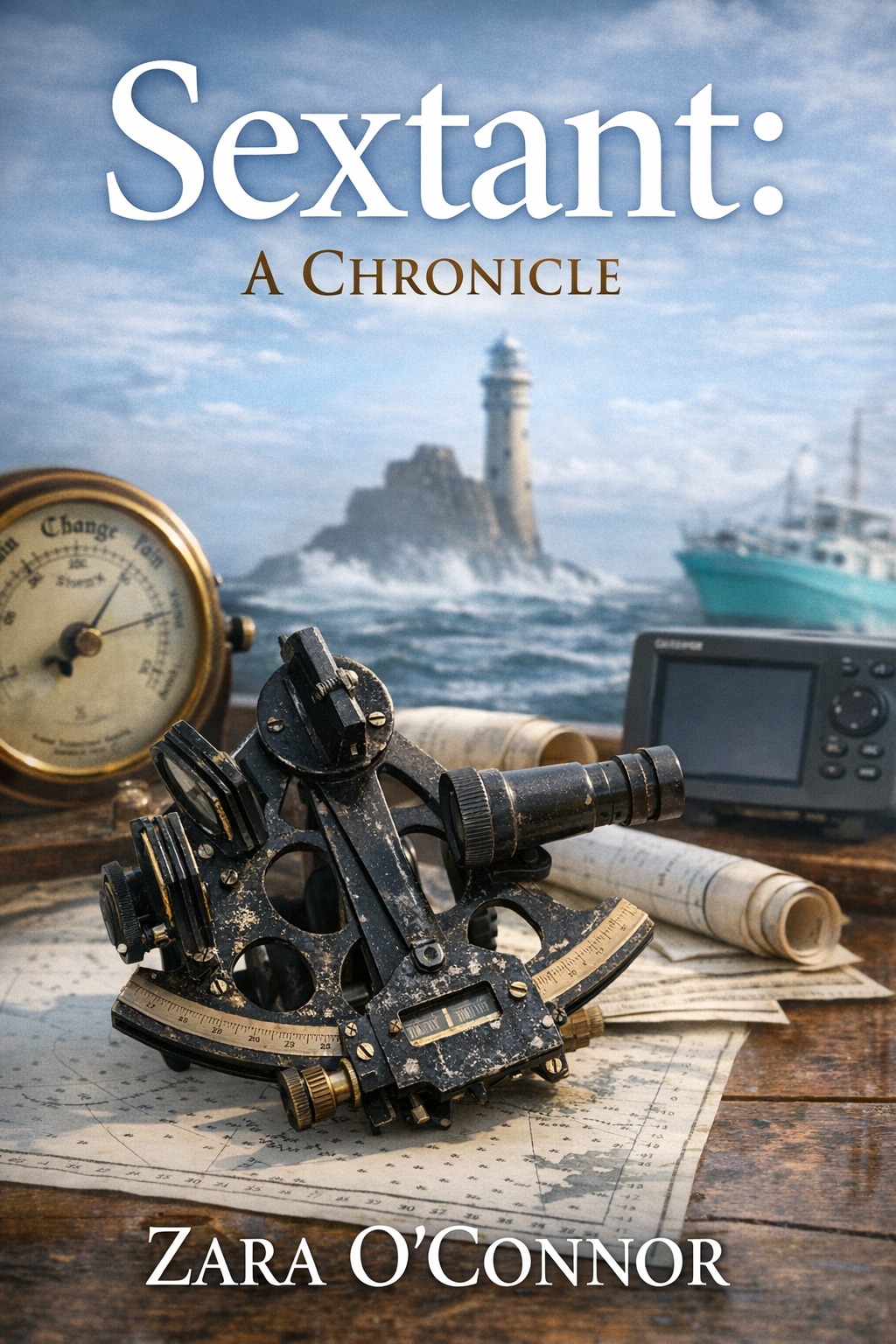
Which is more dangerous to a captain rounding Fastnet in March: a dead GPS or a falling barometer? What do salvage skippers and divorce solicitors have in common? Why do some smugglers repaint their hulls turquoise the week before a norther? And what can a scuffed Cassens & Plath sextant on a pawnshop shelf in Key West tell us about a vanished freighter off Tarifa?
In Sextant: A Chronicle, O'Connor, Zara turns her court reporter's ear and sailor's eye toward the coasts where technology, crime, and weather braid together. She starts with tide tables and odd, unasked questions and follows them through logbooks, trial transcripts, AIS pings, and storm archives. From the Shannon Estuary and Loop Head to Piraeus, Nassau, and the Straits of Florida, she maps how incentives, not legends, steer behavior—on pilothouses, on docks, and in courtrooms where the sea's arguments are rehearsed in fluorescent light.
Here are the inner workings of a go-fast crew that learned to spoof its AIS transponder to shadow cruise ships, and the simple telltale mark that convicted them. The truth about yacht brokers on the Miami River and the quiet economies that hum behind gleaming Raymarine plotters and polished chromed winches. The myths and math of storm-season insurance—how a tropic's wobble can move more money than a convoy—and the court in Limerick where Garda Sgt. Maeve Kelleher and an insurer named Orlaith Byrne argue over a rust-streaked RIB discovered with twelve petrol jerrycans and a single EPIRB taped under the transom. A Nassau underwriter named Winston Rolle explains why paperwork, not pirates, keeps a freighter captain from sleeping; a NOAA cartographer, Nareen Patel, shows how a misplaced buoy off Haulover Inlet created a summer of groundings and a cottage industry in fiberglass repair.
Across these stories, O'Connor studies the littoral economy of attention: what a night watch stands to gain by cutting a corner, why a lobsterwoman in West Cork keeps a second ledger in pencil, how a Turkish radio operator named Deniz Karaca drifted from maritime codeshares into darknet message boards where ports are reimagined as queues and containers as variables. She finds that the same incentives drawing a family into a rubber raft at midnight—the wind, the rumor of a window, the whispered price at a Balbriggan cafe—animate the flashy cat-and-mouse feats of a hacker collective in Miami who call themselves Lagoon Nine and sell ghost ship tracks by the hour.
Sextant: A Chronicle is organized by altitudes and bearings rather than chapters: each section fixed to a star, a headland, a case file. A 38-degree sight on Dubhe opens a meditation on certainty and the false authority of screens. A noon sight at Mizen Head intersects with a courtroom lesson on salvage law and the ethics of finding what the sea has set adrift. O'Connor crews out of Stock Island with a wary salvage skipper known as Big Sal Calderón and learns why PVC fender lines and good coffee settle disputes faster than statutes; she sits in Dublin's Four Courts and hears language that turns a sinking into an actuarial story; she steps aboard a Piraeus tug at 3 a.m. and measures how a union vote can reroute a hundred thousand tons of canned peaches.
What unites these pages is a steady insistence that coasts are not unknowable and seas are not solely romantic—if you ask the right, sometimes impolite, questions. How do fishermen price risk when their GPS goes dark? Why would a smuggler mail himself a postcard from Tarifa before every run? What makes a harbormaster in Baltimore, Ireland, look the other way one season and clamp down the next? O'Connor's answers, wry and clear-eyed, make drift nets, court transcripts, and weather windows into clues. She charts not heroism or villainy but the logic that curls inside them.
If seamanship is how we want the ocean to behave, then incentives describe how people actually move across it. With a sextant in one hand and a stack of data in the other, O'Connor points us toward a new way of seeing coasts and those who work them—salvors and smugglers, brokers and barristers, migrants and meteorologists—and, in doing so, redraws the margins of the map we thought we knew.