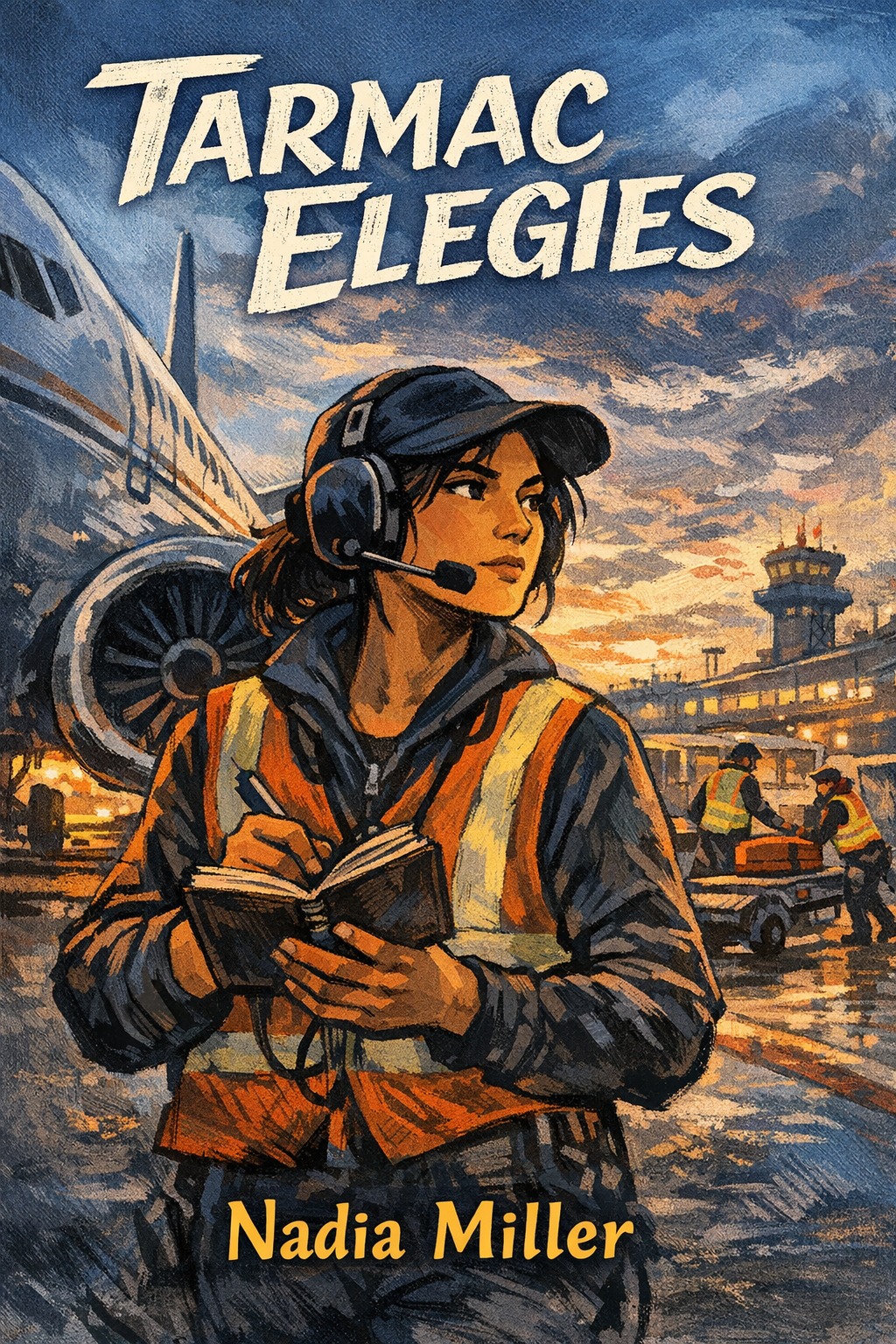
Nadia Miller, indie cartoonist and master of blue-collar epics, unveils a haunted, luminous graphic novel set where jet engines tremble the ribs and stories are rolled flat into paint. Tarmac Elegies follows Mireya Santos, a ramp lead at San Isidro International, who keeps a pocket log of tail numbers, callsigns, and last words she swears the concrete remembers.
Control towers. Windsocks. De-icing rigs. We recognize the sky's architecture; few notice the chalked hash marks, the marshalling wands, the men and women in hearing protection carving sigils in thermoplastic before dawn. After a near-miss at Gate F14 and a lightning strike that turns the puddles neon, Mireya starts seeing blue ghost-lights braided through tire scuffs—a phenomenon old pilots call St. Elmo's whisper. Her only clues: a chipped canteen coin stamped BOAC, a wheel chock stamped JFK 1963, and a name scratched into an aluminum tow bar: Tavi.
When a budget carrier's expansion threatens to pave over the row house where her mother, Pilar, still keeps a shrine of boarding passes, Mireya chases the name from Veracruz to Heathrow to Keflavík, reading runway designators and ILS frequencies like verses. With a union organizer, Kwesi Boateng, and a retired follow-me driver, Ulla Nordin, she maps a clandestine network of ground crews who have been passing a hymn of survival through maintenance graffiti and chalk codes for decades. The path arcs beneath Boeing 737 bellies, across A320 nosewheel lines, past the red hash of Runway 16R.
Drawn in oil-slick blues and sodium orange, Tarmac Elegies traces a working-class hero's journey that never leaves the ground. Mireya's fate turns not on prophecy but on a punch clock: when to hold an arrival with crossed batons, when to wave it through, and when to shut everything down. On a stormbound night at 09R, amid headset chatter and a single magnesium flare, she makes a choice that trades personal safety for a broader kind of immortality—the kind etched in centerline paint, seen by millions, credited to none.