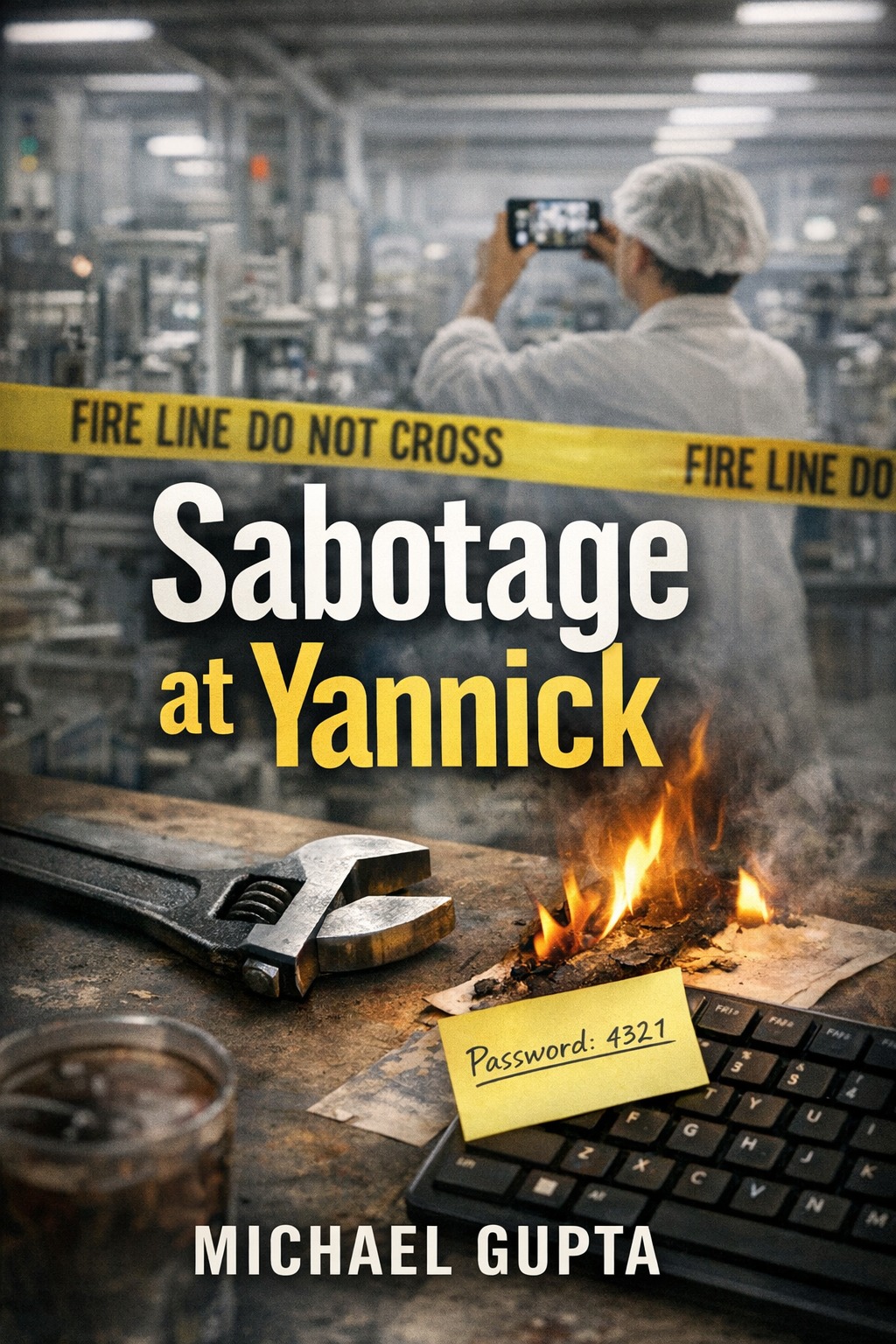
Cover of Sabotage at Yannick

Sabotage at Yannick

Nonfiction · 352 pages · Published 2025-09-16 · Avg 3.2★ (6 reviews)

Which cripples a factory faster, a rumor or a wrench? What do pastry chefs and arson investigators have in common? Why do temp workers film the shop floor? How much damage can a password do? And what did a 1978 postal strike predict about a 2023 cloud outage? Sabotage at Yannick asks the questions managers never do, and follows the answers into welding bays, WhatsApp groups, and the quiet corners where modern industry actually runs.

Michael Gupta is not your standard management guru. Trained as an engineer and reporter, he starts with terabytes of machine logs, forklift GPS traces, payroll anomalies, and a simple, unasked question: Who benefits when things go wrong? He calls the field 'operational mischief,' the study of how people bend, break, and game systems to get what they want, even when everyone else wants throughput and safety.

At the center is Yannick Composite Works, a French maker of wind turbine blades with plants in Saint-Étienne, Kenosha, and Pune. When the Saint-Étienne resin line began failing every third Thursday, executives blamed luck and suppliers. Gupta pairs epoxy viscosity curves with breakroom seating charts, and meets Aïcha Benabdelkarim, a procurement clerk in Lyon; Ron Beattie, a shift boss in Wisconsin; and Tomasz Walczak, a union steward in Gdańsk, whose messages map neatly onto torque-wrench miscalibrations no audit ever caught.

He shows the inner logic of a cracked impeller and a cooked spreadsheet. The rogue employee is mostly a myth; the real culprits are misaligned incentives. A safety stop that earns overtime. A counterfeit O-ring that clears a late fee. A parking lot camera aimed just off-center, so a night crew can swap pallets. In Nigeria, a telecom switch goes dark whenever diesel deliveries arrive. In Shenzhen, a drone line speeds up by quietly disabling two quality checks no executive will miss until a recall lands.

Gupta dissects procurement kickbacks in Marseille, the secret slang of temp agencies in Łódź, and the telltale marks of doctored maintenance records in Baton Rouge. He shows why a cafeteria's salad bar predicts defect rates, why backordered bolts correlate with divorce filings, and how a closed Telegram channel called 'Yannick Friends' moved a million euros worth of downtime. The patterns are legible if you ask heretical questions and follow the incentives, not the org chart.

What unites these stories is a belief that the industrial world, thick with jargon, dashboards, and cover-your-back emails, is knowable. If ethics is how we wish operations would behave, incentives are how they actually do. With scenes from factory floors and code repositories, with wry clarity and patient data work, Sabotage at Yannick reveals the hidden economy of getting away with it—and how to see it coming. You will leave with enough stories to last a thousand walkthroughs, and a new way of looking at breakdowns.

Gupta, Michael (born 1983) is an American investigative journalist and data engineer whose reporting sits at the intersection of labor, technology, and risk. Raised in Edison, New Jersey, he studied electrical engineering at Rutgers (B.S., 2005) and information science at the University of Michigan (M.S., 2010). He worked as a systems analyst in Midwest manufacturing before turning to journalism, reporting for ProPublica and later serving as a data editor for a London-based financial newspaper. His investigations have earned a Gerald Loeb Award and a George Polk Award, and have been cited by regulators in the U.S. and the EU. He has taught courses on data reporting and industrial systems at Northwestern University, and has conducted fieldwork in Lyon, Shenzhen, Łódź, and Lagos. He splits his time between Chicago and Lyon.

Ratings & Reviews

Oumou Traoré
2026-04-05

Aïcha, Ron, et Tomasz sont évoqués puis rushed past like instruments for the thesis, leaving their motives sketched so thin that the human stakes blur.

Claire Dubois
2026-03-12

Gupta rend visibles des coulisses que l'on croit opaques: ateliers de Saint-Étienne, quarts à Kenosha, horaires décalés à Pune, et ces fils WhatsApp ou Telegram où tout se joue en douce. Le monde industriel ici n'est pas abstrait, il a des odeurs de résine et des colonnes de tableur, et les enjeux sont clairs — sécurité, primes, pénalités, rappels produits. On voit comment une simple caméra mal orientée ou un O-ring douteux devient un langage de pouvoir, et c'est passionnant sans être voyeuriste.

Sasha Petrovic
2026-02-20

This sits between systems journalism and an operations casebook: occasionally dry, frequently illuminating. If you like supply chain explainers and labor reportage, you'll find value in the cross-plant parallels and the way chat logs rhyme with machine logs. For general readers the breadth may outrun the depth, but managers, union stewards, and data analysts will walk away with angles they can test on Monday.

Neil Kavanagh
2026-01-08

Gupta writes in clear, reportorial prose; the structure braids log-data with floor interviews, cutting between Saint-Étienne, Kenosha, and Pune in arcs that actually resolve. Transitions are smooth, payoffs arrive where promised, and the argument tightens as the small cheats accrete into visible systems. A bit of jargon haze lingers and a few metaphors clang, but the scaffolding holds and the final chapters land with earned clarity.

Kenji Ortiz
2025-11-15

The premise is sharp, but the ride felt lumpy.

  • Episodic chapters keep resetting momentum
  • Heaps of examples, thin connective tissue to the Yannick through-line
  • Too much travelogue, not enough sustained analysis in one plant
  • Insight buried under piles of acronyms and side notes
Mara Ellington
2025-10-02

What a jolt. This is the rare business book that feels like sleuthing and systems thinking at once, and it crackles with the audacity to ask forbidden questions.

Gupta keeps circling one moral: incentives beat intentions. He shows how a salad bar hints at defect rates, how a parking lot camera nudges pallet swaps, how a Telegram backchannel can mint a million euros of downtime. Suddenly, "who gains when the line goes down?" stops sounding cynical and starts sounding like professional due diligence.

I loved the method. Pairing epoxy viscosity curves with breakroom seating charts sounds absurd until the pattern clicks, and then you cannot unsee it. Machine logs meet human favors; torque settings meet WhatsApp jokes.

The scenes across Saint-Étienne, Kenosha, and Pune aren't glamorous, but their consequences are enormous. Rumor or wrench? Password or pallet? He shows how each becomes leverage when incentives point sideways, and he does it without blaming the nearest worker.

If you run anything with moving parts, read this. If you audit, negotiate, or forecast, read this. The term "operational mischief" will stick to your brain, and so will the feeling that the next outage is already legible if you trace the incentives.

Generated on 2026-04-13 14:06 UTC