Cover of Dark House

Dark House

Nonfiction · 288 pages · Published 2025-10-15 · Avg 3.6★ (7 reviews)

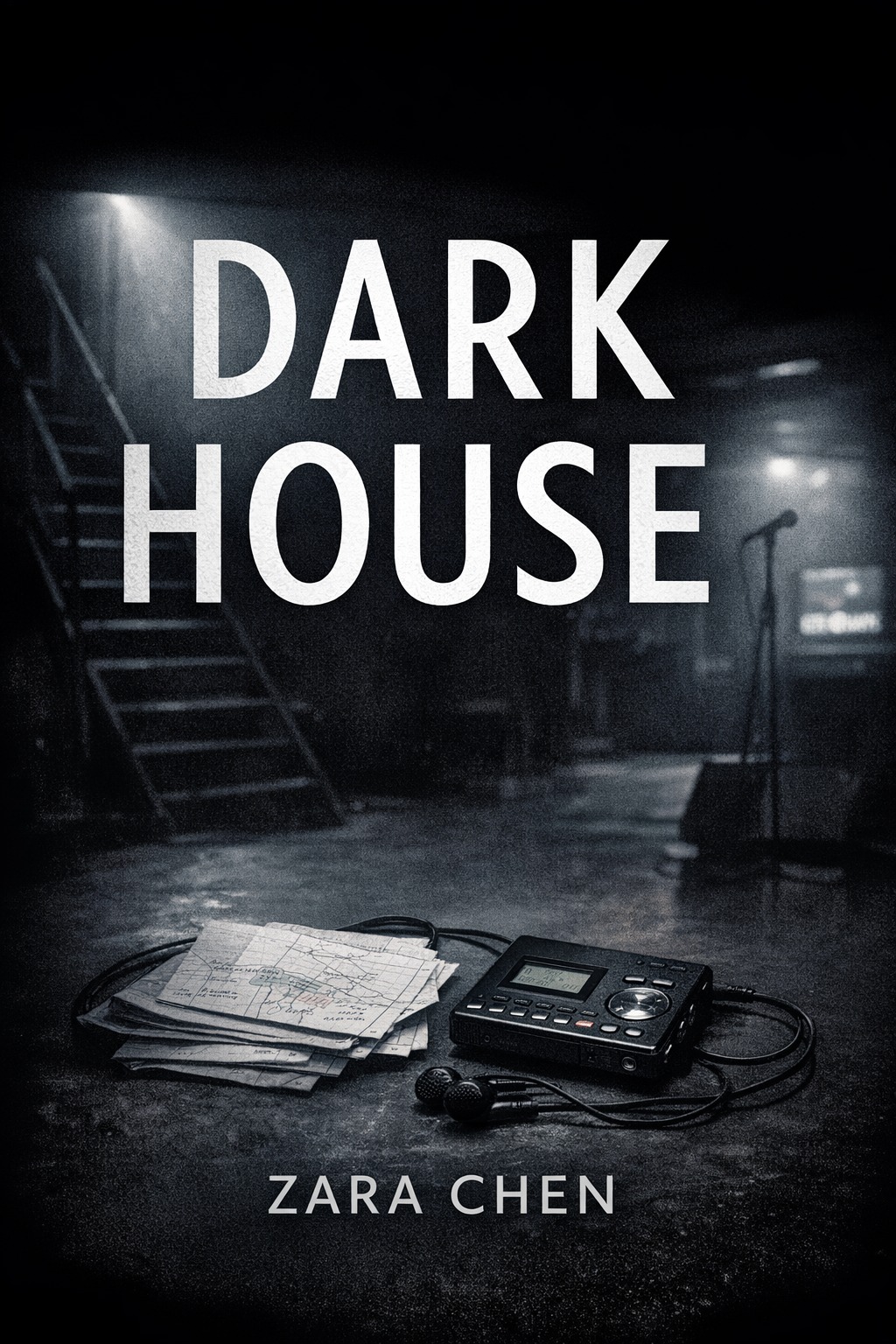
Dark House follows the afterlives of shuttered DIY venues, basements, and karaoke boxes across Montreal, Vancouver, Guangzhou, and Taipei. With a MiniDisc recorder and a stack of annotated maps, the reporting listens alongside promoters, cleaners, and bouncers to trace the frequencies that outlast eviction notices and pandemics. The result is a cartography of room tone—beer fridges, rattling ducts, stairwell echo—stitched to the voices of people who once held the keys.

Structured as a hybrid oral history and field diary, the book moves from a Clark Street basement where feedback became communion, to a Pearl River warehouse where subwoofers shook loose plaster. In a windowless KTV on Kingsway, Li Wei catalogs lost songs; in Ximending, Asha, Marigold, and Khalil rebuild a sound system from pawned parts. What does a city remember when the house goes dark, and who gets to switch the lights back on?

Chen, Zara (b. 1986) is a Canadian journalist and biographer raised in Vancouver by Shanghai-born parents. A former music editor at The Walrus and contributor to The Wire, the Guardian, and the South China Morning Post, she has spent fifteen years documenting underground scenes from Montreal lofts to Guangzhou warehouses. Her long-form features have won two National Magazine Awards in Canada and a gold Digital Publishing Award for cultural reporting. She is the author of the essay collection Hum of the Spillways and the oral history Nine Ways of Listening to a City. Chen studied sociology at the University of British Columbia and ethnomusicology at McGill. She splits her time between Montreal and Taipei, where she teaches narrative nonfiction workshops and still carries a MiniDisc recorder in her bag.

Ratings & Reviews

Mireille Duclos
2026-04-03

The microphones aim at rooms I wanted to visit, but the book lingers so long on hum and hiss that the people recede, and I lost patience.

Lucie Tremblay
2026-03-20

Ce livre écoute la mémoire urbaine avec une patience rare. On passe d'une cave de Clark Street à un entrepôt sur le Pearl River, puis à un KTV sans fenêtres sur Kingsway, et chaque lieu renvoie sa propre morale sonore.

Les thèmes sont tenaces: qui garde les clés, qui peut revenir après une fermeture, "que retient une ville quand la maison s'éteint, et qui rallume". Quelques digressions techniques étirent le fil, mais la cartographie des bruits résiduels donne un sens neuf à l'idée d'archives vivantes.

Hao Nguyen
2026-02-13

As an oral history, the voices are sincere and grounded, but they sometimes smear together. Li Wei, cataloging lost songs in that windowless KTV, feels vivid; Asha, Marigold, and Khalil resurfacing in Ximending get striking fragments, yet the microphone often tilts back to the room rather than the person. I came away impressed by the chorus, if not always moved by the solos.

Gideon Park
2026-01-08

The book hears cities the way some see light. Montreal basements, Guangzhou warehouses, a windowless KTV on Kingsway, and alleyways in Ximending all become instruments, and the author tunes you to each frequency.

Room tone becomes testimony: the rattle of ducts, the wet clunk of a beer cooler, the echo that climbs a stairwell after load-out. It is generous to the people who kept keys and cables alike, and it lets their rooms keep speaking.

Rowan Iqbal
2025-12-05

Concept is strong, but the pacing sagged for me.

  • too many reprises of HVAC hum and feedback rituals
  • maps and timestamps halt the flow
  • quick jumps across cities feel scattered
  • MiniDisc tech notes feel niche
Tessa Moriyama
2025-11-02

Dark House is a deft hybrid: oral history braided with a field diary, each chapter anchored to a single room and the sounds that claim it.

I loved how the MiniDisc cuts and annotated maps interleave; voices rise from promoters, cleaners, and bouncers without grandstanding, and the margins hum with beer fridges and stairwells. A few sequences loop longer than needed, but the architecture holds, and the final pages leave a resonant hush.

Taryn Velasco
2025-10-26

Imagine the granular city time of Will Hermes's Love Goes to Buildings on Fire crossed with the collector's ear of Amanda Petrusich's Do Not Sell at Any Price. Dark House is quieter and more local, but the effect is electric in slow motion.

The reporting trusts small textures over big claims; promoters and cleaners are treated like curators, and the MiniDisc becomes a modest ethics machine. I finished with a new atlas of rooms I'll never enter and a better idea of why they matter.

Generated on 2026-04-10 12:03 UTC