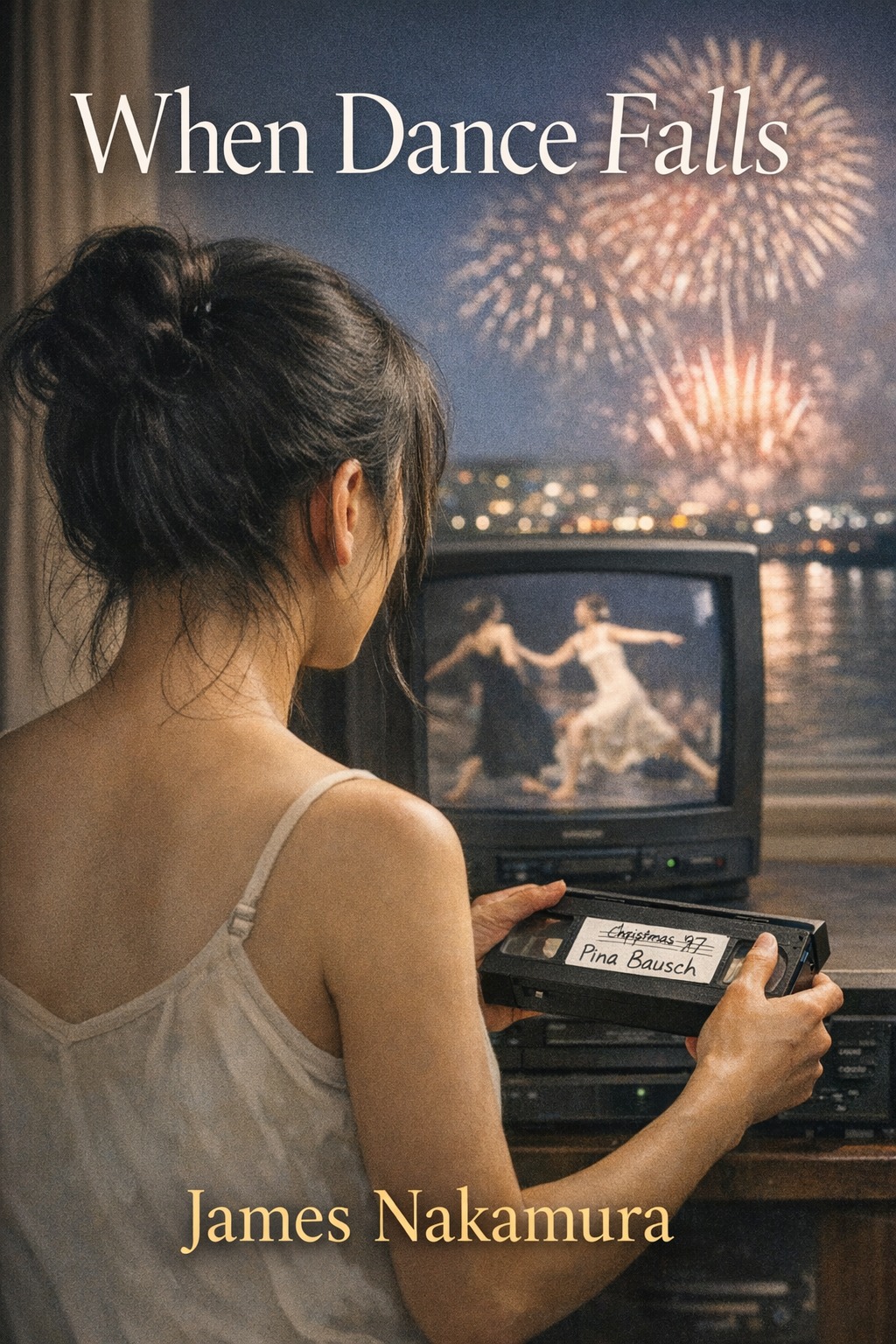
Cover of When Dance Falls

When Dance Falls

Literary Fiction · 320 pages · Published 2025-10-14 · Avg 4.5★ (6 reviews)

A luminous, aching novel about ambition, love, and the fragile geometry of movement from James Nakamura. December 31, 1999: as fireworks thud over the River Irwell and the Millennium Dome flashes on television, a girl named Miko Hara tapes a bootleg of Pina Bausch over a VHS labeled Christmas 97, then practices pliés on the linoleum between her mother's kettle and a bright red metronome. When Dance Falls is her story.

Miko grows up in a tower block off Chapel Street in Salford, counting time against the radiators and the squeak of her school shoes. Years later, she is one of the most daring choreographers on either side of the Channel, her work rippling across the black Marley floors of Sadler's Wells, the Venice Biennale, and a converted tram depot in Berlin. When a risk-drunk tech magnate, Alistair Clyne, commissions her to stage a dusk-to-dawn performance along the glass skybridge above Roppongi Hills and the Mori Art Museum in Tokyo, Miko chooses to center the piece on a dangerous motif she's never managed to master: the art of falling. The decision jolts every orbit of her life—her father, Shun, a lift engineer who keeps a drawer of coins from shuttered mills; her mother, Reiko, who works nights at Salford Royal; Luka Reed, the jazz pianist she loved in New York; and Hana, the niece she quietly co-parents with her brother Ken after a winter crash on the A1. As typhoon season gnaws at the bolts and the city hums far below, the rehearsal rooms fill with taped ankles, laser-printed floor maps, a battered pair of Capezio 321s, a silver safety harness that smells faintly of machine oil, and a metronome that will not keep time.

As the premiere inches closer, Miko retreats into the past: scholarship days at Northern Ballet School and late trains from Victoria; a cramped bedsit in Camden above a nail bar where she learned to sleep between sirens; cheap katsu at Kingly Court before a midnight slot; feverish months in Brooklyn counting time with her palm on Luka's shoulder; a Shinkansen ride to Osaka where she watched dancers sleep with their hands curved like questions. She can read a room by the angle of a collarbone and coax a chorus from the silence between breath and beat, yet she misses birthdays, forgets to call back, and steps cleanly through rehearsals while stumbling over the simplest offers of care. Will the life she has mapped in pencil and sweat still be there when she comes down from the skybridge.

James Nakamura's novel is a portrait of a complicated artist whose unrivaled sense of rhythm and risk cannot always be translated offstage. A breathtaking tale of memory, hard choices, and the ties that hold and fray, When Dance Falls is an unforgettable story of fate, love, and sacrifice that asks what we owe ourselves—and those who wait for us—when our ambitions and loyalties collide.

Nakamura, James (b. 1984) is a Japanese American novelist and essayist from San Jose, California, raised in Torrance. He studied English and dance history at the University of California, Berkeley, and earned an MFA from the Iowa Writers' Workshop. His fiction and criticism have appeared in ZYZZYVA, The Believer, and Ploughshares, and he has received fellowships from Kundiman and the Fine Arts Work Center in Provincetown. He has taught creative writing at Goldsmiths, University of London, and served as a mentor for early-career writers. He lives between London and Kyoto with his partner, a lighting designer, and their daughter.

Ratings & Reviews

Marcus Osei
2026-04-05

Think Paul Yoon for the quiet radiance and Gwendoline Riley for the precision: Nakamura balances lyric heat with cool control. If you crave art-process novels that sweat the details, from taped ankles to floor maps to a stubborn metronome, this will reward you.

Ivy Delgado
2026-04-01
  • Lush prose that sometimes lingers
  • A few rehearsal passages repeat beats
  • Big set piece is stunning
  • Emotional fallout feels intentionally muted

Verdict is thoughtful, occasionally distant, worth reading.

Colin Mercer
2026-03-05

I finished this book and sat perfectly still, the way a dancer holds a landing before breath rushes back. What a radiant meditation on risk, choice, and the cost of making a life inside rhythm!

Nakamura threads an entire philosophy through a single idea, "the art of falling." It is not a stunt; it is ethics. Gravity is memory, time is a score, and love is the partner who may not always catch you yet still stands at the edge, ready.

The containers are ordinary—VHS tape labeled Christmas 97, a red metronome, a drawer of old coins—but the music inside them keeps moving. I felt the taping of ankles, the grain of a battered pair of Capezio 321s, and the thrum of the city below the skybridge as typhoon season nips at the bolts.

And the people: Shun, Reiko, Luka, Hana, each drawn with a tenderness that resists easy sentiment. The novel knows that a gift can glitter and wound at once, that ambition can bless a city while forgetting a birthday.

By the time rehearsal turns to night and night to morning, the story has taught you how to read silence, how to hear a measure held a beat too long. I loved it, utterly, for its courage and its grace!

Hiroshi Kato
2026-01-22

サルフォードの塔、リノリウムの台所、サドラーズ・ウェルズの黒い床、ヴェネツィア・ビエンナーレ、ベルリンの車庫、そして六本木ヒルズのガラスの空中回廊まで、風景が身体の延長として描かれる。台風の季節に鳴るボルトのきしみ、機械油の匂いがする安全ハーネス、テープで固定された足首の感触まで、空気が震えるようだった。

世界は舞台に寄り添い、舞台は世界を測り直す。この小説は都市の高さと記憶の深さを同時に感じさせ、落下の美学を怖さごと抱きしめる。

Sana Riaz
2025-12-31

Miko is as brilliant as she is exasperating; I believed every choice, every flinch, every rehearsal she walks through while missing the calls that would make life simpler. The quiet gravity of Shun and Reiko, the ache of Luka's music, and the tender, provisional bond with Hana all register with an intimacy that never tips into melodrama.

I kept hearing the metronome that will not keep time.

Jules Merritt
2025-11-10

James Nakamura writes with dancerly precision, snapping scenes from Salford kitchens to Berlin tram depots and the glass arc over Roppongi, then looping them back through memory until the timeline feels like choreography. The structural motif of counting—metronomes, radiators, Luka's shoulder—gives the book a pulse that rarely falters, though a few late transitions blur and the rehearsal inventories can crowd the air.

Generated on 2026-04-05 12:03 UTC