
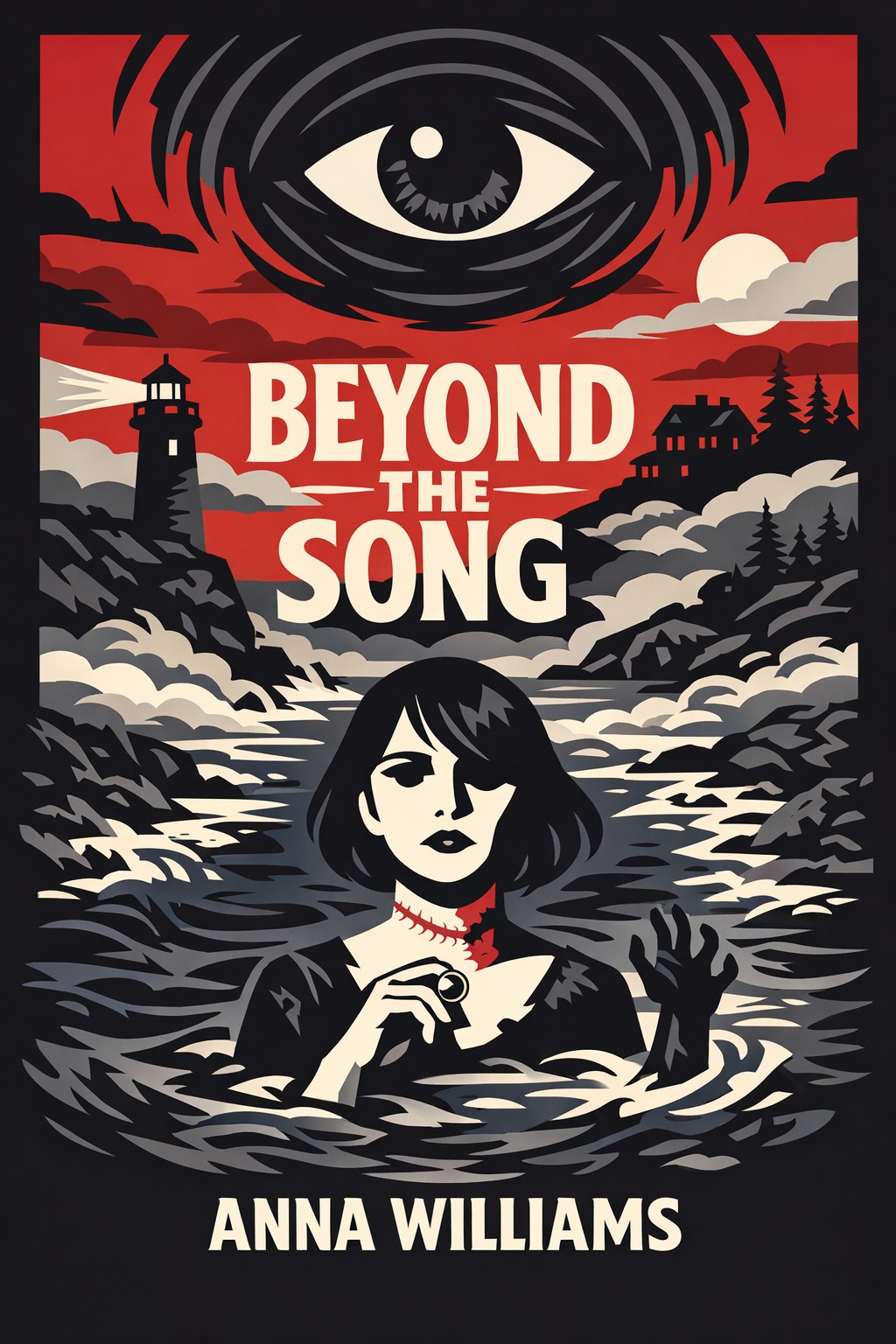
Cover of Beyond the Song

Beyond the Song

Horror · 312 pages · Published 2023-08-15 · Avg 3.7★ (6 reviews)

Something older than the tide listens along the ragged coves of Down East Maine in Beyond the Song, a salt-stained Gothic of fog, folklore, and broken voices. The year is 1931 and Mara Ellison is a failed soprano with a scarred throat and a pawned wedding ring. When reclusive acoustician Dr. Thaddeus Kreel invites her to Wrenhaven, his cliffside sanatorium near Machiasport, to help catalog a cache of wax cylinders recovered from a wrecked missionary ship, she seizes the chance to earn her passage out of Boston and maybe hear music again. But the gulls wheel in patterns no birder can name, the church bell tolls under a clear sky, and the locals at Red Hook Store mutter about "note thieves" that take the breath right out of a body.

With the quiet aid of Mrs. Isobel Hatch, Wrenhaven's housekeeper, and a Passamaquoddy net-maker named Jonah Nicolar, Mara uncovers Kreel's true design: a network of iron singing-bowls and Helmholtz resonators sunk in tide caves to harvest certain frequencies that nest in marrow. The cylinders hold drowners' hymns and last gasps, and the sanatorium's chapel is tuned to feed the thing Kreel calls the Choir Mother—an appetite older than psalms that breeds in brine and throat. As storms close the coast and the cylinders begin to hum on their own, Mara must decide whether to break the instruments that could restore her voice—or silence a music that will one day learn to sing through everyone.

Williams, Anna (b. 1987) is an American writer of coastal Gothic and folkloric horror. Raised in Beaufort, North Carolina, she studied ethnomusicology at UNC Chapel Hill and later worked on oral history projects preserving maritime ballads and work songs. Her short fiction has appeared in regional journals and radio anthologies, drawing on the liminal spaces where tide, industry, and memory meet. She lives in Providence, Rhode Island, where she volunteers with a community archive and collects antique pitch pipes.

Ratings & Reviews

Lucille Baptiste
2026-03-29

I am still buzzing like a struck bowl. Beyond the Song isn't just spooky, it's sonic terror, and I devoured every salt-bitten page!

Mara's damaged voice and Kreel's cold curiosity create a duet that teeters between hope and predation. Every trip to the chapel felt like walking into a throat where the tide breathes for you.

The details absolutely sing, with gulls spiraling in unreadable sigils, iron bowls thrumming in caves, wax cylinders whispering last, broken hymns. I kept pausing to listen to my house settle, sure that something in the walls was answering.

For vibe seekers, think the grief-haunted vastness of The Fisherman meeting the precise, body-borne dread of Brian Evenson's Last Days. The result is brackish and beautiful, a hymnbook written for bones.

Horror that engages the ear is rare, and this book nails it without cheap jumps. Five stars, and I will be recommending it to anyone who has ever leaned in when a room went quiet.

Tanya McKee
2025-10-08

Beyond the Song turns voice into currency, trading breaths and hymns to ask who gets to speak and who is harvested for listening. The folklore of "note thieves" rubs against the economic desperation of 1931, so survival and art sit on the same splintered pew. I admired the ideas more than the execution in places, but the image of a chapel tuned like a throat will ring for a while.

Rafael Ibáñez
2025-02-16

La costa de Maine aquí se siente húmeda, salina y peligrosa, no por monstruos visibles sino por patrones de sonido que se cuelan en hueso. Los resonadores en cuevas de marea, la campana que suena con cielo despejado y los coros de ahogados crean una mitología acústica convincente, la amenaza del llamado "Coro Madre" se entiende sin mostrarla de frente y las mareas vuelven los pasillos de Wrenhaven en un instrumento vivo.

Priya Menon
2024-11-05

Mara's voice may be marred, yet her interior monologue is clean and unsentimental, the kind of grit that explains why she takes Kreel's offer and why she keeps listening when the cylinders start to hum. Kreel is mostly seen in angles and pauses rather than speeches, which keeps him eerie but also a little hollow, while Mrs. Hatch and Jonah Nicolar provide humane counterpoints whose quiet dialogue carries more weight than some of the sermonlike passages.

Owen Carlisle
2024-03-22

The prose vibrates with brine and tinnitus, lines clipped short then swelling into long, tidal sentences; it's an acoustic approach that suits a tale about stolen breath and predatory listening. Structure-wise, the book loops back through recovered sounds and chapel scenes, a motif that sometimes slows the march inland but pays off in atmosphere and resonance.

Glenna Moore
2023-09-10

Fog, wax cylinders, and a cliffside sanatorium yield a steady, uncanny crawl, with memorable set pieces even as the middle drifts like tide.

Generated on 2026-04-04 12:01 UTC